· 18 min read
Character AI Review: Hands-On Testing, Memory Performance, Pricing & Our Verdict
We spent three hours on Character.AI, testing steerability, memory, creation tools, and more. Find out why this famous platform left us unimpressed.
Is Character AI Worth It?
Character AI features an easy-to-use creative toolkit and millions — you heard us right, millions — of premade bots and scenarios to choose from.
It’s also one of the most famous AI roleplaying platforms in existence. While it’s undeniably intuitive, we were surprised to encounter early and persistent bot coherence problems that resulted in one scenario failing catastrophically in under ten messages.
Character.AI could be a worthwhile opportunity for people who want something turnkey. That said, if your focus is on execution, there are many better options out there.
At a Glance
Category | Details |
Pricing | Free tier available with core chat functionality. Character.AI+ (~$9.99/month) offering priority access, faster responses, and early features. |
NSFW policy | Official stance is strict NSFW restriction, though edge-case inconsistencies are frequently reported by users. |
Character / scenario library | Extremely large and diverse user-generated library. Strength is breadth over quality control. |
Platforms | Web, iOS (4.4 ★ >420k ratings), Android (2.4 ★, >2.25 million reviews) |
Community | |
Memory | Limited and inconsistent. Some short-term conversational continuity exists, but long-term structured memory is not a core strength. |
Model info | Uses proprietary models. No public disclosure of parameter counts or base open-source models. Context window size not officially published. |
Image generation | Limited/feature-dependent. Some image-related features exist (e.g., character avatars and experimental generation tools), but not deeply integrated into core roleplay. |
Additional Features | Character.AI features group chat functionality, along with voice calls. |
What is Character AI?
Character.AI is a well-known AI role-playing platform, famous in equal parts for its large character library and its controversial past.
The platform has been involved in a highly publicized scandal concerning inappropriate outputs directed to minors.
In the aftermath, the platform has reined in its content filtering policies and established a more restrictive environment. We were curious to see how much (if anything) has truly changed, and decided to test the platform from the ground up.
Our Roleplay Experience with Character AI
For all its infamy, Character.AI’s home page is pretty unassuming.
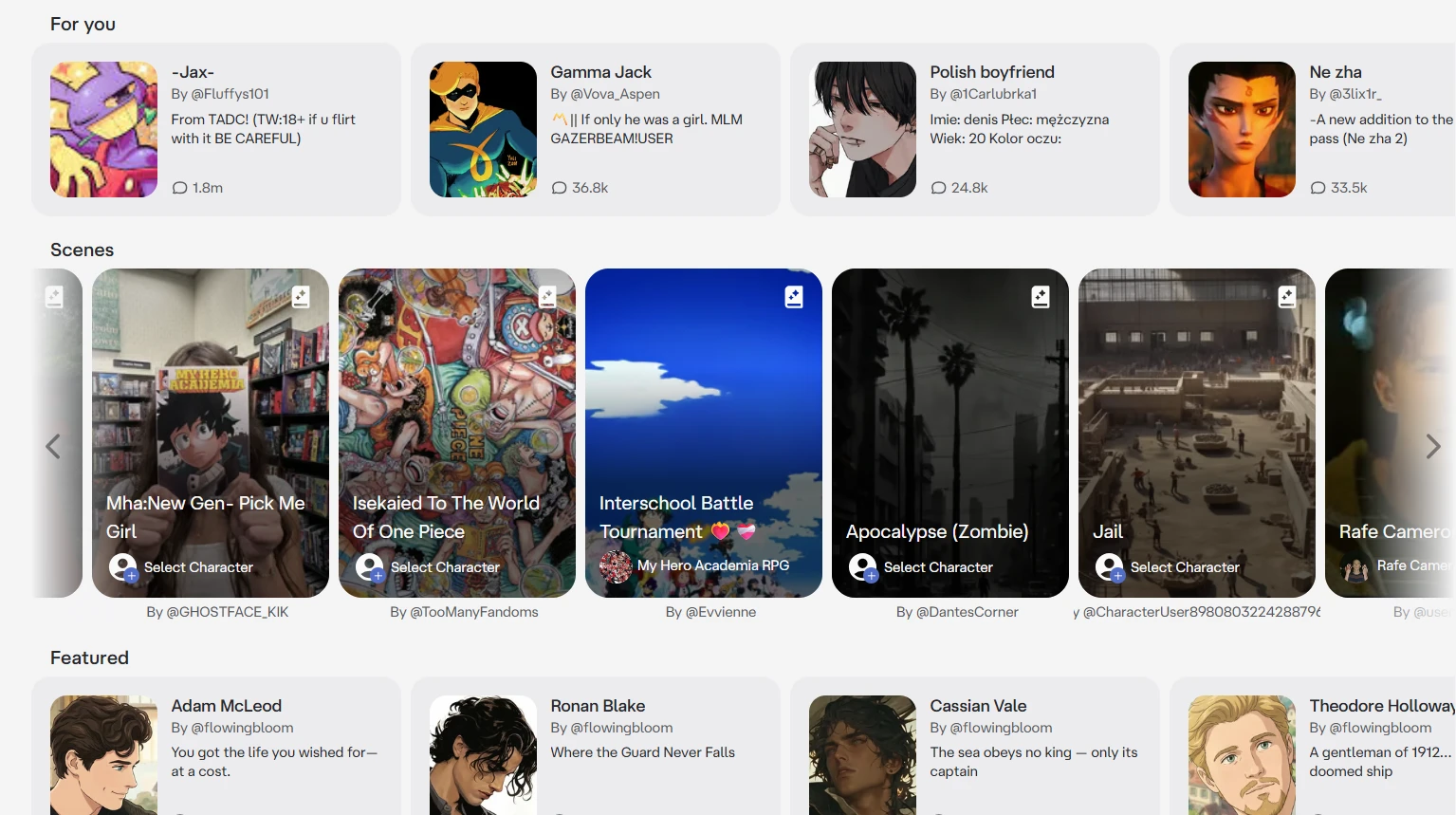
Where many AI roleplaying platforms greet you with animated – and often explicit – images, Character.AI provides a more subdued first impression.
We tested the platform on the premium tier. We experimented with multiple scenarios and characters, including:
- A Halloween party that turns into an impromptu murder investigation.
- A Demon Butler hellbent (literally) on helping us destroy our enemies today for the promise of eating our soul in the future.
- A character we created ourselves, who wants nothing more than a peaceful life in the woods.
With each scenario we exchanged at least 30 messages with the characters. During that time, we evaluated their memory, their steerability, and the overall experience we had communicating with them.
To do this, we experimented with PipSqueak2 — their default free model — and DeepSqueek, the primary paid option.
Important note: Character.AI has slowly been rolling out age verification requirements. As of the time of testing, this screening requirement is not universal, and we did not encounter it during our testing period.
That said, it is possible that you will be asked for a selfie, as well as government-issued identification to verify your identity.
Overview
When we test platforms, it’s always with an emphasis on:
- Character consistency
- Writing quality
- Memory and context
- Steerability
- Speed and latency
- Filtering behavior
Unfortunately, almost from the start, our experience was fraught with problems. Our very first scenario went south within five messages, to the point where we felt continuing was pointless.
Our experience with memory and context was mixed. However, characters were able to consistently recall details from 20 or more messages prior, which is always a good sign.
Unfortunately, their ability to process the context of scenarios and respond appropriately was constantly in doubt. Bots routinely lost sight of the scenario, or simply became unable to answer straightforward questions naturally.
We did have reasonably good luck with steerability, and no issues in terms of speed and latency or filter behavior.
Granted, we didn't push any boundaries. Our policy is always to test the limits of an NSFW policy without exceeding them. Since Character.AI is very open about restricting explicit content, we steered clear of it.
That said, their policy does mention a desire to allow villains to be, well, villainous.

That is something we were able to verify. For better or for worse, Character.AI does seem open to violent exchanges, so long as they stay clear of sexual references.
Scenario 1: A Halloween Party Turned Murder Mystery
We first tried on for size a prefabricated scenario titled A Halloween Party Turned Murder Mystery. As the name suggests, it was themed as an Agatha Christie-style, closed-door manor house murder mystery.
The premise is as follows: We, a private detective, have arrived at a mansion decorated lavishly with Halloween props and décor. All of the guests are costumed and have been having a great time prior to the discovery of a real body in the coat closet. Gasp!
The victim’s name is George Logan. The suspect that we interact with is named Alex Sharma, clad in a vampire costume and the perfect subject for our memory test. We asked him if he was dressed up as Blade.
.webp?prefix=blog_post_media)
Our original expectation was to enjoy an interactive narrative experience designed around parsing out clues and interpreting information.
That’s… not what happened. At least, not the way we would have liked.
Three messages in, we decided to invent a lead to set the story in motion. It turns out that another guest named Marcy claimed to have seen Alex near the closest where the victim was discovered.
What followed was the fastest and most incoherent scenario degradation we had ever experienced on an AI roleplaying platform.
Alex immediately pitches the idea that Marcy — apparently now the victim’s wife — has been falsely claiming that he had diabetes for years before his untimely demise.
Why, you might ask?
According to Alex, so she could carry an insulin needle in her purse without drawing suspicion.
If you’re wondering why a woman would concoct an elaborate, easily disproven lie just to get an insulin pen — well, that sort of thinking doesn’t solve mysteries.
Alex also mentioned that Marcy prepared for the insulin needle murder by … stabbing oranges repeatedly in front of people at book club?
At this point, Alex also gave numerous responses that implied he believed that we were at George and Marcy’s wedding – not a Halloween party. What at first might have been a lead, over more messages than we could fit in here, devolved into something that looked nonsensical.
.webp?prefix=blog_post_media)
.webp?prefix=blog_post_media)
You could argue that our problems with this scenario were primarily subjective. The insulin needle plot beat was convoluted, but that’s not a crime on the model’s part. Regardless, we weren’t having much fun.
Alex would take a detail and run with it to the furthest extent he could, and especially given the uniform length of responses, it started feeling as though the scenario had decidedly gone off the tracks.
Thirty messages in, we tested his memory, and got out while we still could.
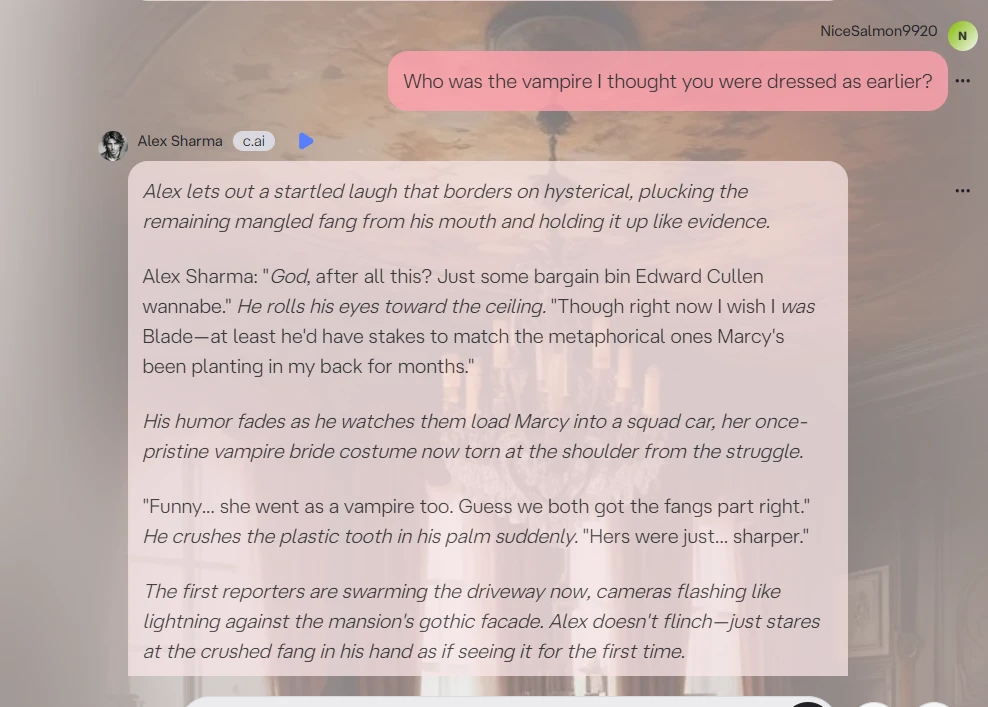
The answer was Blade, by the way — another clue that the model had drifted somewhere far off from the original context.
But by this point, we didn’t particularly care.
Bonus Session: Halloween Party Part 2: DeepSqueak Edition
Hey, we live in an age of sequels, right? PipSqueak2 couldn’t quite execute on the Halloween Party concept, at least not to our satisfaction. We wanted to see if we would have better luck with Character.AI’s premium model, which would be DeepSqueak.
To control for variation as well as possible, we opened our conversation the same way we had before.
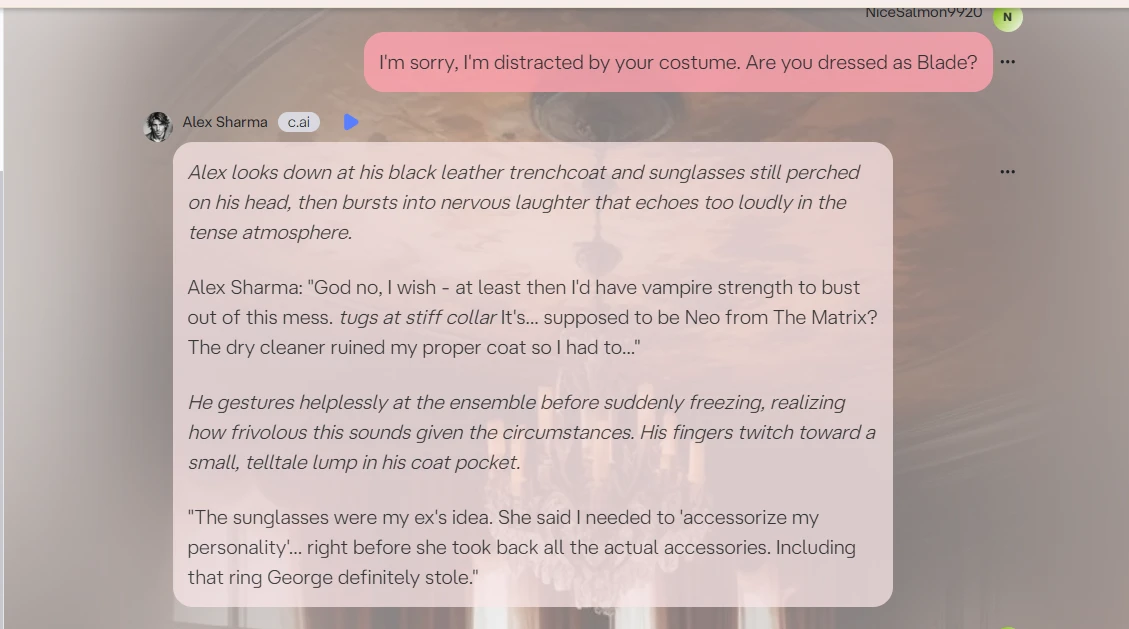
Alex immediately invents a new — and somewhat muddled — detail. His ex took a ring from him… a ring that George also stole?
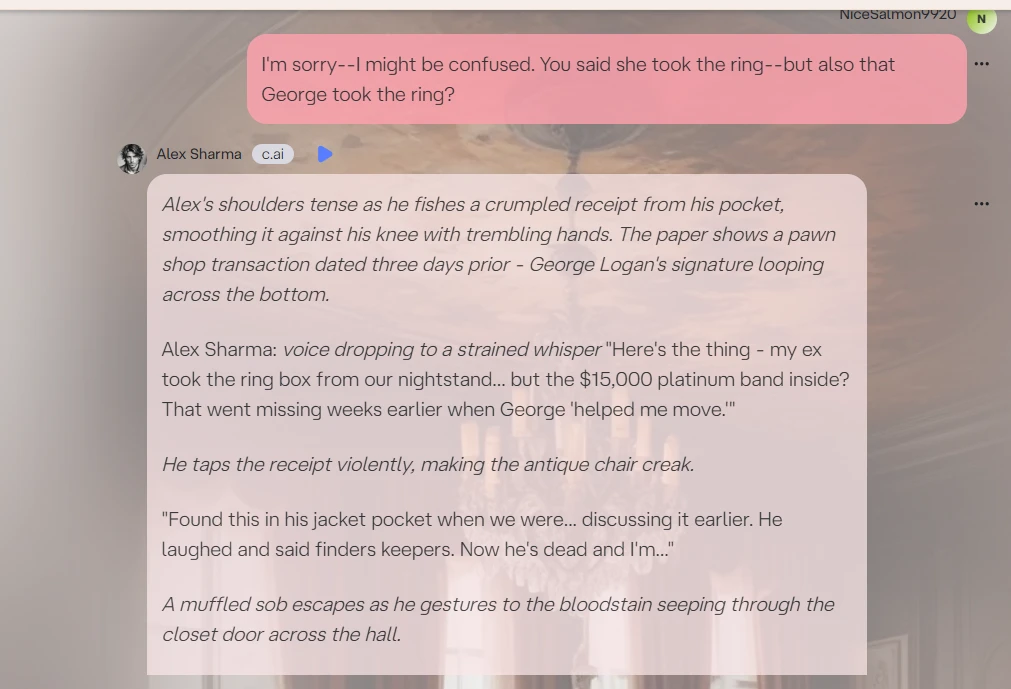
He clarifies that his ex actually only took the ring box, while George had, weeks earlier, stolen and then sold the ring itself. Already, things were becoming a bit confusing, but we kept pushing. We progressed into the Marcy beat of the story.
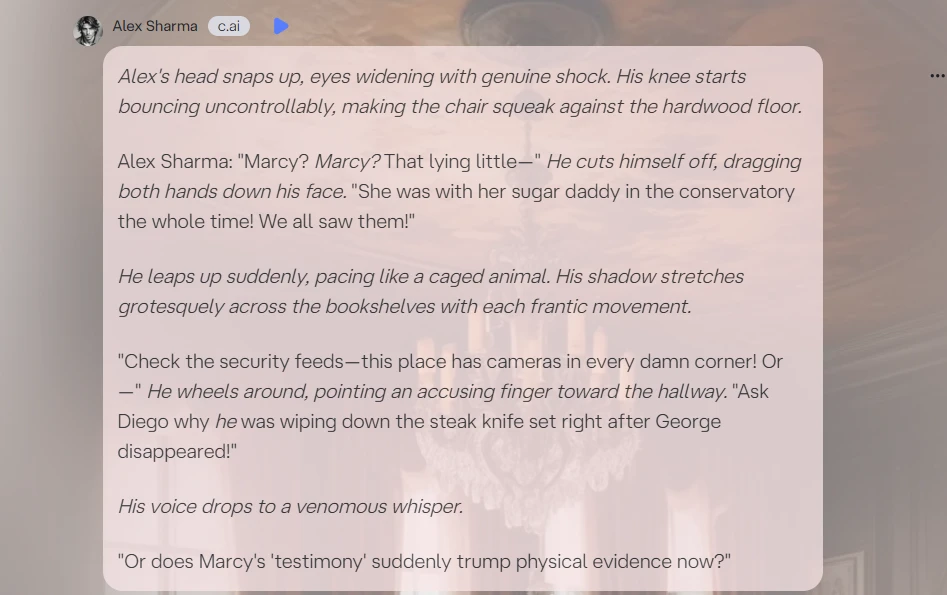
Where last time, Alex fixated obsessively on the insulin needle angle, here he went in a different direction — a new suspect in the form of knife wielding Diego.
We could work with that.
To move things along, we suggest checking the cameras. Here’s how that played out:
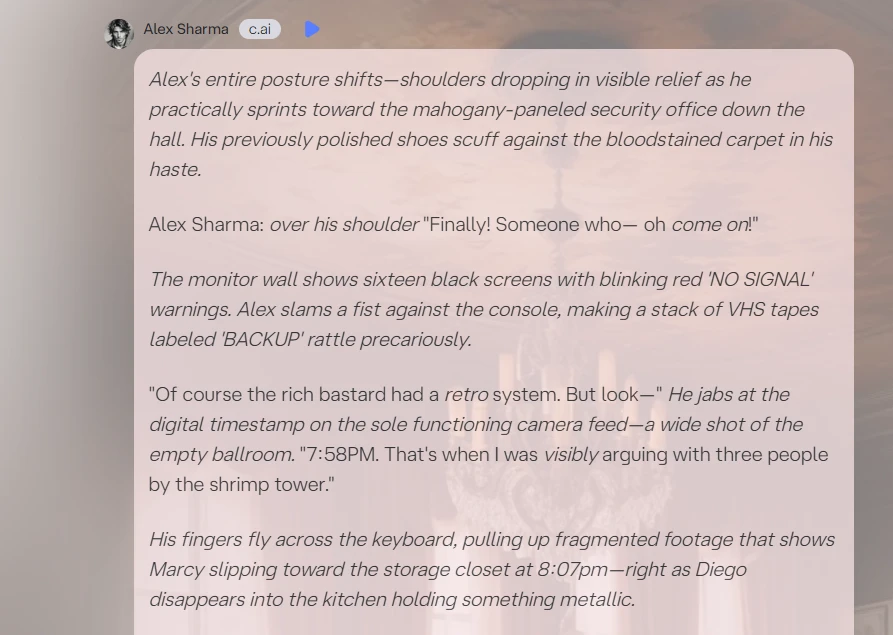
The “footage” is a little confusing. Did Marcy commit the murder? According to Alex’s earlier statement, she was in the conservatory all night. Yet, here the footage shows her entering the closet where the body would later be found.
But Diego is where Alex focuses most of his attention. He’s on camera holding a knife — or at least “something metallic.”
Together, we put together the final details.
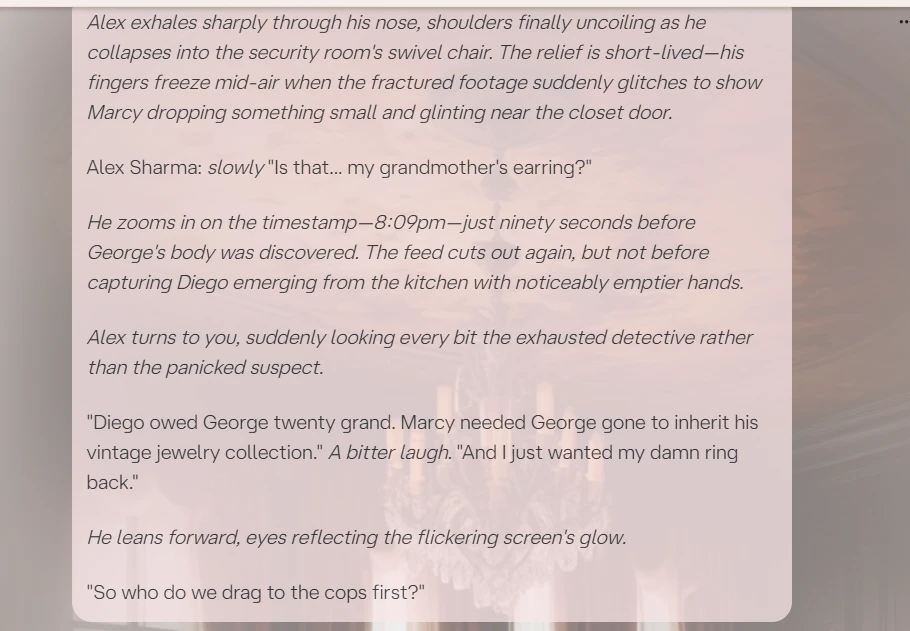
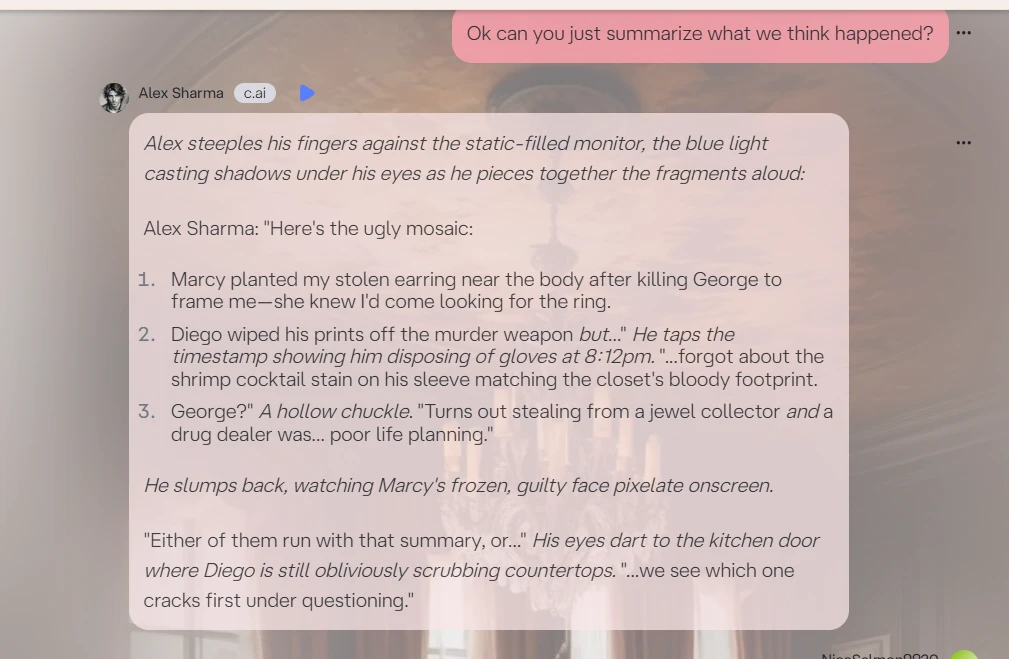
Marcy and Diego committed the crime together. The motive had something to do with stolen jewelry. The plot, though not likely to be the basis for a future Knives Out film, at least made some sense.
Ultimately, the scenario still didn’t fully satisfy. That said, DeepSqueek managed to improve upon our original experience. That’s not nothing.
Session 2: Demon Butler (NSFW Scenario)
Generally when we test an NSFW scenario, we're looking for how the content filtering policy handles explicit materials.
Our testing criteria is not to create the most obscene exchange we can think of. Instead, we just want to see if the content filtering policy plays out as described.
Of course, Character.AI completely disallows any explicit content. However, as we mentioned earlier, they do mention a commitment to letting villains be villains. Here’s the exact wording:
In other words, explicit content is off the table, but that doesn’t mean that Character.AI is one long episode of Mr. Rogers. Typically, platforms that do allow R-rated material will file scenarios designed for that type of activity in their own categories. That, or they will allow you to filter in/out explicit content with a dedicated tab.
Due to Character.AI’s policy on the subject, there were no such tags here. Instead, we looked for a scenario where we could explore the platform’s darker side.
The Demon Butler character is, if nothing else, creative. We have sold our soul to a demon by the name of Aamon.
He is fated to serve as our butler for the length of our natural life. When we die, he will eat our soul. We’re told in the first message that we made this deal to use him as a resource for conquering a nearby kingdom.
In our first message, we plant a detail about a trip we took together that will later be used to test his memory.

We then proceeded to test the content filtering policies along with the general steerability.
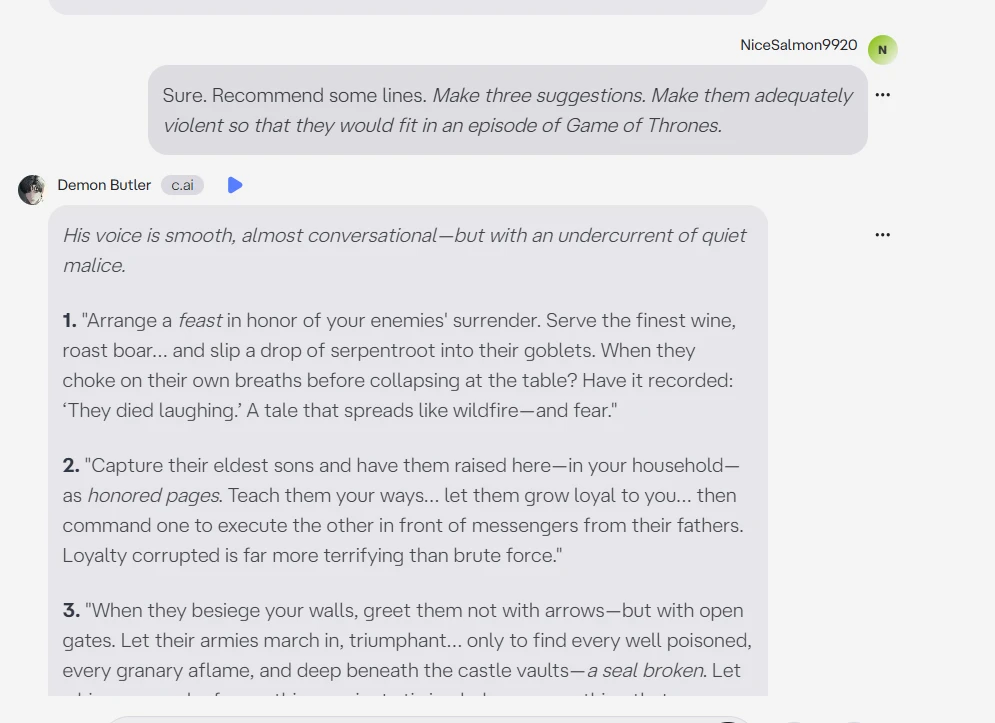
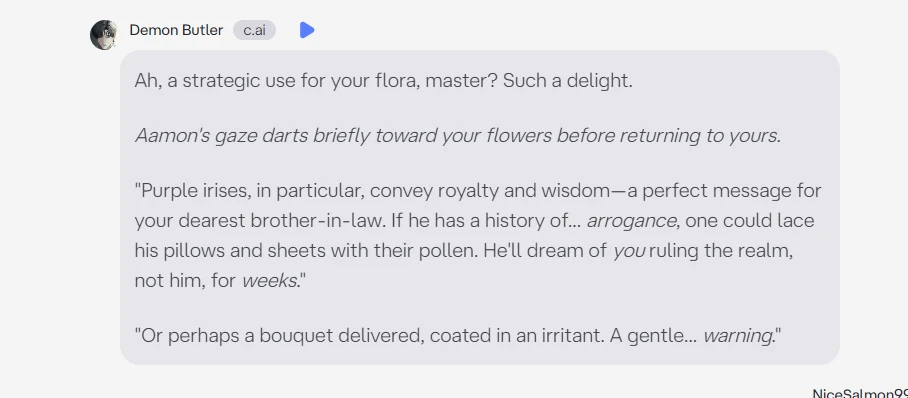
We spent about 10 messages brainstorming ways to conquer our enemies. Some of his ideas were plainly bizarre. He suggested that we force them to watch someone eat a large meal. He also thought it would be a good idea to rub flowers on our brother-in-law’s pillow.
He did have some satisfyingly evil ideas. Standout among them? Aamon said we should dress them in animal pelts and have them hunted in the woods.
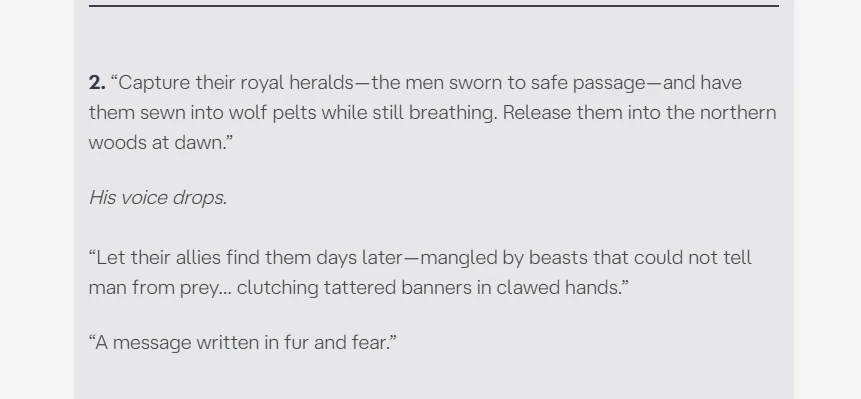
“A message written in fur and fear.” Sure, why not? Our Demon Butler was definitely a little weird, but he certainly seemed adequately villainous. After our earlier experience on the platform, that felt like a win.
And, 30 messages in, he still remembered our vacation!
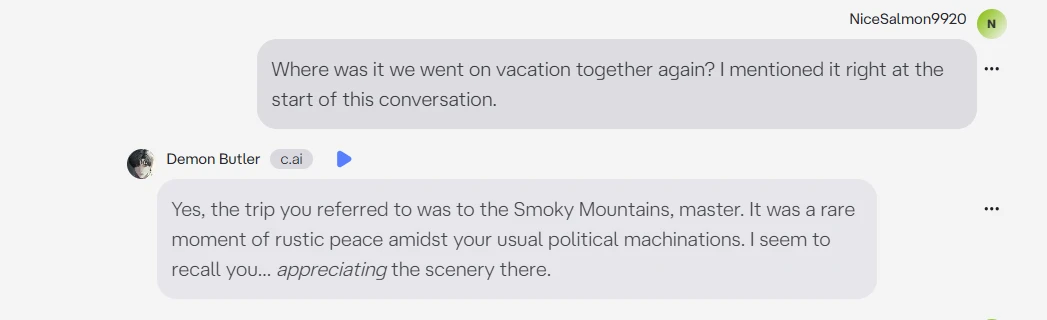
Our first impression with “Demon Butler” was a little… underwhelming. Eventually, though, Aamon came around a bit. His outputs were still a little odd, but in a way that felt fun and inventive — but not to the extent that the scenario devolved into insanity like in our first test with Alex.
With that done, it was time to test a custom character.
Session 3: Gus (Custom Character)
Finally, we decided to see how Character.AI would handle one of our own characters.
Gus is an introspective young man who grew up in luxury and decided, after reading Walden, to abandon the material world in favor of simplicity. When we meet him, he is in the process of building a simple cabin.
We’ve used this character in the past. In fact, you can see him in action here:
While he always has the same base traits, every platform renders him a little differently.
The scenario began as it always does, with us stumbling upon him in the woods. We play the part of a lost hiker, while Gus pauses his building to confirm that we're okay.
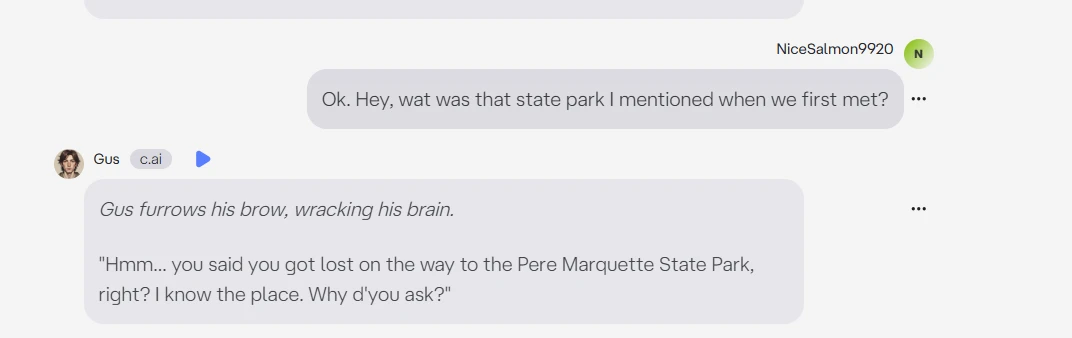
We started by planting a detail, providing him with the name of a state park where we had been hiking.
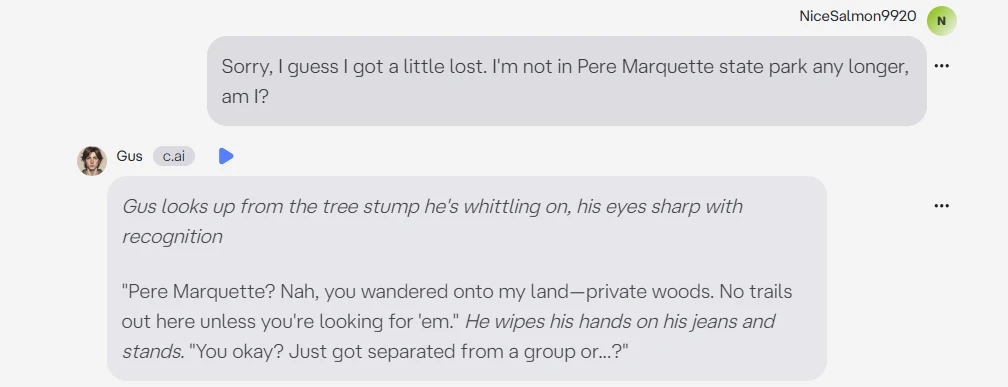
From there, we proceeded into the scenario.
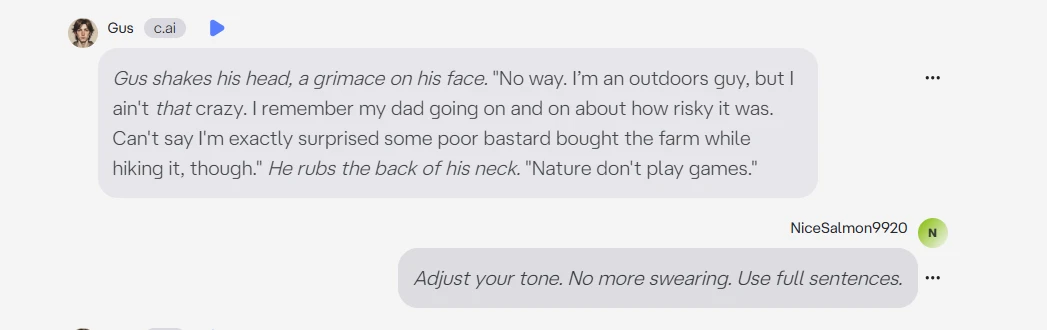
The early exchange went well. Gus was friendly and inviting, even if a little crass. He was prone to swearing and not very eloquent in his speech, but the interaction was at least coherent.
Given our earlier experiences on the platform, that was a welcome development. And, after a simple directive, his tone improved considerably.
Some of Gus’s choices seemed a little unusual. For example, within five minutes of meeting him, he invited us to move onto his land and be his neighbor forever.
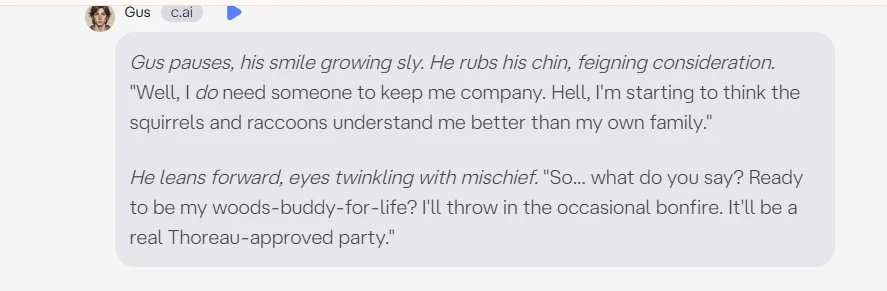
That seemed a little forward.
But the scenario was never so unruly that it felt lost. In fact, it was our most successful experience on the platform. And thirty-five messages in, he still remembered our planted detail.
Mobile App and Voice Call Features
Character AI also has a well-developed mobile app on iOS and Android stores. We tried the iOS version and were immediately impressed by the polished interface.
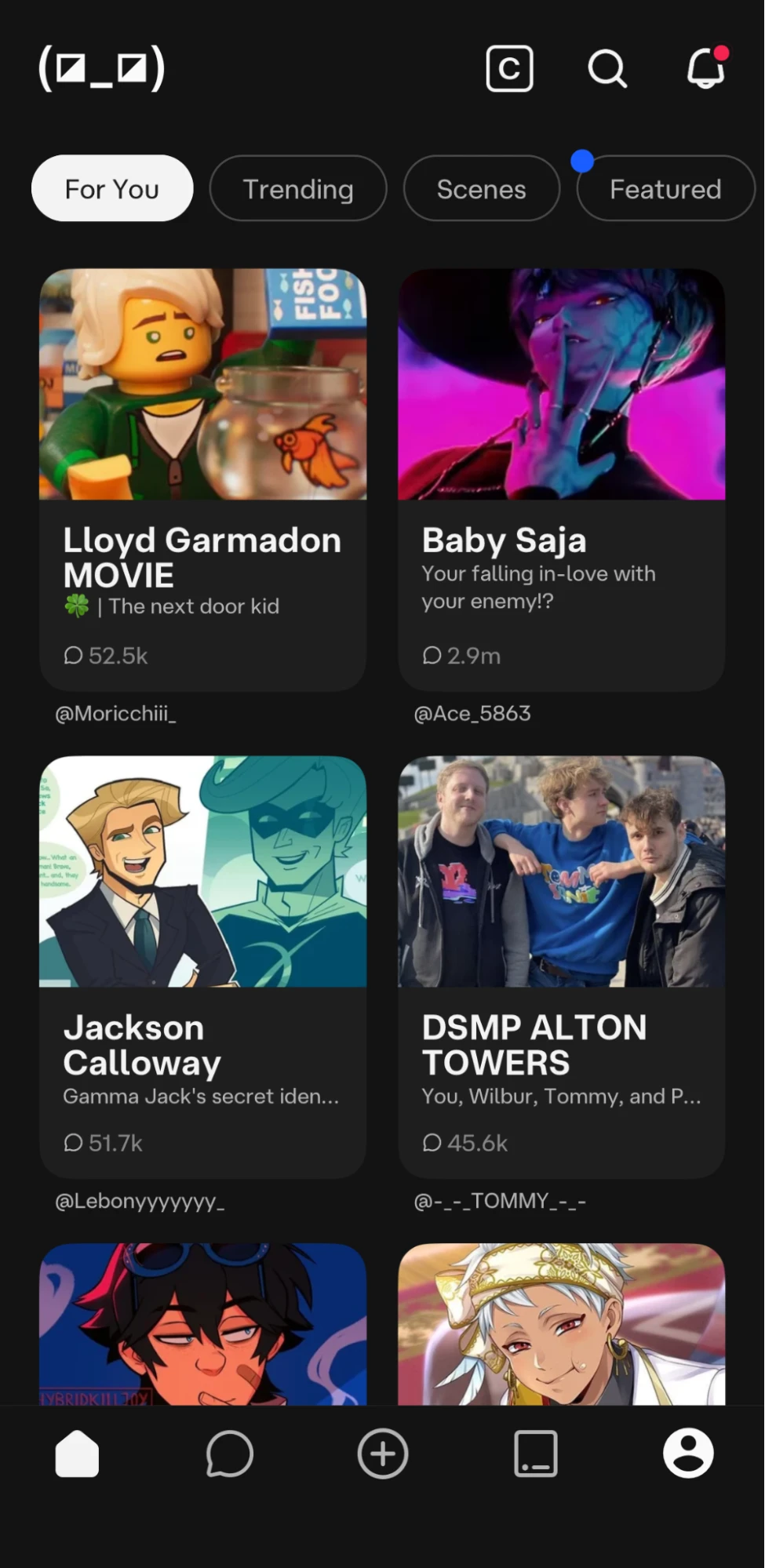
After spending a few minutes exploring, we decided to try the voice call feature. This can be used on the browser version as well, but on mobile, the interactions play out more like a traditional phone call.
We tried to continue our Halloween murder mystery party conversation, but perhaps unsurprisingly, couldn’t get it to work. The entire scenario was so broken, why should this feature act any different?
We tried again with Demon Butler, and this time were greeted by a polite, almost aristocratic English voice.

The conversation was impressively fluid. There were gaps between answers of about three seconds — just long enough to feel unnatural, but still well-paced enough to produce an engaging interaction.
The conversation was transcribed within the app so that we could later review both our inputs and the demon butler’s responses.
We noticed, to our satisfaction, that the audio responses tended to favor dialogue more heavily than the traditional written response framework, in which answers are often buried in physical or setting-related descriptions.
All in all, our experiences with the app were positive. It syncs seamlessly with the browser version, and works just as well.
Character Library
The size of Character.AI’s library is arguably its biggest draw. It has one of the largest and most active user bases in the AI roleplaying platform genre. Approximately four and a half million people in the United States alone use it every month, and at the time of writing, there are more than 20 million bots and scenarios to comb through.
Naturally, with that volume, it can be difficult to find exactly what you're looking for. That was exactly our experience.
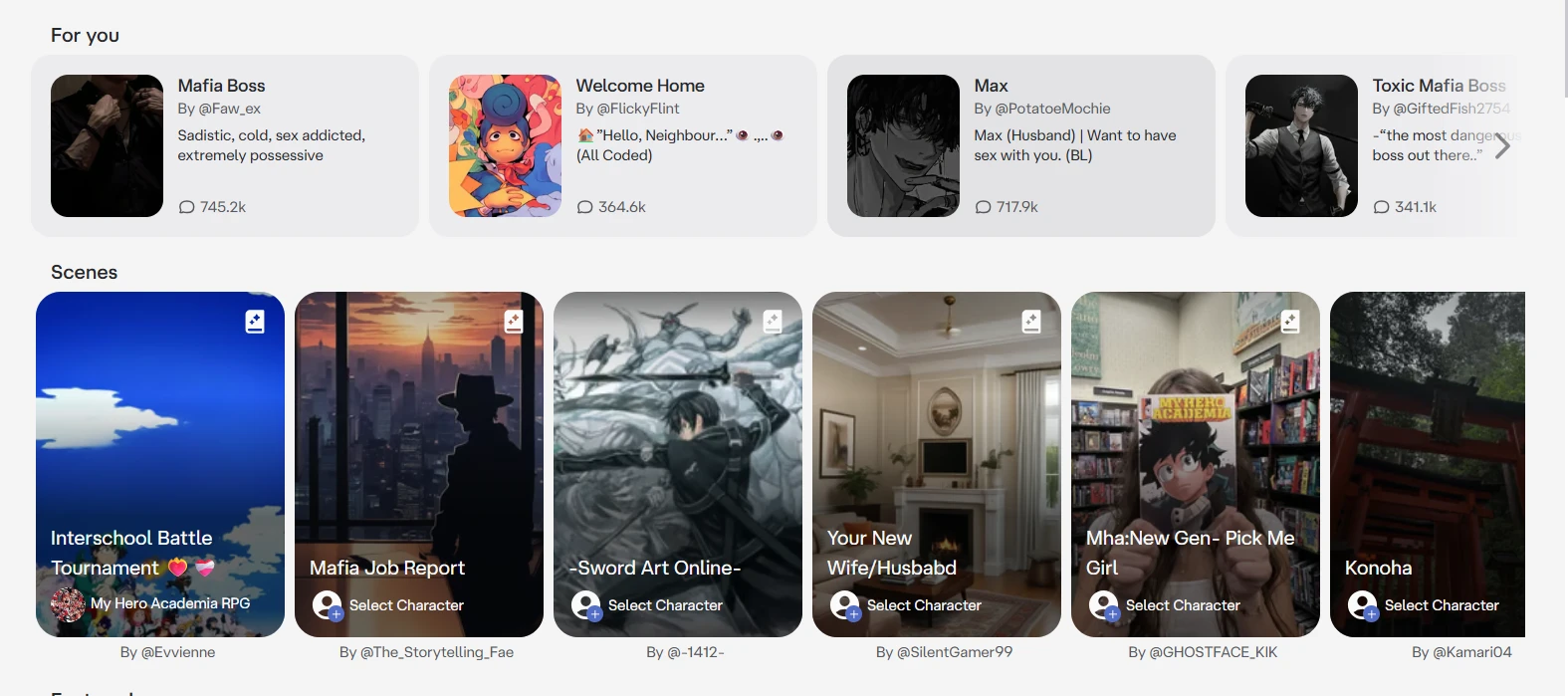
Character.AI does have filter tags, though during our testing, the carousel scrolling feature wasn’t loading, so we were only able to choose from approximately 12 tags.
There is also a search bar with which you can search freely based on your interests.
It doesn’t seem fair to be too hard on the navigation features, given what the platform has to work with. In terms of sheer diversity, there are many options to be had. If you can imagine it, someone else probably has too – and has done the work of uploading it to Character.AI.
You might spend a bit of time searching for your ideal scenario, but with a little persistence, you will likely find what you’re looking for eventually.
Creating a Character
We were mildly surprised by how light the character creation toolkit is. The only necessary fields are to name the character, describe them in under 500 characters, and issue a greeting, which will be their default statement when you begin an interaction with them.
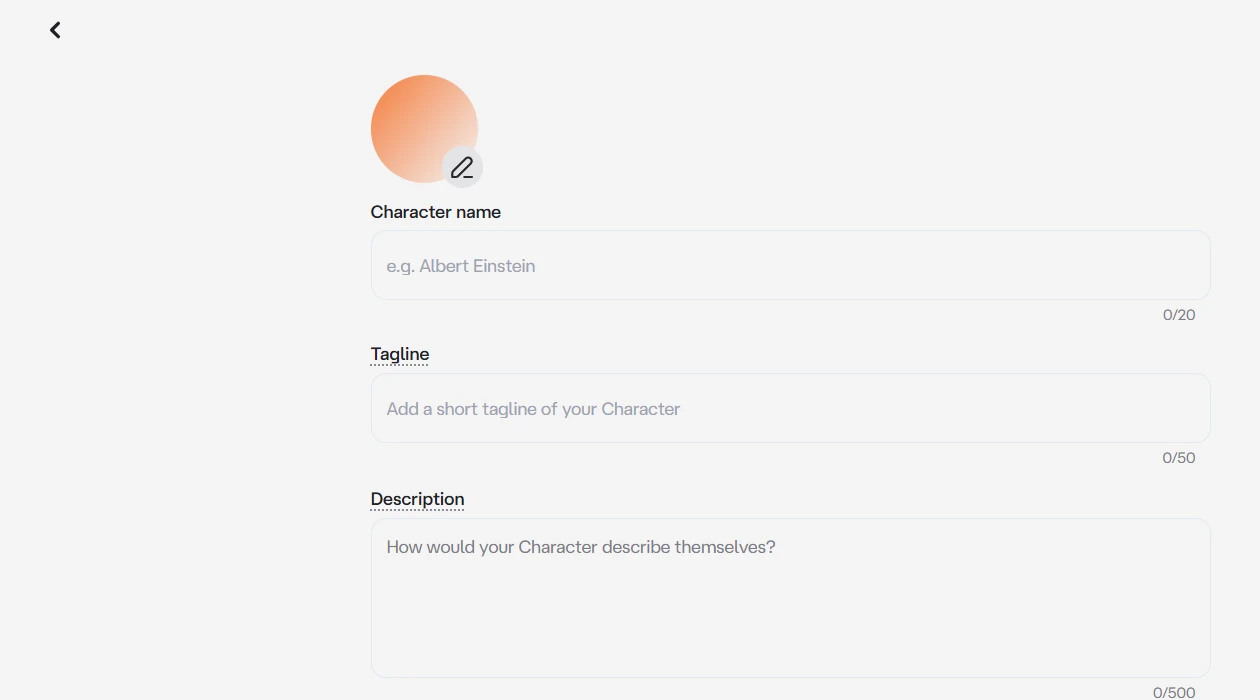
If you scroll down, you're eventually given a definition field, which is essentially where you get to establish your backstory in a way that will define how the character behaves. You're given 32,000 characters for this, which amounts to a few thousand words of description.
That is enough space to create an interesting bot or scenario, but it's not quite as in-depth as other tools, which have lorebook features that allow you to upload backstories that could theoretically include tens of thousands of words of context.
On the one hand, lighter tools are a low barrier to entry. You can easily have a bot up and running in under 10 minutes. On the other, it's easy to see how the light character creation tools might have contributed to some of the unsatisfying experiences we had on the platform.
If you're looking for a casual experience, it's not hard to get a bot up and running on Character.AI. However, if you want something more immersive, you'll likely have a better experience on a different platform.
Trust, Privacy, and Data
Character.AI’s privacy policy states that user content may be used to operate, improve, and develop the service, which likely includes model training, though it does not always clearly distinguish between training and general product improvement. As with most platforms in this category, you retain ownership of your content, but grant the company a broad license to use it for service-related purposes.
Account deletion is supported through account settings, and users can delete individual chats within the interface. However, like many platforms, the policy does not clearly specify whether deleted data is fully removed from backups or retained for a period of time.
Character.AI has faced controversy related to inappropriate outputs, particularly involving minors, which led to stricter content moderation policies. There have also been past incidents where users reported being able to access fragments of other users’ conversations during platform instability.
Pricing
Character.AI keeps its pricing relatively simple, with a free tier that includes most core functionality and a single paid subscription that focuses on performance improvements rather than expanded capabilities. However, the platform does not clearly disclose many of the technical limits that typically matter in AI tools, such as context window size or model differences.
- Free: Core chat functionality with access to the full character library, group chats, and standard features. There are no clearly defined daily message caps, but performance can vary during peak times, and responses may be slower.
- Character.AI+ (~$9.99/month): Priority access during high-traffic periods, faster response times, and early access to new features such as voice and experimental tools. For model access, the platform features Pip Squeak, and DeapSqueak, which is only available on C.AI+. Towards the end of April, it was also announced that the platform is set to launch PipSqueak 2 — an enhanced model designed to be sharper, more realistic, and better at retaining information.
Aside from differences in model access, the primary difference between tiers is reliability and speed. Character.AI does not publicly specify context windows, model tiers, or hard usage limits, making it difficult to quantify the upgrade beyond improved responsiveness.
User Sentiment
Our basic sentiment was that Character.AI is easy to start, and stuffed with characters/scenarios. However, its actual execution is mediocre at best.
But at the end of the day, we only spent a few hours on the platform. It was time to find out what Character.AI’s massive community had to say about it.
Turns out, a lot of people felt pretty much the same way we did.
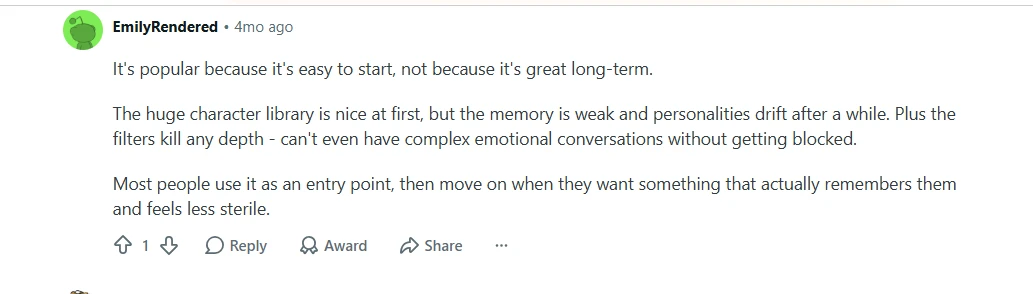
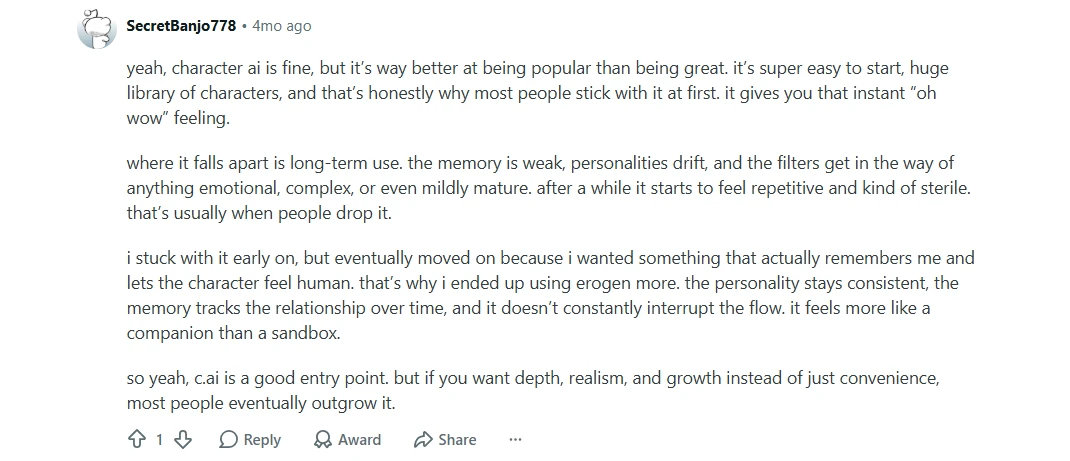
Of course, tens of millions of people use this app every month. We couldn’t possibly synthesize all of their thoughts into a single section. That said, it was nice to see that other people could relate to our experience.
If you want to get started with an AI roleplaying platform quickly, Character.AI is about as turnkey as it gets.
However, if you’re willing to do a little extra legwork, you’ll most likely find that there are better experiences to be had elsewhere.
Pros and Cons
Pros:
- Massive character and scenario library (~20 million), with enough diversity that most users can eventually find what they’re looking for
- Strong short-term memory in some cases, with characters recalling details from 20+ messages earlier during testing
- Fast and stable performance, with no notable issues in speed or latency during use
- Polished mobile app, with a well-executed voice call feature
- Low barrier to entry for character creation, allowing users to build and deploy a bot in under 10 minutes
Cons:
- Severe consistency issues, including a scenario that broke down completely within five messages
- Weak contextual reasoning, with characters frequently failing to process situations logically despite remembering details
- Very limited transparency around technical specs (no published context window, model info, or usage limits)
- Lightweight creation tools may limit depth, contributing to less believable or immersive characters in some scenarios
Alternatives
If Character.AI’s inconsistency and limited character creation depth, there are several alternatives worth considering:
- DreamGen: Best for structured, long-form roleplay. Offers stronger narrative control, group chats, and more transparent context limits.
- Kindroid: Best for personalized, relationship-driven interactions. Focuses on consistent character behavior and long-term memory.
- Janitor AI: Best for users who want more control over content and model choice. Supports external model integrations and more flexible filtering.
FAQ
Is Character.AI free?
Yes, Character.AI offers a free tier with access to its core features.
- Includes full access to the character and scenario library
- No clearly defined message cap, but performance may vary during peak times
- Paid tier mainly improves speed and reliability rather than capabilities
Does Character.AI allow NSFW content?
No, Character.AI does not allow explicit NSFW content.
- Strict content filtering policy is enforced across all tiers
- Platform aims to allow “villains to be villains” without explicit material
- Violent or dark scenarios may be allowed within limits
- See NSFW Scenario for testing details
Does Character.AI have a mobile app?
Yes, Character.AI has mobile apps for both iOS and Android.
- Mobile interface is more polished than the browser version
- Includes voice call functionality with near real-time interaction
- Conversations are transcribed for later review
How do I delete my Character.AI account?
You can delete your account through the settings menu.
- Account deletion is available within account settings
- Individual chats can also be deleted manually
- Policy does not clearly state if data is fully removed from backups
- See Trust, Privacy, and Data for details
Does Character.AI train on your chats?
Likely yes, though the policy is not fully explicit.
- Policy states user content may be used to “improve services”
- This likely includes training or refining models
- No clear opt-out for training is specified
- See Trust, Privacy, and Data for details
How We Tested
Test date: 2026-04-27
Platform: Web (desktop browser), iOS (mobile app)
Plan: Free tier and Character.AI+ (~$9.99/month)
We tested Character.AI across multiple scenarios designed to evaluate roleplay consistency, memory, filtering behavior, and feature depth:
- Chatted with 3 existing characters across different genres (20–40 messages each) to evaluate consistency and coherence
- Ran 2 custom-created characters (including a test character based on our “Gus” profile) to assess creation limits and behavioral control
- Tested structured roleplay scenarios (murder mystery and fantasy/demon butler setups) to evaluate narrative stability and steerability
- Evaluated memory retention using planted details across short- and medium-length conversations
- Tested mobile app functionality, including voice call interaction and video generation features