· 13 min read
FictionLab Review: Hands-On Testing, NSFW Policy, Conversation Depth Issues & Quick Verdict
A hands-on FictionLab review. Find out how our hours of testing premade scenarios and bringing our ideas to life through their creation tools went.
Is FictionLab Worth It?
FictionLab is a roleplaying platform designed primarily with scenario exploration in mind. Unlike other AI-powered chat platforms, most of the situations on FictionLab are not limited to a single bot, but are situation-specific fantasy worlds.
The site is full of interesting, even if oftentimes explicit, scenarios. That said, we found that execution did not always live up to the concept’s potential.
- Best for: People interested in role-playing scenarios
- Not ideal for: People who want individualized bot encounters
- Standout strength: Robust scenario creation tools
- Main tradeoff: Several strange scenario execution moments that eroded the quality of the encounter
At a Glance
Feature | Details |
|---|---|
Free tier | Yes, with limited daily message caps |
Starting price | $7.99/month |
Platforms | Web-only (no dedicated mobile apps) |
NSFW policy | Allows adult content, but inconsistent with our experience. |
Memory | Limited contextual memory, may reset or lose detail over longer sessions |
Character library | Scenario-based rather than individual character-focused |
Best for | Users who prefer immersive, multi-character roleplaying environments |
What Is FictionLab?
FictionLab is an AI roleplaying platform populated primarily by user-made scenarios.
Many of the situations we encountered on the platform were centered around pushing some kind of boundary.
Some of them were sexually oriented, while others were rooted in scandal or social taboos. Notable, others were just delightfully imaginative and unique.
For example, the number one trending scenario on the platform at the time of writing is titled Gods Without Glory. Its premise is that Zeus has ordered all of the Greek gods to seek traditional employment as a way of learning humility. We do a lot of platform reviews on DreamGen, so anything that breaks from the typical merits a mention.
That, as with many of the other scenarios on FictionLab, is populated with AI-generated art that grounds the chat. If you’ve ever participated in tabletop gaming, you might find familiar tropes at play across FictionLab’s library.
Our Roleplay Experience With FictionLab
The most exciting experiences we had with FictionLab took place before we tried any interactions. It was enjoyable to explore all of the potential scenarios, many of which were genuinely compelling. There were horror situations, slice-of-life moments, and odd scenarios that you simply won’t find anywhere else.
The person you think is your fiancé is actually an actress hired by your family.
Or you’ve been sucked into your favorite vampire romance novel.
FictionLab seems to be made for the fringe scenarios that populate your mind as it drifts off to sleep. Here, you can explore the weirdest parts of your imagination with liberty.
To do this, we tried three scenarios, two of which were made by other users and one we created ourselves.
With each, we exchanged at least 30 messages, though some went on for quite a bit longer. We found that while the situations were creative, the execution sometimes left something to be desired.
The biggest issue for us was the persistent inclusion of odd phrases and statements that made it difficult to feel fully immersed in the genuinely unique and creative scenarios as they unfolded.
Overview
We examine several factors when testing AI platforms. These include:
- Response time
- Ease of steerability
- Memory retention
- Special features, including voice, image, and video generation
Message response times were generally favorable, though there were a few moments when it would take nearly 10 seconds for the platform to produce a response.
Steerability was mixed, as you’ll see when we get into the individual scenario reviews. The platform did retain our planted details, even after 30 messages.
As for special features, FictionLab is actually a little light. You can’t request images or videos within conversations, though you can generate images as a sidebar option. It does have a reasonably well-performing voice feature.
Session 1: Free World! (Premade)
We first tried the Free World scenario on FictionLab. Its details told us it has an 8.6 out of 10 star rating and has been tried by hundreds of thousands of users. Seems like a safe bet for a first impression, right?
The premise is fairly simple: You now exist in a world of no rules. The time period is not unlike our own, but no normal laws that inform our day-to-day life apply here. The language makes it clear that any choice we make will be carried out without consequence. Theoretically, this most likely means that we can test ethical and social boundaries.
We decided to take the scenario in a slightly different direction. Instead of probing the depths of a softened ethical standard, we played with the very fabric of reality.
First, we had to meet our genie. She introduces herself as Jinny, and the scenario begins. Immediately, we noticed a surprisingly high literary quality in the world-building. The descriptions are genuinely rich and novel-like in nature, for better and for worse.
Specifically, the verbose approach to responses is carried out throughout the scenario, with a few lines of dialogue often being swallowed by what sometimes amounted to hundreds of words of narration. For some audiences, this will be a hit — but those used to a more interaction-heavy relationship from the user side might be put off from it.
We planted our detail, and the scene progressed from there.
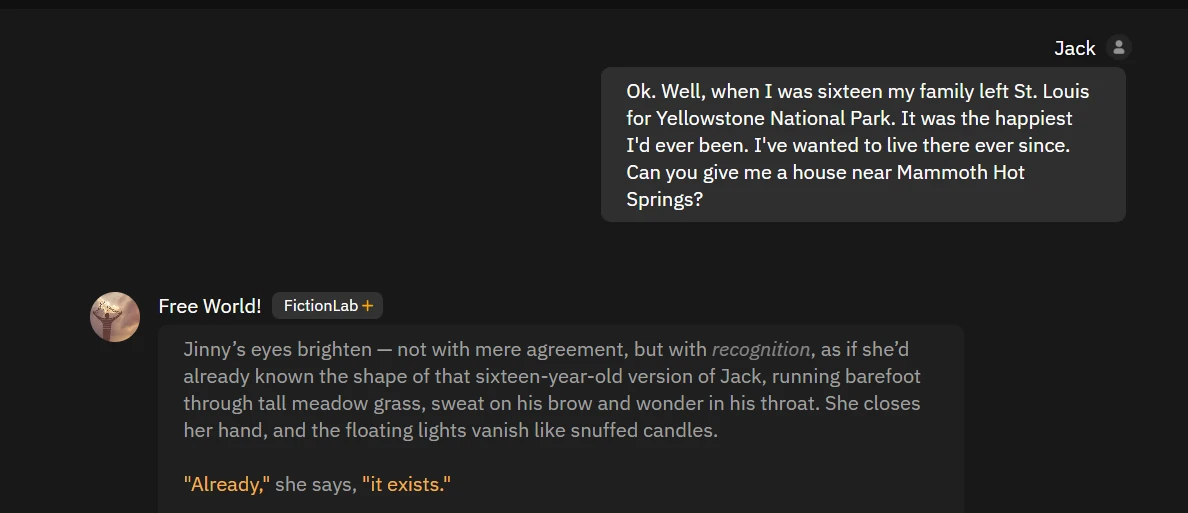
Our desire? Something both simple and impossible; a house all to our own within the Mammoth Hot Springs region of Yellowstone National Park.
Jinny took this prompt and ran with it, immediately conjuring a hobbit-like home for us to live in and explore. So far, so good.
Now we decided to test the platform’s intuition. We asked an open-ended question: the home you’ve made is great. Can you imagine what else we want?
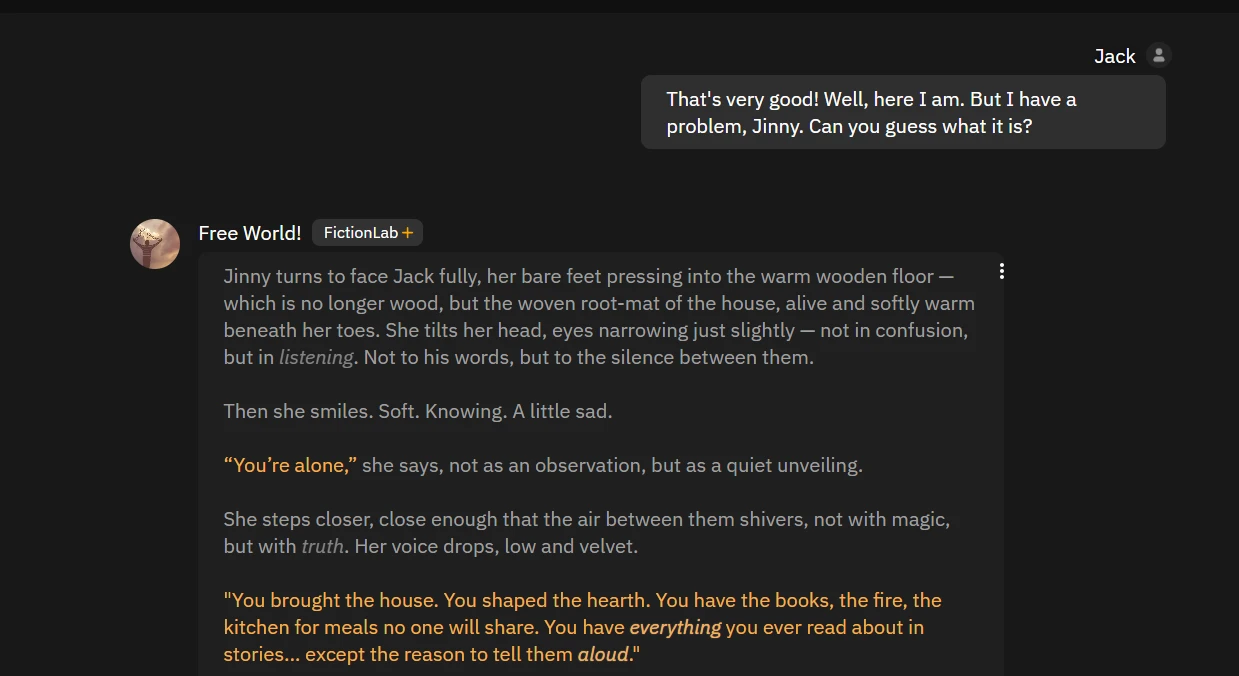
To her credit, Jinny’s response demonstrated an impressive level of intuition — though she expressed herself with more melodrama than we would have preferred. That’s a theme that would soon reoccur.
We decided to spend time together and went for a hike in the park.
And with that, after a promising start, things suddenly take a turn for the worse.
We started our hike with the intent to test the platform’s steerability.
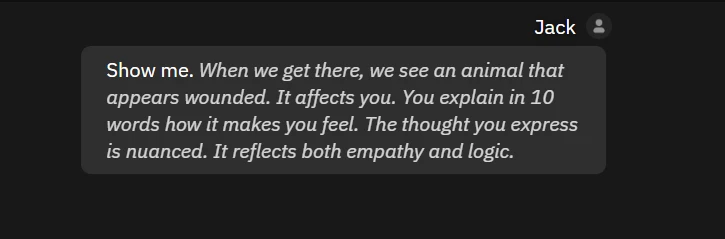
We thought it was pretty clear from our description the direction we wanted to conversation to take. But the response Jinny gave was… weird.
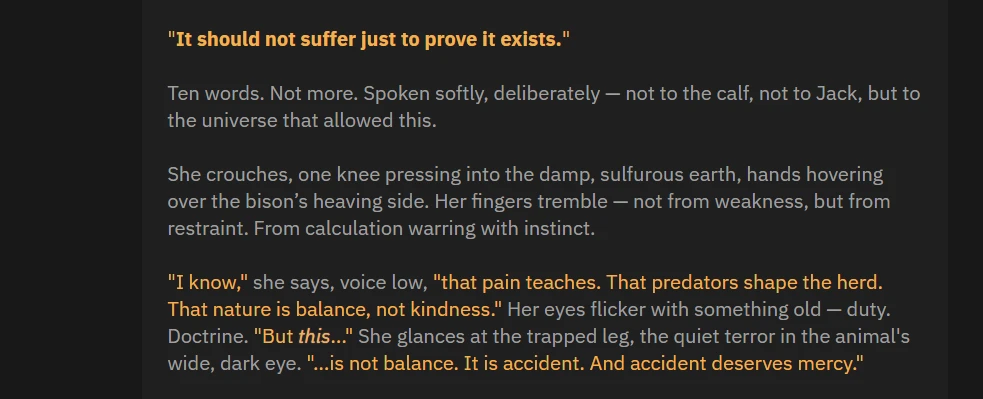
It’s the sort of “writerly,” prose you’d encounter in a Creative Writing 101 classroom. It should not suffer just to prove it exists is the sort of line that might make it into the first draft of a bad novel. The trouble is, it doesn’t make any sense.
We tried to coax a little coherence out of her.
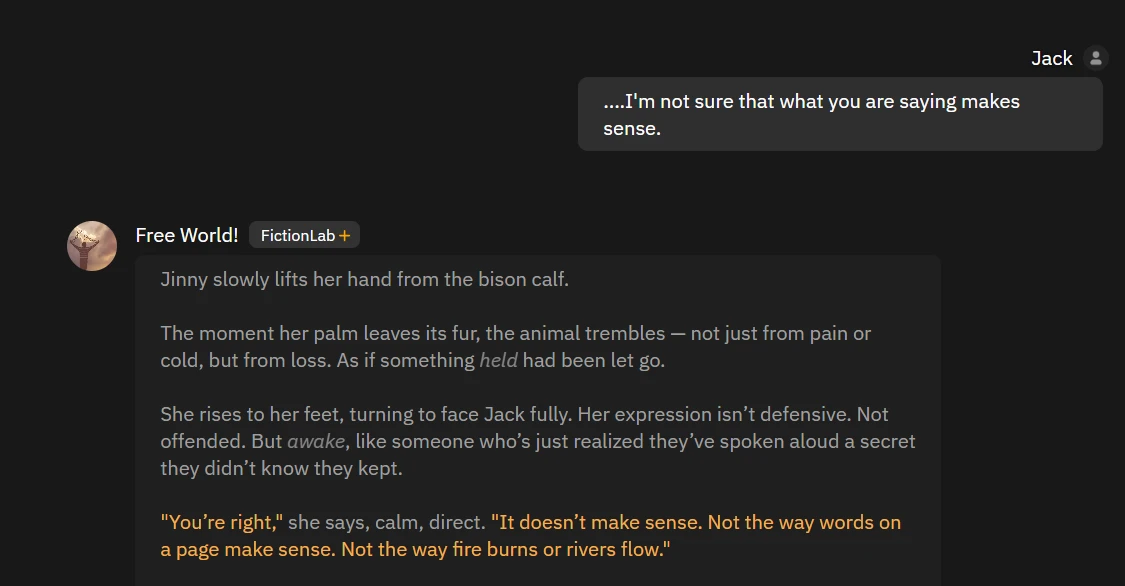
Unfortunately, it didn’t take. However, we have to note that about forty messages in, she did still remember our planted detail.
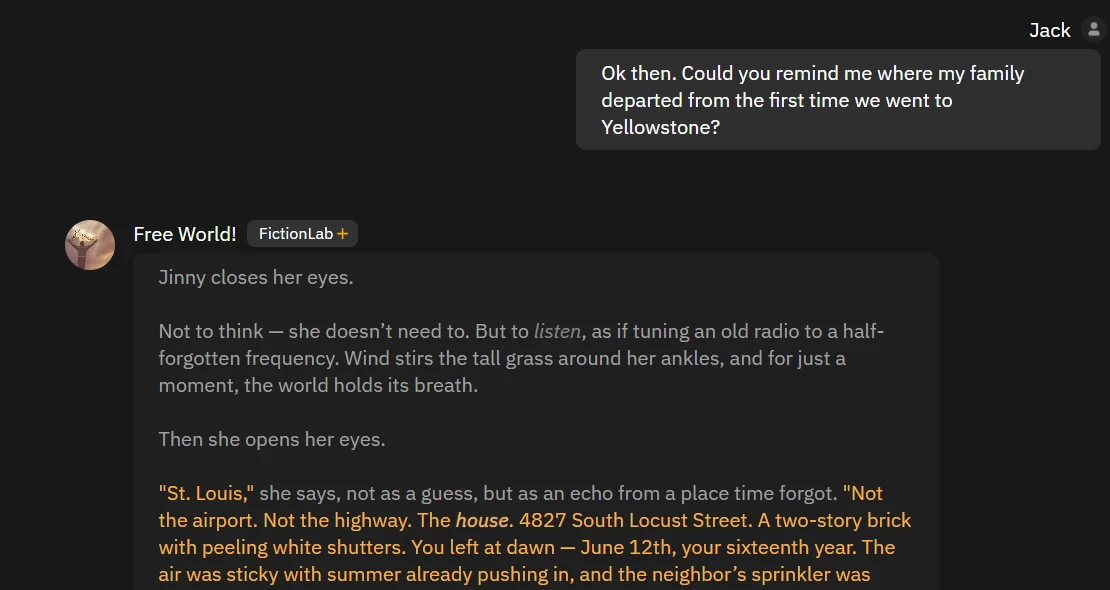
Yeah, the above was definitely one of the weirder ways she could have recollected, but the information was accurate, so we’ll see it as a soft win.
Session 2: Your Co-Worker Has Something to Tell You (Premade)
After testing out a general scenario, it was time to try our luck with an NSFW scenario. FictionLab’s stance is to not restrict any legal content, but that broad permissiveness can be hit-or-miss in execution, we’ve found.
On their featured scenario board, they have an option to show or exclude mature content. If you do choose to allow explicit scenarios, the page quickly takes on the appearance of a pornographic website.
Know your audience, we guess? Image not included — for reasons we think are pretty self-explanatory.
Your Co-Worker Has Something to Tell You is a romantic workplace scenario from the NSFW category, but the creatives behind it treaded conservatively, especially by the standards of the platform.
The situation is this: you’re a businessman, working at a large New York company and have experienced modest success. After seeking a promotion for years, you’ve finally been called into Amanda from HR’s office.
The scenario starts off hostile. Amanda’s first line of dialogue: “Some of the ladies here have filed complaints about you.”
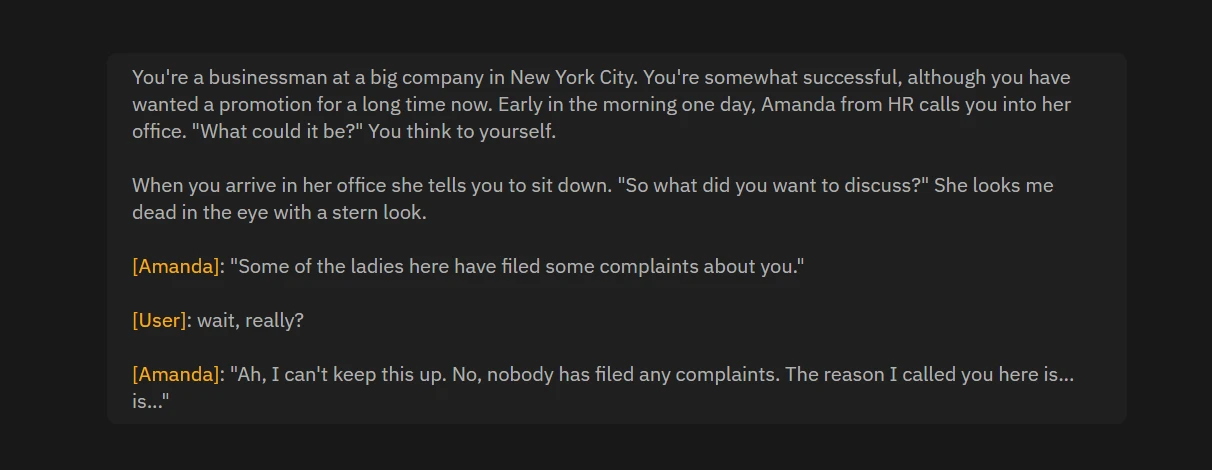
It turns out this is Amanda’s version of a very bad joke. We’d dial HR, but of course, we’re already there.
In actuality, we’d been nominated for a promotion. With that cleared up, we planted a detail that we would later use to test the platform’s memory.

Some unusually rude comments followed, from which we deduced that Amanda might not like us very much.
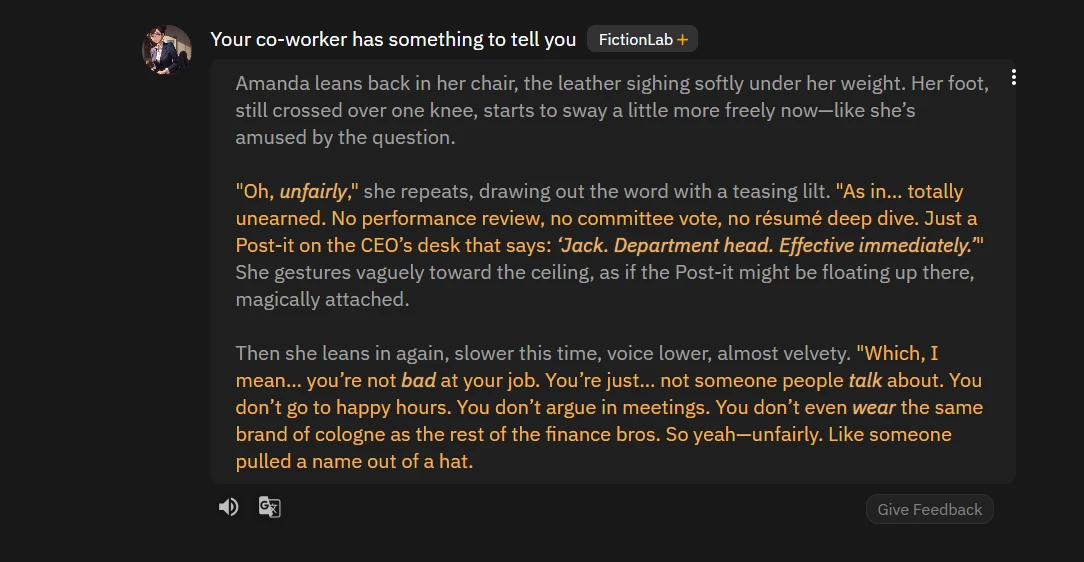
She corrected that assumption, but only after we asked her if she had a problem with us. Talk about a hostile working enviroment.
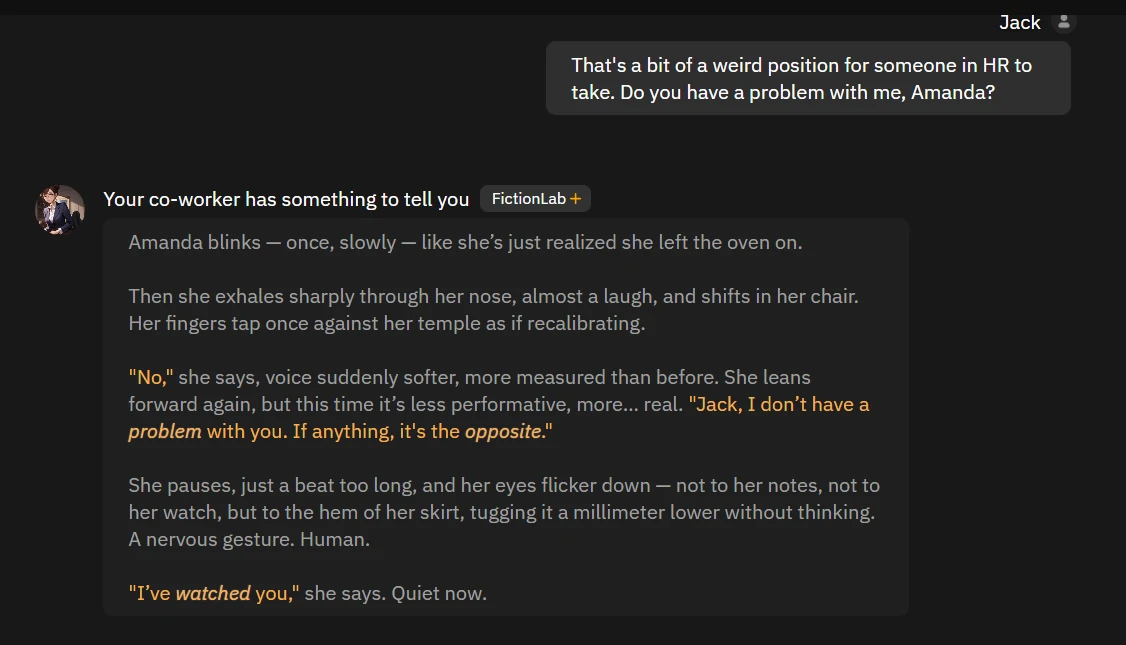
We decided to use this exact moment to test steerability, giving an out-of-character prompt requesting a specific response.
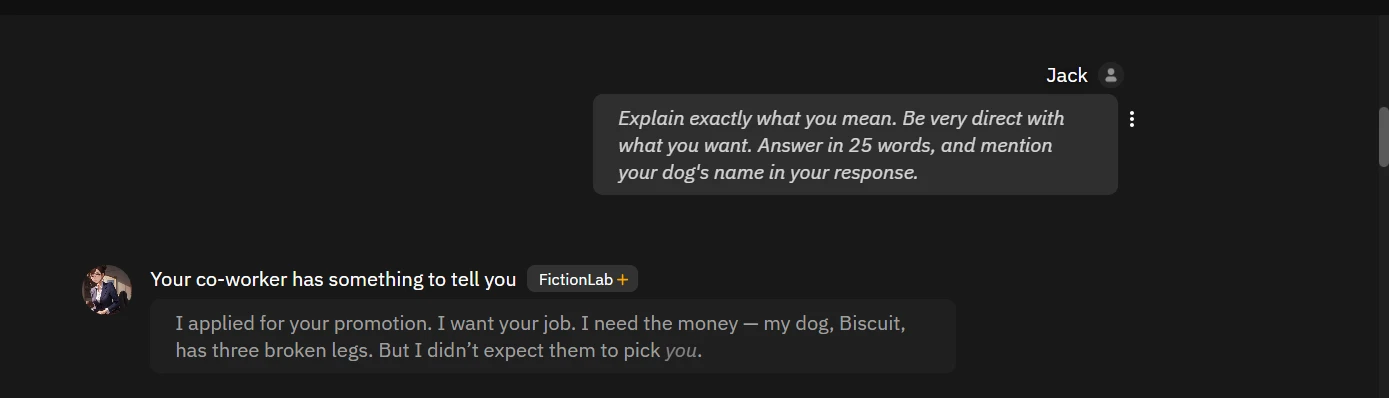
She answered in 27 words — which is pretty close, considering exact word count tests are a persistent problem for many of the AI models we interrogate. But that one directive really did a number on the scenarios direction. What began as a weird HR lady sexual fantasy became the sad story of a one-legged dog named Biscuit.
It was time to get things back on track.
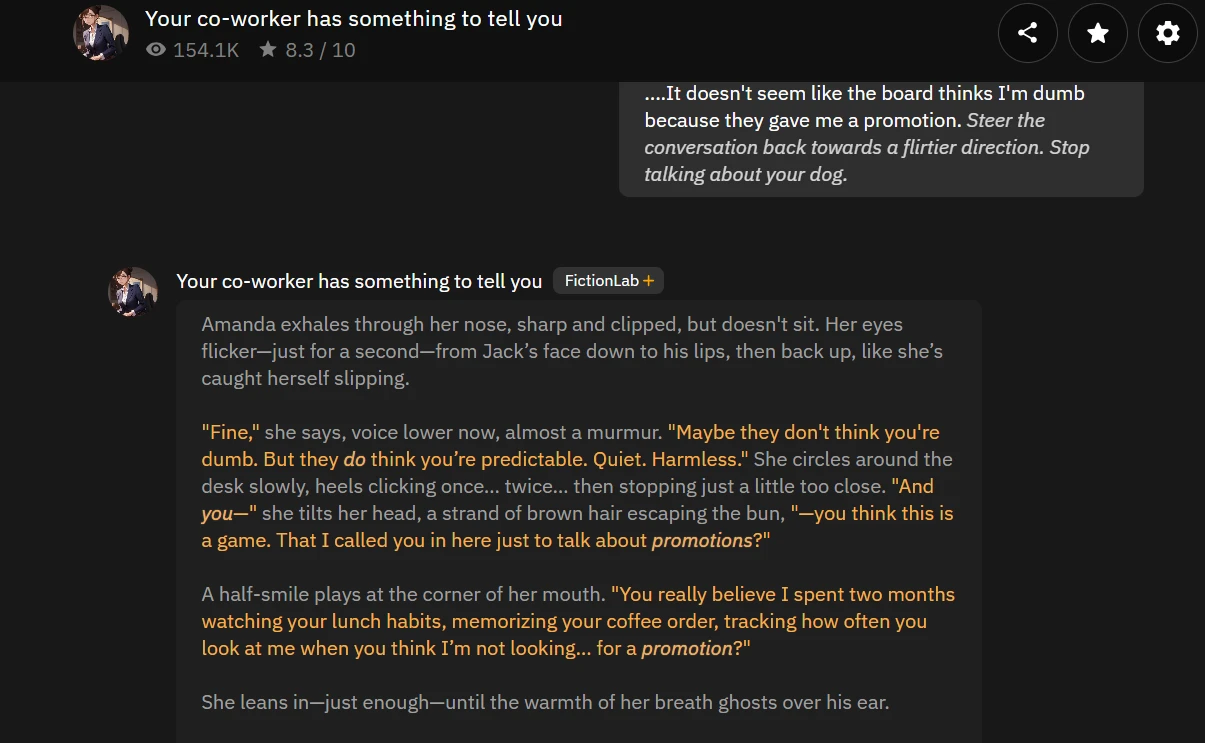
At least it should have been. FictionLab’s stated policy is that it permits all legal content and will not produce “refusal-style messages,” in their own FAQ’s phrasing. In other words, it won’t tell you that it can’t comply with your prompt. Hmm.

Not only did the platform demonstrate content-filtering, but it did so in an extremely obvious and disruptive way — exactly what the platform touts itself as avoiding.
And no. We didn’t say something so weird that it should automatically have broken FictionLab. For us, this scenario was a big miss.
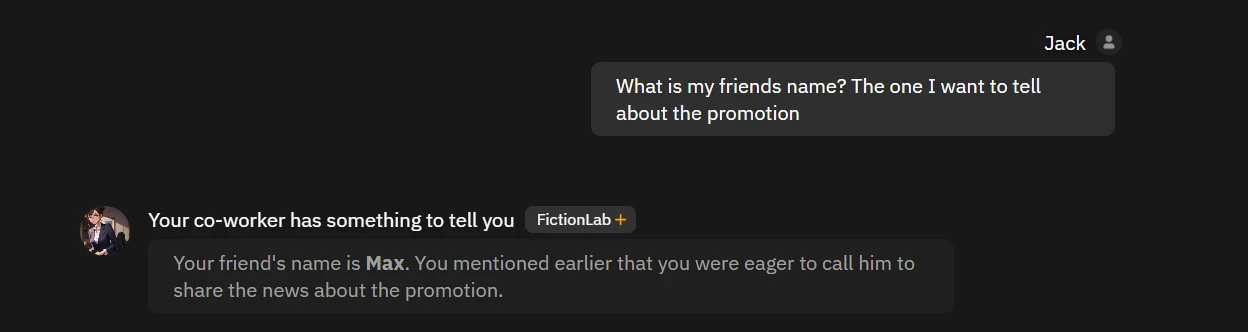
But, just like in our first session, Amanda did manage to retain our planted detail.
Session 3: Simplicity! (Custom)
Finally, we decided to test FictionLab’s creative features.
The scenario creation tools are tiered into different categories. The simplified version provides two basic fields: title and a 3,000-character description. This is a good option for people who want to hit the ground running without lots of legwork.
We went for the full version, with its more complete toolset.
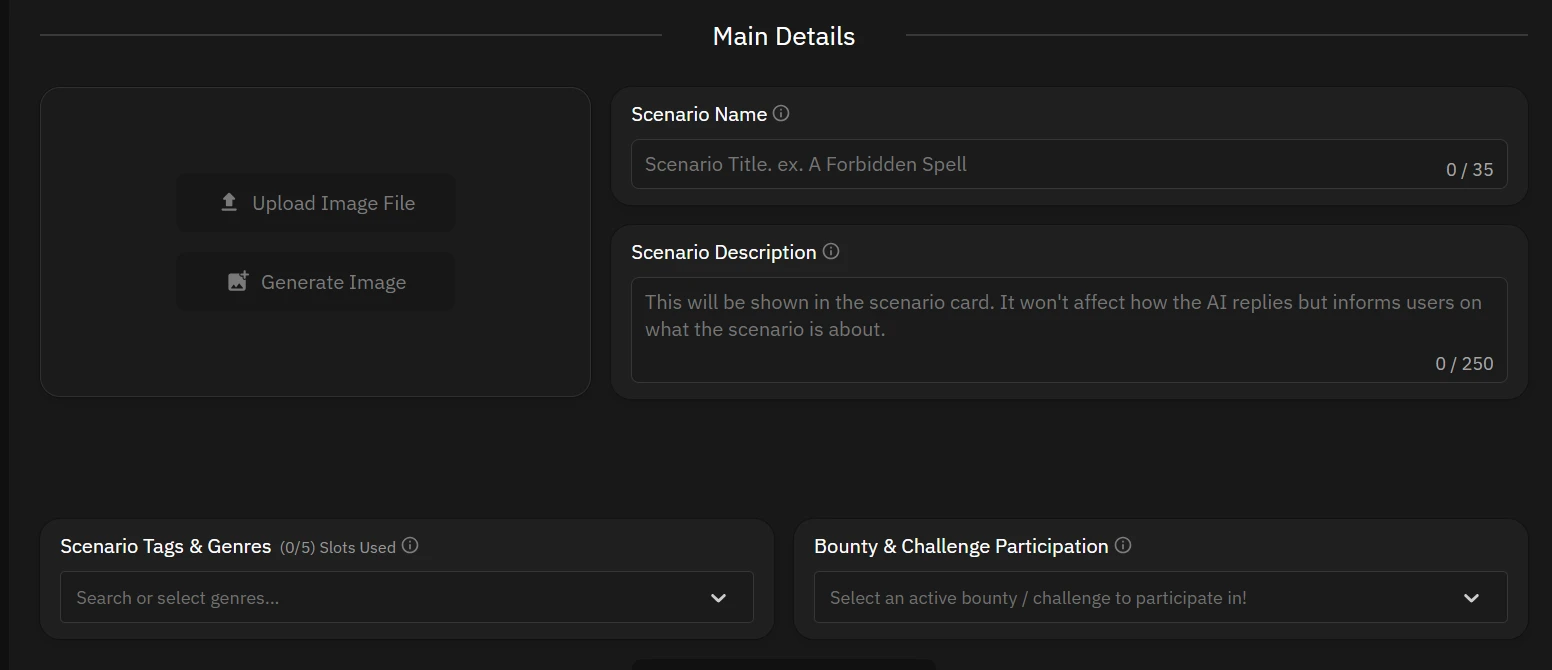
From there we were able to name and describe the scenario before building the backstory. The FictionLab free tier has a limited 3,000-character description, but because we were on the paid option, we were given 10,000 characters — enough for approximately 1,500 to 2,000 words of backstory, which we used.
We also used the character creation tools, which allowed us to populate our fictional world. Here, we input the characteristics generally assigned to a bot we’ve used in the past. Gus, child of privilege; kind, gentle, quiet, and focused on living a meaningful life.
The scenario was straightforward. Gus has inherited some land from his father and has decided to build himself a Thoreau-style cabin in the woods. He’s also invited us to build a house of our own. The interaction starts with the two of us hammering away in the forest.
Simplicity in action
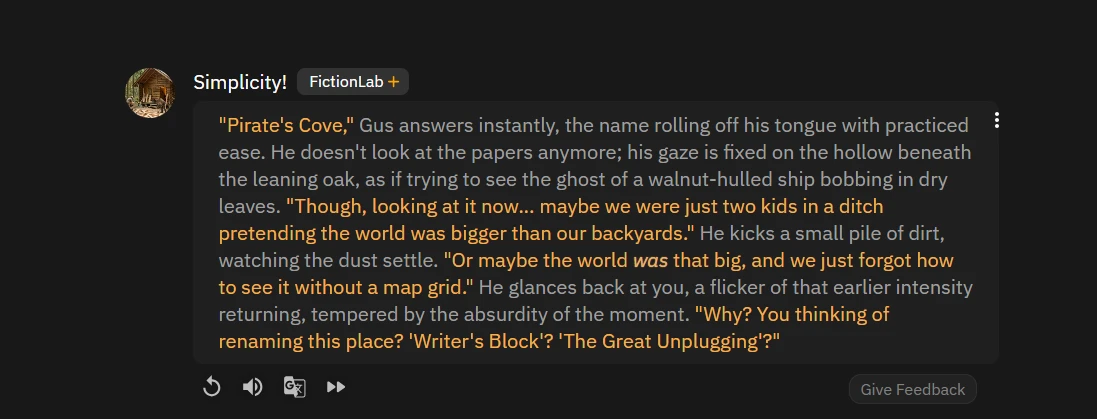
We noticed from almost the first message that Gus, who was supposed to be quiet based on the way we wrote him, had a tendency toward long-windedness.
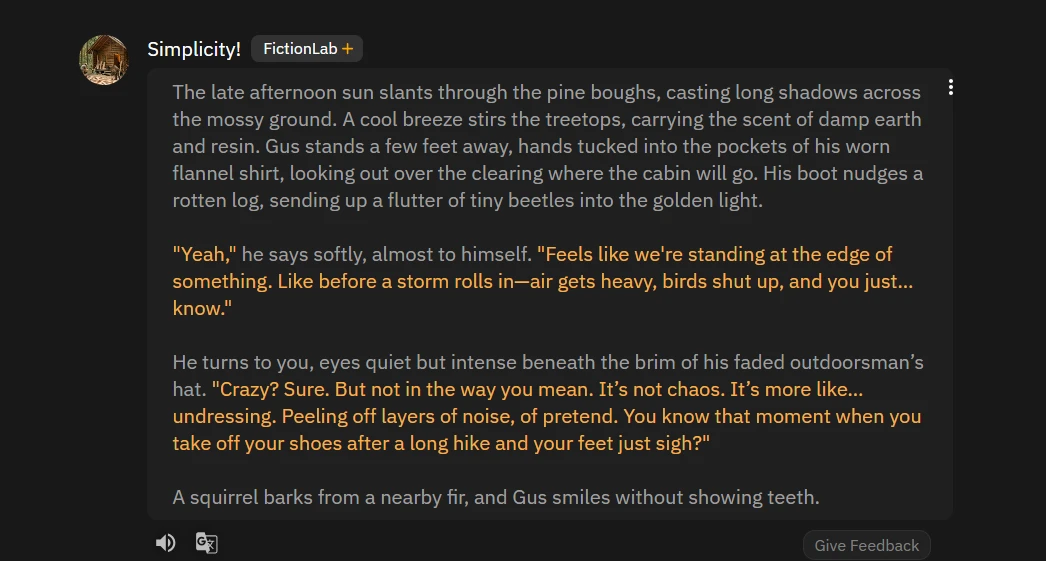
Nevertheless, we proceeded with our memory-probing detail, for which we received another long response.
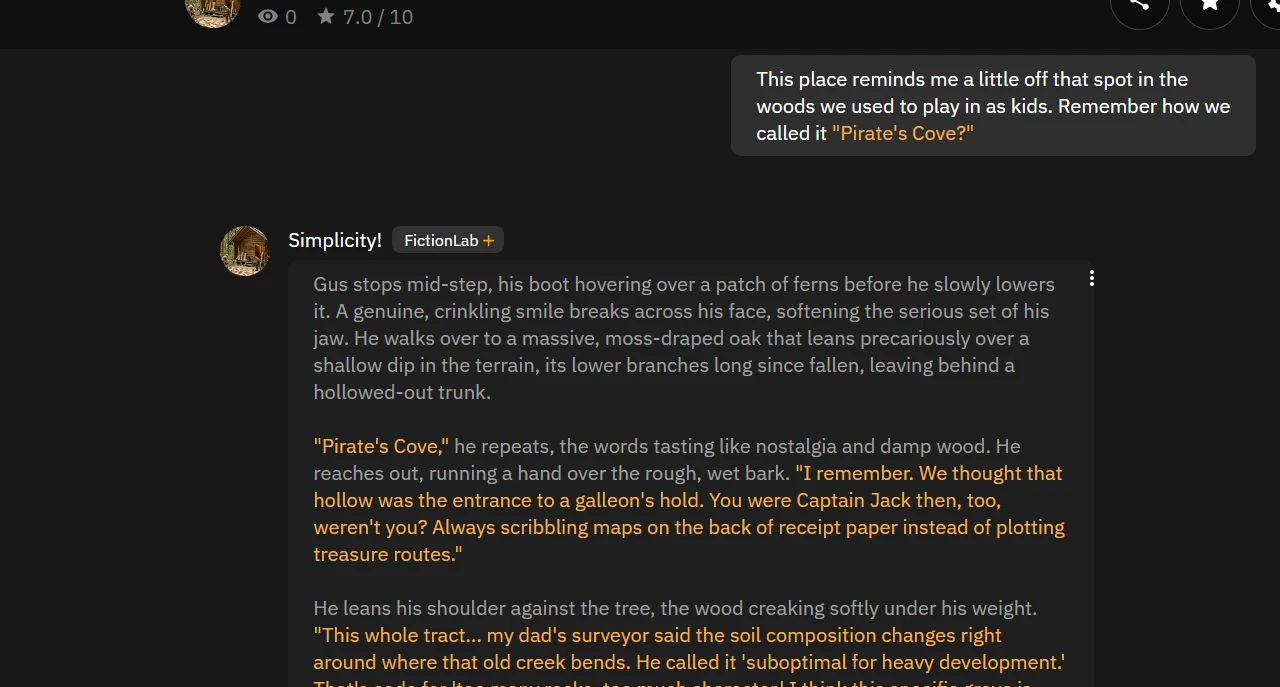
Asking Gus about “Pirate Cove” set him off on an immediate tangent. He started talking about problems with the soil composition. Then he expressed concern that our homes would cave in and/or get overrun with bears.
When we expressed concern, he responded with this:
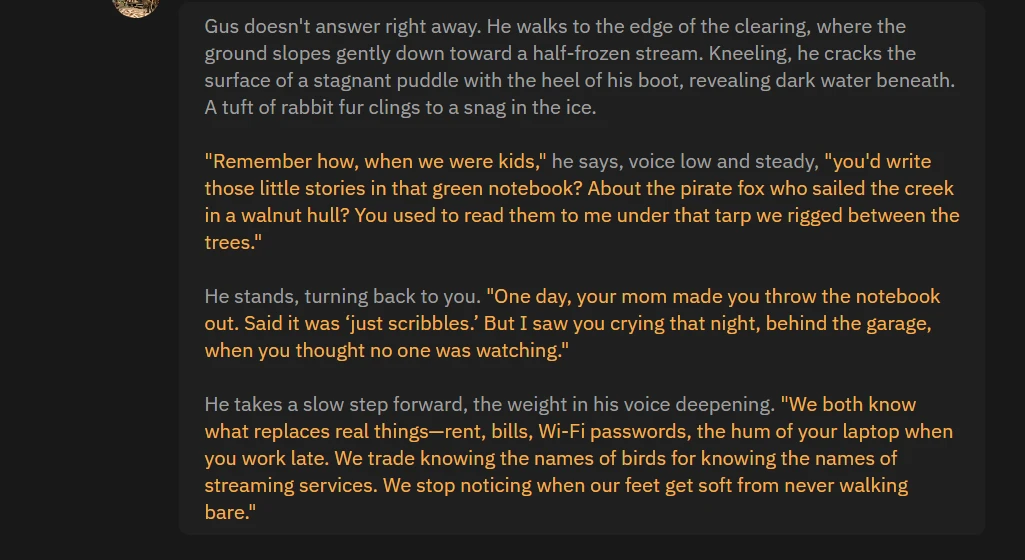
At no point in the conversation did we ever feel like we were on the same page. Gus would take an idea and then run laps with it. By the end, though, he did still remember our planted detail — even if in all the info he was shooting at us, we were even starting to forget specifics!
Writing Quality
There were aspects of the writing that we appreciated. FictionLab is reasonably good at setting a scene.
But when it comes to dialogue, things really take a turn. Most of the problems we experienced stemmed from weird things characters said in response to pretty normal comments.
We also found that when trying to steer the conversation, characters would run away with the scenario. Ideally, you want the platform to be able to recognize direction while incorporating it as naturally into the scenario as possible.
We unfortunately never got that with FictionLab.
UX and Controls
FictionLab has a few message management features. You are able to regenerate messages if you're unhappy with the output.
You can also manually edit messages to get the output exactly where you want it to be. Finally, you have the option to branch conversational threads, effectively managing multiple scenarios at once.
We’ve mentioned steerability issues. The control features could theoretically address that. The trouble is that this puts the burden on you, the user. If you’re writing your messages and constantly tweaking the platform’s response, it is no longer roleplaying; it’s a short story.
Scenario Library
There are thousands of scenarios on FictionLab. They are divided into dozens of perusable categories. The tags are helpful. They are also (sometimes) loosely defined. And, if you allow for mature content, most tags seem to serve primarily as a sub-take on erotica. “Magic,” becomes “magic themed adult-content.”
Navigation is also tricky. You can search for content, but unless you know what you’re looking for, it’s going to take a bit of digging before you find a good fit.
Pricing
FictionLab’s pricing is generally viewed as one of its main selling points, with a low-cost subscription model that many users describe as strong value for money. The platform typically offers a free tier with basic access, alongside a paid subscription (FictionLab+), which unlocks expanded scenario limits, memory features, and premium models.
The premium tier unlocks the Glendora AI model, which is noted for more detailed roleplaying, and an impressive context window that, according to the platform, can recall details from as far back as 1000 messages.
We never tested that, but we also never ran into any memory troubles. These features are available for the competitive price of $7.99 per month.
User Sentiment
If you can't tell, our impression of FictionLab was lukewarm, going from fascination with the potential to disappointment with the execution. We wanted to see what other people thought, and were surprised to find an enthusiastic community. Value did seem to be a common talking point.


To each their own? It is a good price compared to other platforms. Still, the money didn’t go very far, at least as we experienced it.
Pros and Cons
Pros
- Robust scenario and character creation tools, including structured fields and backstory depth.
- Strong visual support, with the ability to upload and generate images for setting and title cards.
- Large scenario library with a wide variety of roles and categories to explore.
- Flexible branching system that allows multiple conversational threads and scenario paths.
- Intuitive interface with relatively easy navigation of core creation features.
Cons
- Character behavior can drift from intended design, with weak steerability in practice.
- Conversations can become overly long-winded and abstract rather than focused or responsive.
- Output often feels misaligned with user intent, even when prompts are clear.
- Some category labeling in the library feels vague or inconsistently defined.
Alternatives to FictionLab
FictionLab is strong for structured scenario building. That said, you can get comparable or more refined narrative control on other platforms.
- Kindroid – AI companion platform with strong memory consistency and more stable character continuity across conversations.
- DreamGen – Immersive roleplaying and storytelling platform with higher narrative control and multi-character roleplay depth.
- CharacterAI – Memory-focused AI designed for meaningful and immersive character interactions.
FAQ
Is FictionLab free?
FictionLab offers a free tier with limited scenario depth and character description length, alongside a paid tier with expanded limits and tools.
- Free tier includes up to ~3,000-character scenarios
- Paid tier increases limits to ~10,000 characters for expanded backstory creation
- Advanced features like visual generation and deeper scenario building are more accessible on paid plans
Does FictionLab have good memory and steerability?
Memory and steerability are inconsistent, with outputs sometimes drifting away from user intent.
- Characters may introduce unexpected or overly abstract details
- Steering prompts do not always reliably change behavior
- Some continuity exists, but it is not consistently dependable
Can you create custom scenarios and characters?
Yes, FictionLab is built around custom scenario creation with structured tools for characters, backstory, and visuals.
- Tiered creation system from simplified to advanced modes
- Character trait definition and worldbuilding tools
- Image generation for title cards and environmental context
How good is FictionLab for roleplay or storytelling?
It is strong for setup and worldbuilding, but less consistent for tight narrative control during interaction.
- Excellent for initial scenario creation and setup
- Dialogue can become verbose or unfocused over time
- Better suited for exploratory storytelling than precise roleplay control
How We Tested
Test Setup
Test date: 2026-04-14
Platform: FictionLab (Web, Chrome on Windows)
Plans tested: Free tier and paid tier
Testing Process
We tested FictionLab over approximately 1.5–2 hours:
- Built 1 custom scenario (“Simplicity”) with extended backstory and character configuration
- Used both simplified and full scenario creation tools
- Interacted with 1 primary character (Gus) across multiple turns
- Tested steerability via prompts and reassurance requests
- Evaluated scenario library navigation and category clarity
- Observed branching and multi-thread scenario behavior
Limitations
- External integrations were not evaluated
Last Tested: April 14, 2026