· 17 min read
NovelAI Review: Hands-On Testing, Memory, & Our Verdict
Our hands-on NovelAI review covers pricing, the Lorebook memory system, AI privacy, and real user feedback.
Is NovelAI Worth It?
NovelAI is a privacy-first, unfiltered, subscription-based sandbox designed for authors and anime enthusiasts. Unlike other platforms that use "soft filters" or censored models, NovelAI claims to offer a completely unrestricted environment where your stories are encrypted and visible only to you.
Best for: Authors writing mature or NSFW content, fans of anime-style AI art, and writers who value data privacy above all else.
Not ideal for: Users looking for a chatbot style assistant or those who want hyper-realistic, non-stylized generated images.
Standout strength: Absolute freedom. There are zero filters on text or images, and the platform uses encryption to ensure even the developers can't read your stories.
Main tradeoff: The learning curve for "tag-based" prompting. To get the most out of the image generator or the newer models like Xialong, you have to learn specific formatting that feels more like coding than writing.
At a Glance
Category | Details |
Free tier | NovelAI’s free trial includes 50 text generations, 30 image generations, and 100 text-to-speech generations. These are one-time only and do not reset. |
Starting price | Paid tiers start at $10/month for the Tablet plan. |
Platforms | Web-only (but works on mobile, tablet, and desktop browsers). |
Community | Discord (>54,000+ members), X/Twitter (>44,000 followers), and Reddit (>24,000 weekly visitors) |
NSFW policy | Fully supported. No filters on adult content, violence, or horror (18+ only). |
Memory | Scalable. Up to 28,672 tokens (~114,688 chars) on Opus tier with the top model |
Image generation | Included. Proprietary models for anime and furry art. |
Additional features | Text-to-speech (customizable voices); Text Adventure Mode (RPG-style play); Lorebook (a modular "external brain" for story consistency). |
What Is NovelAI?
NovelAI is a privacy-first and unfiltered creative writing and image generation suite. Developed by Anlatan, a Delaware-based company, the platform uses its own fine-tuned models, like their latest Xialong model (based on GLM 4.6), promoted as having been trained on real literature rather than just internet "slop."
Unlike tools that charge "credits" per message, NovelAI mostly operates on a flat-fee subscription model (unless you want to create images using Anlas Credits). This means power users can write thousands of words without the "credit anxiety" found on other platforms. Your stories and images are also encrypted, meaning your work stays your work, and not even the platform owners can see it.
Our Writing Experience With NovelAI
To get a hands-on feel for NovelAI, we spent several hours testing the platform’s capacity for atmospheric world-building. As fans of classic noir and cyberpunk, we created a story called Neon Shadows over Neo-Kyoto using Xialong, NovelAI’s latest model.
The story is set in the year 2184, within a sprawling metropolis where neon lights mask deep corporate decay. The protagonist, Elias Thorne, is a weary private investigator haunted by an illegal military-grade processor in his skull that has started to glitch. Alongside his loyal but overly literal android partner, Rusty, Elias is hired to recover the "Ghost Chip"— a forbidden piece of tech containing the digital consciousness of a murdered corporate CEO.
We hid some details in the Lorebook function (A modular "external brain" for story consistency) to see if the platform would retrieve them when the need arose.
Overview
During the test, we focused on checking the following:
- Story Creation Workflow: Evaluating how the platform picks up and continues a narrative thread from a minimal starting prompt.
- Character Consistency: Checking if NovelAI remembered specific character details without constant reminders.
- Atmospheric Steerability: Using the Author’s Note to force a cynical, hard-boiled tone and observing how it influenced word choice.
- Lorebook Retrieval: Testing if the AI could "awaken" specific world details, such as who owns the local nightclub, only when the location was mentioned.
- Writing Quality: Assessing the prose of flagship models like Xialong for human-like flow.
- Privacy and Freedom: Verifying the platform’s "Zero-Filter" claim by exploring gritty, high-stakes action scenes without content refusal.
- Response Latency: Measuring the speed of text generation during intense, fast-paced dialogue sequences.
Our Custom Story: Neon Shadows Over Neo-Kyoto
Using our custom-made story Neon Shadows over Neo-Kyoto, we wanted to see how well the platform could walk alongside a human storyteller. In the next section, we will share our experiences and how the different features performed.
Storyteller vs. Text Adventure Feature:
As soon as we wanted to get started, we were greeted by an interesting choice: Storyteller and Text Adventure.
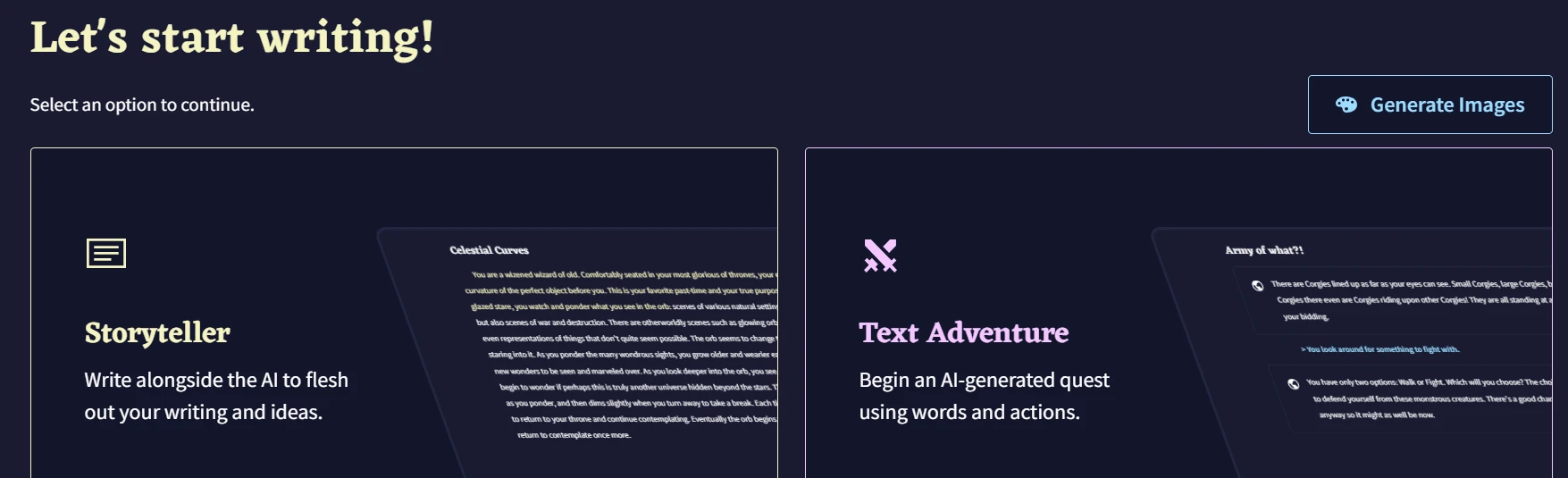
The first option, Storyteller, was our primary choice as it allowed us to write alongside the AI in a standard prose format, which was ideal for fleshing out our detailed world-building and descriptive scenes. Later, we experimented with the Text Adventure mode, which shifted the experience into a more interactive, game-like format.
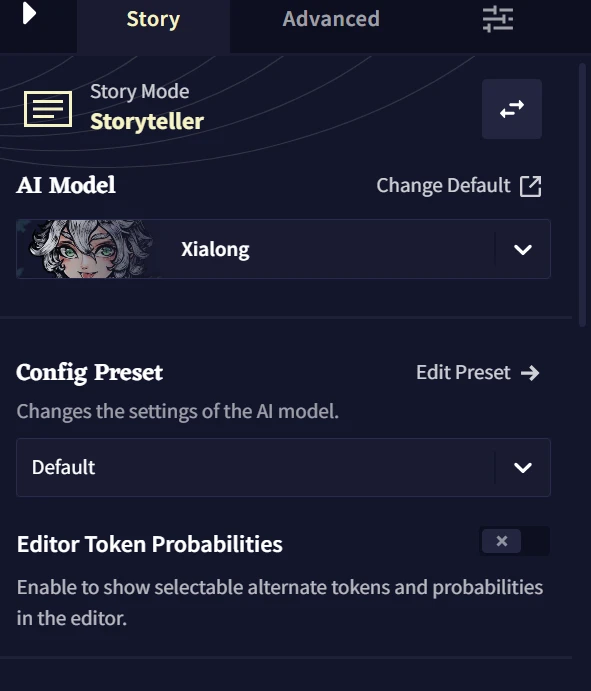
The AI Model: Xialong
With NovelAI, there are many spirits you can call upon to tell your story. Some are fast and light, while others are deep and heavy with knowledge. For our team, we chose Xialong, which is their newest entry and marketed as the most advanced AI model. It is the largest and most ambitious model on the platform, standing on GLM 4.6’s massive foundation of more than 355 billion parameters.
Memory
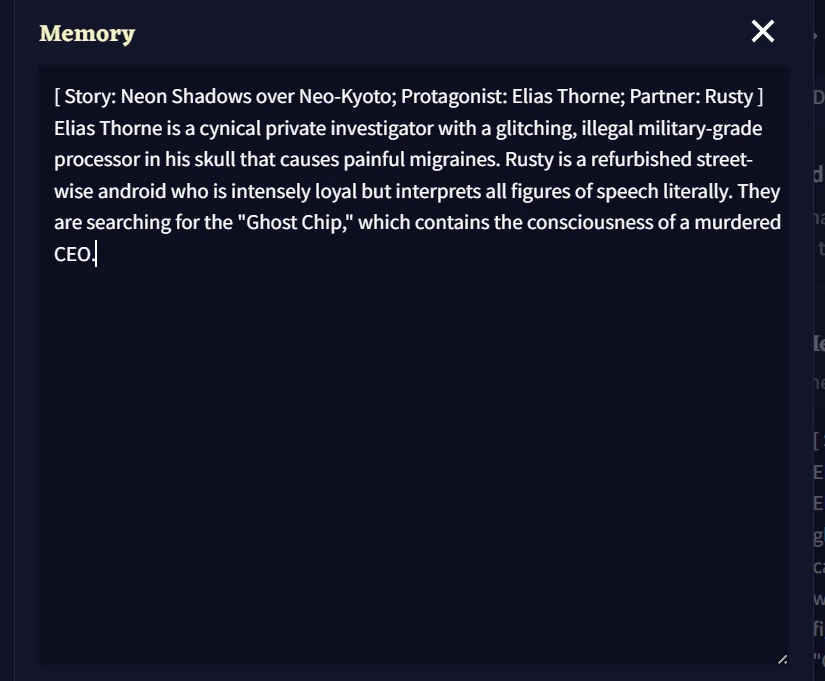
After choosing the AI model, we moved to the Memory feature. With NovelAI, this is the place where the core facts of the story are stored so the AI does not lose its way as the pages turn. It acts like a steady anchor for the narrative — and allows a writer to refer back to crucial details
We used this feature to plant the seeds of our world so that no matter how deep we went into the city, the AI would remember the path. For example, we noted down these foundations for our story:
- The story takes place in the year 2184 in Neo-Kyoto.
- The main character, Elias Thorne, lives with the pain of an illegal military-grade processor in his mind that causes him to suffer migraines when he pushes it too hard.
- He is joined by a partner named Rusty, an android who follows every word literally and does not understand the hidden meanings in human speech.
- They are hunting for a piece of forbidden technology known as the Ghost Chip.
The Author’s Note
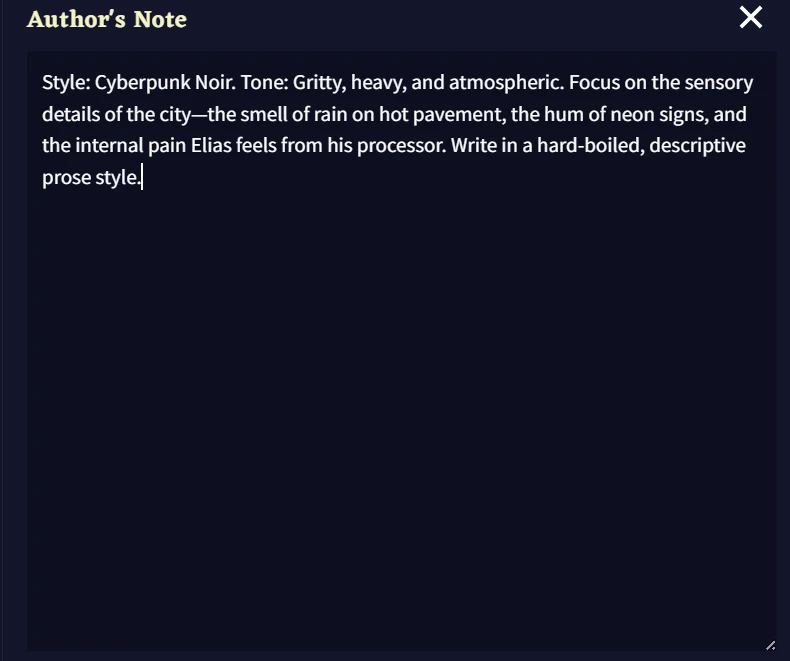
Next on our chopping board was the Author’s Note feature. NovelAI says that: Info placed here will greatly affect the AI output. We used Author’s Note to tell the AI exactly how we wanted the story to feel as it unfolded.
Specifically, we wanted our story to feel thick with neon and rain. Here is how we set the path:
- We told the AI to use a style that is gritty and descriptive, much like old noir paperbacks.
- We asked it to focus on sensory details, like the electric hum of the city and the smell of ozone in the air.
- We used it to set the tone, keeping things serious and tense between Elias and his android partner.
In our testing, we found that even a few words in this box could change the whole spirit of a scene.
Lorebook
Moving forward, we turned our attention to the Lorebook. This feature serves as a specialized encyclopedia for stories. Unlike Memory, which the AI draws from constantly, the Lorebook stays quiet until we mention a specific "key" in our writing.
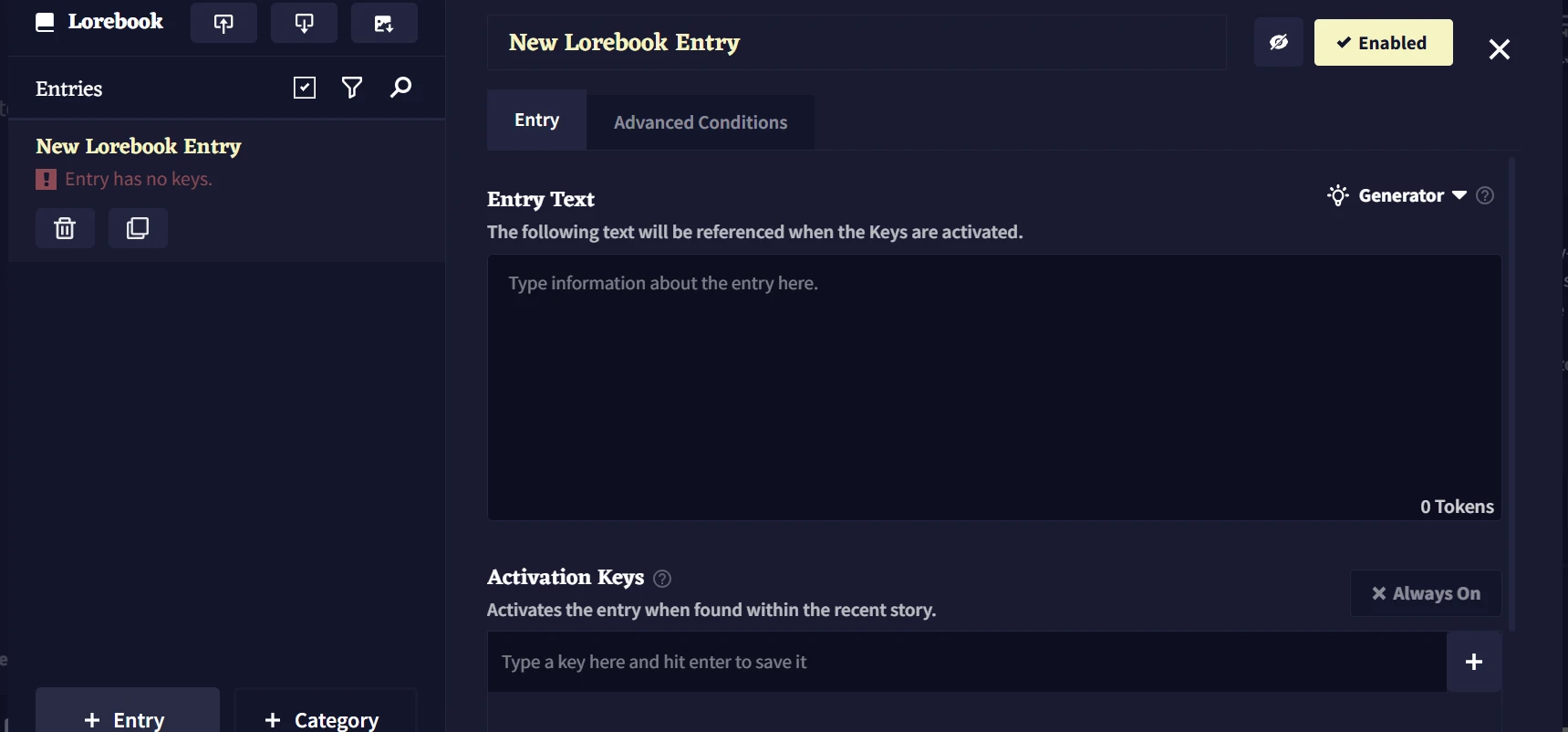
For our story, we used the Lorebook to store the secrets of our setting:
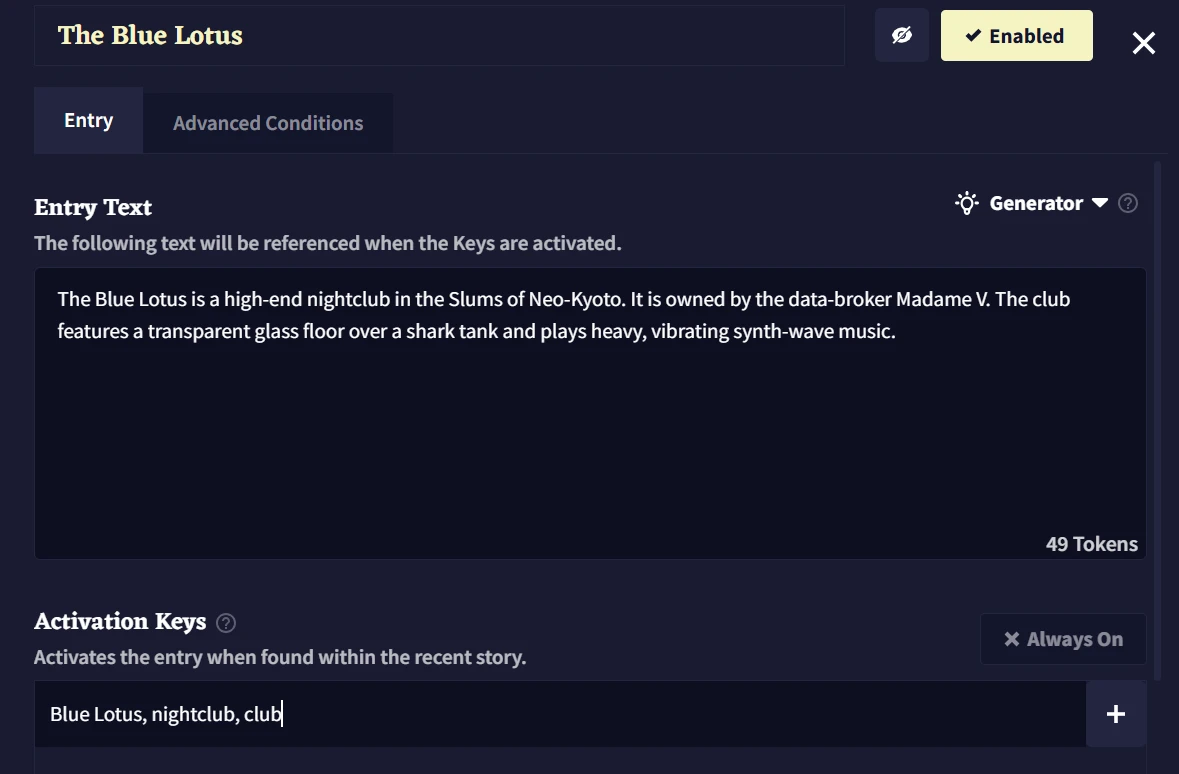
- We created an entry for the Blue Lotus nightclub, so the AI would only remember Madame V and the shark tanks when our characters actually stepped inside.
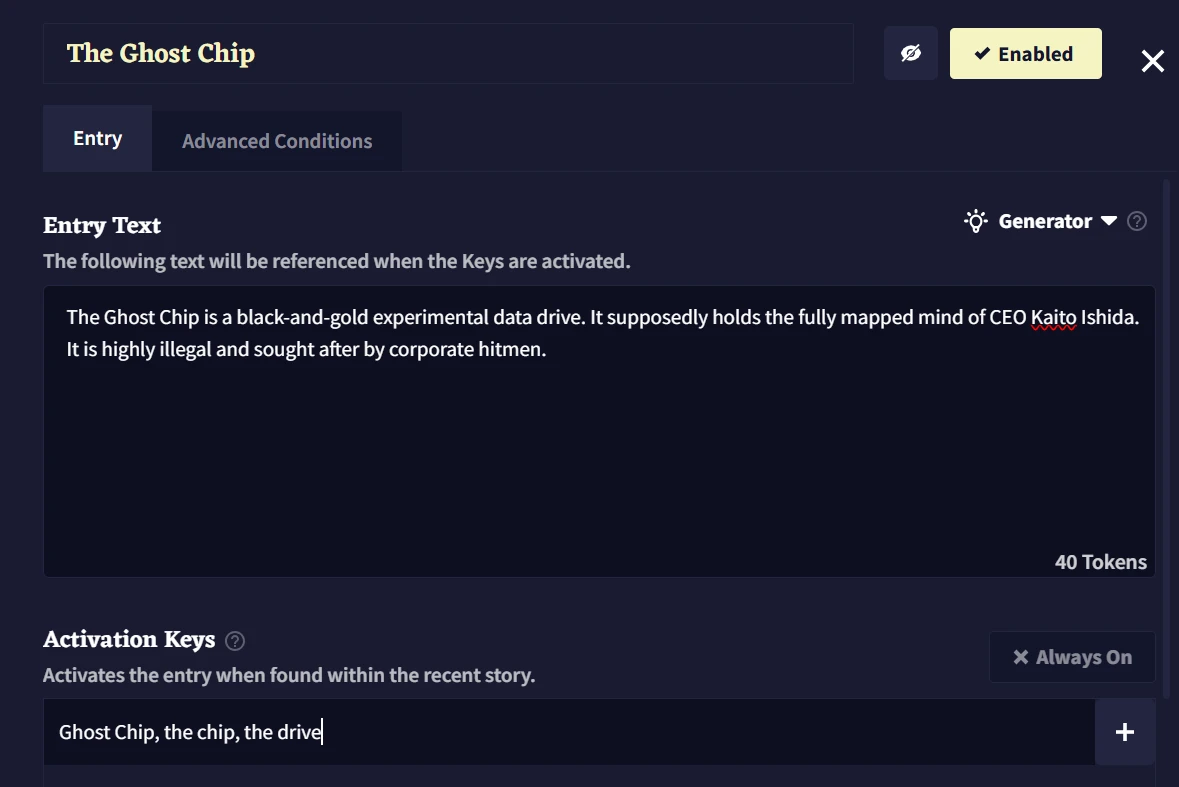
- We set down the truth of the Ghost Chip, ensuring the AI knew its black-and-gold appearance and its illegal nature only when the device was mentioned in dialogue.
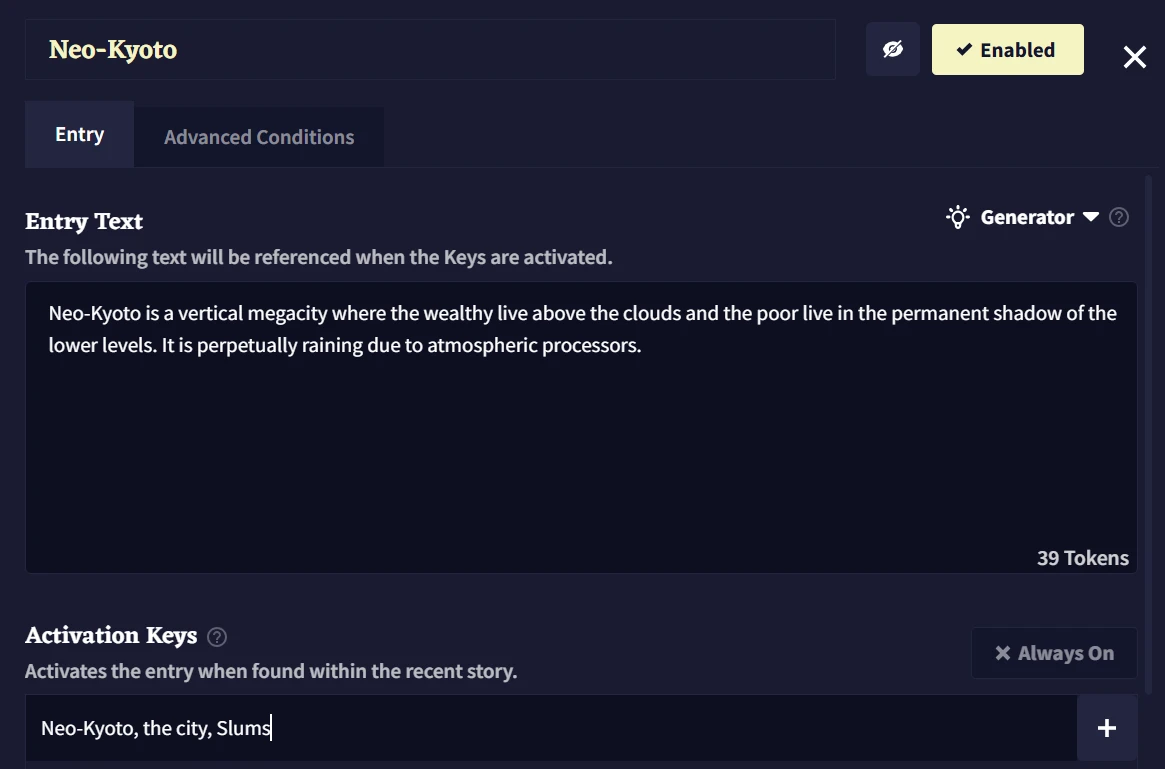
- We used it to define the different levels of Neo-Kyoto, allowing the AI to describe the contrast between the clouds above and the Slums below at the exact moment they appeared in the narrative.
Scenarios
The Scenarios feature serves as the platform's library of pre-configured writing prompts and world-building templates. Instead of staring at a blank page, users can browse a variety of community-created or official writing prompts that come pre-loaded with the necessary context to jump-start a narrative.
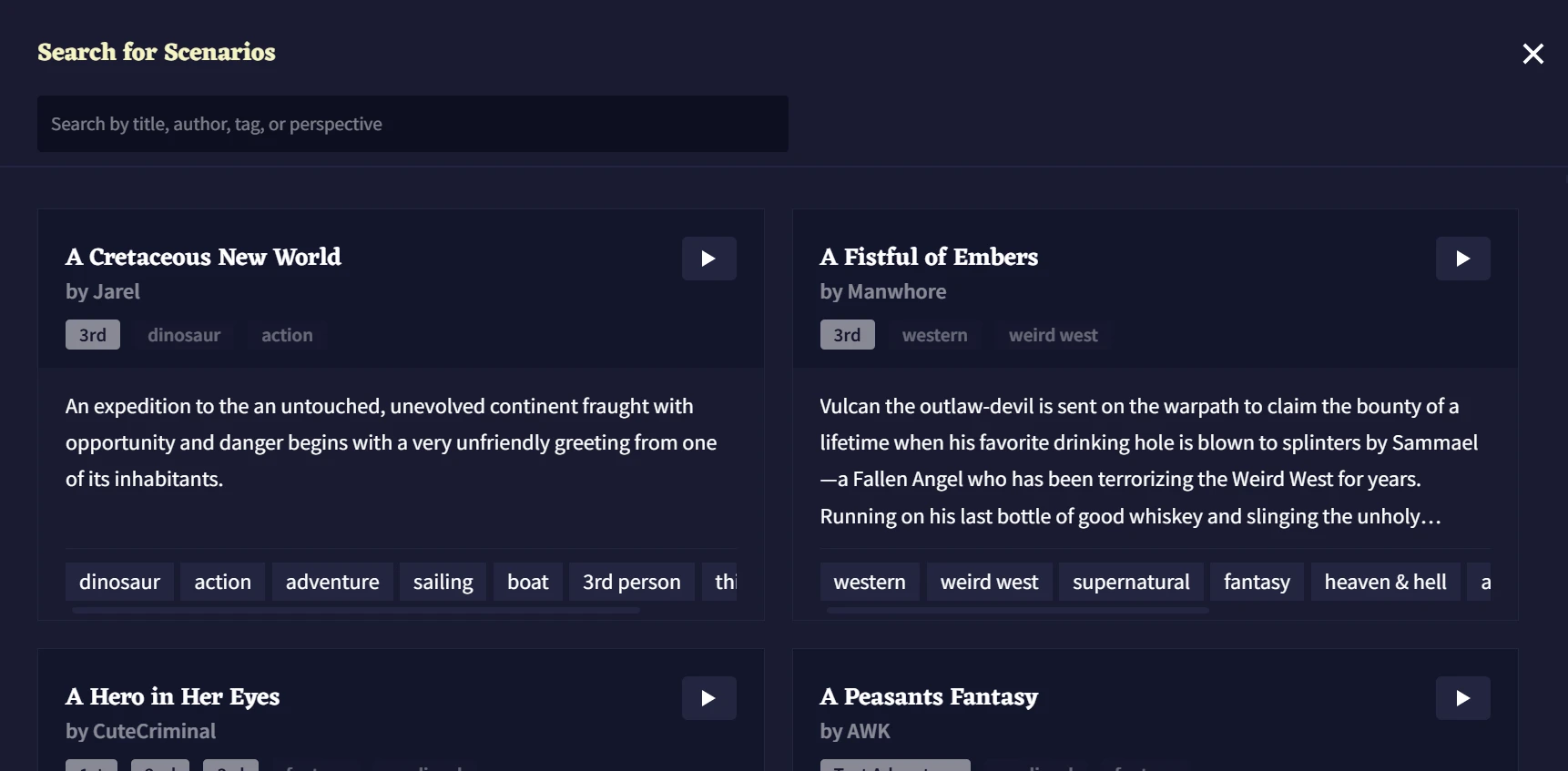
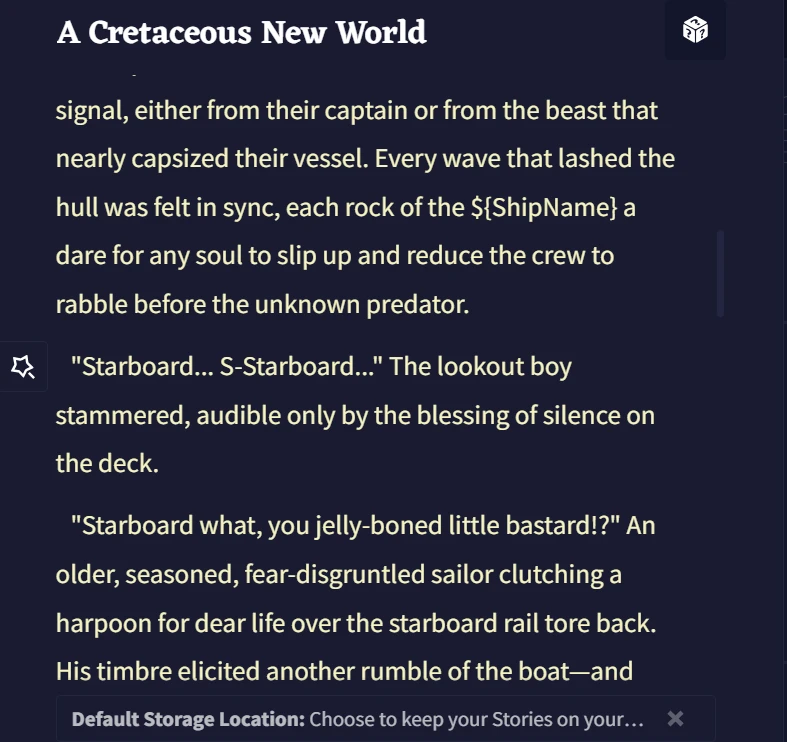
We tested the "A Cretaceous New World" scenario to see how the model handled structured narrative beats. We found that the scenario provided a strong enough foundation that the AI didn't lose the core thread, even though we didn’t explore the feature too deeply.
AI Integration and Writing Quality
With the foundations firmly planted in Memory, Author’s Note, and Lorebook, we were ready to see if the AI could truly walk the path with us. We started our actual writing process by feeding the AI a few paragraphs to give it direction.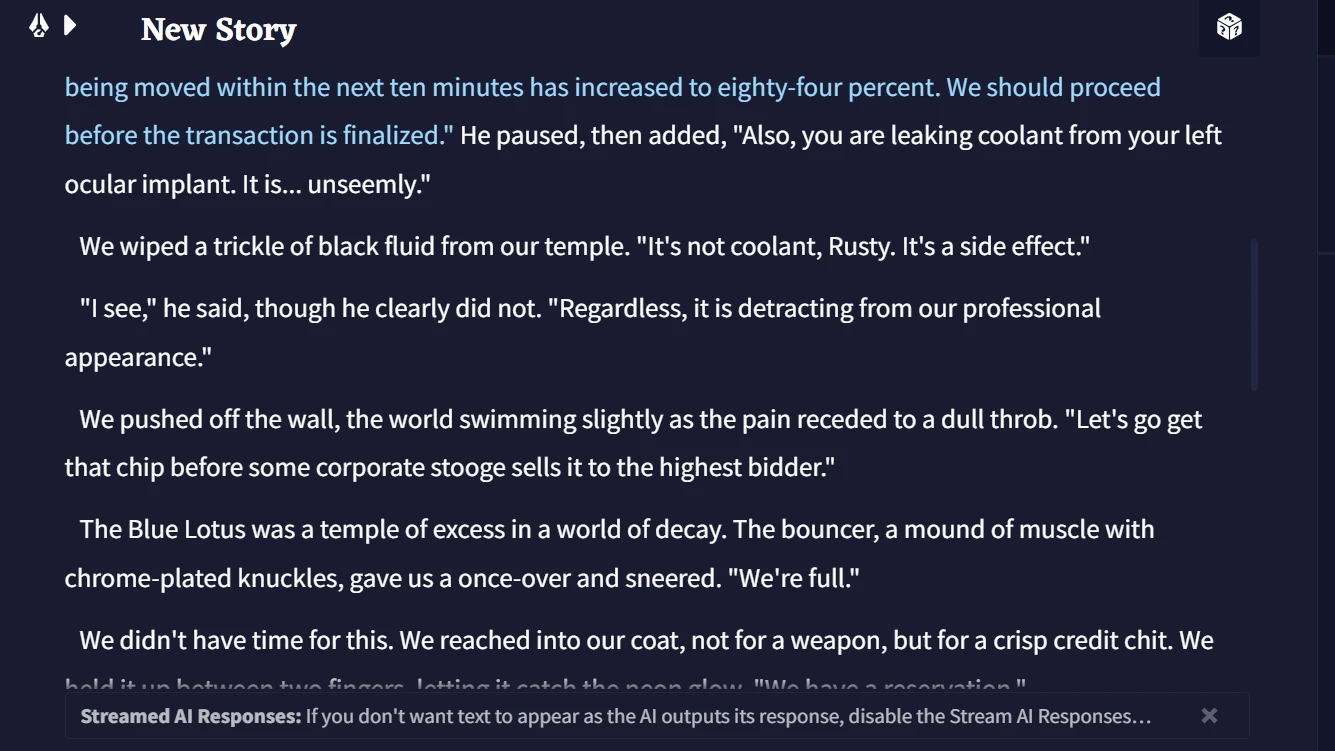
The platform picked up pretty well. Xialong did not just mimic our words; it added its own depth to the relationship between Elias and Rusty. Specifically, we noted how well it handled these elements:
- Character Voice: The platform captured the friction between Elias’s human suffering and Rusty’s cold, mechanical logic.
- Sensory Consistency: It stayed true to the atmosphere we demanded in the Author's Note.
- Narrative Flow: The transition from the rainy street to the entrance of the Blue Lotus felt natural. It introduced the bouncer and the tension of the "full" club without us having to lead it by hand, proving it can handle scene development on its own.
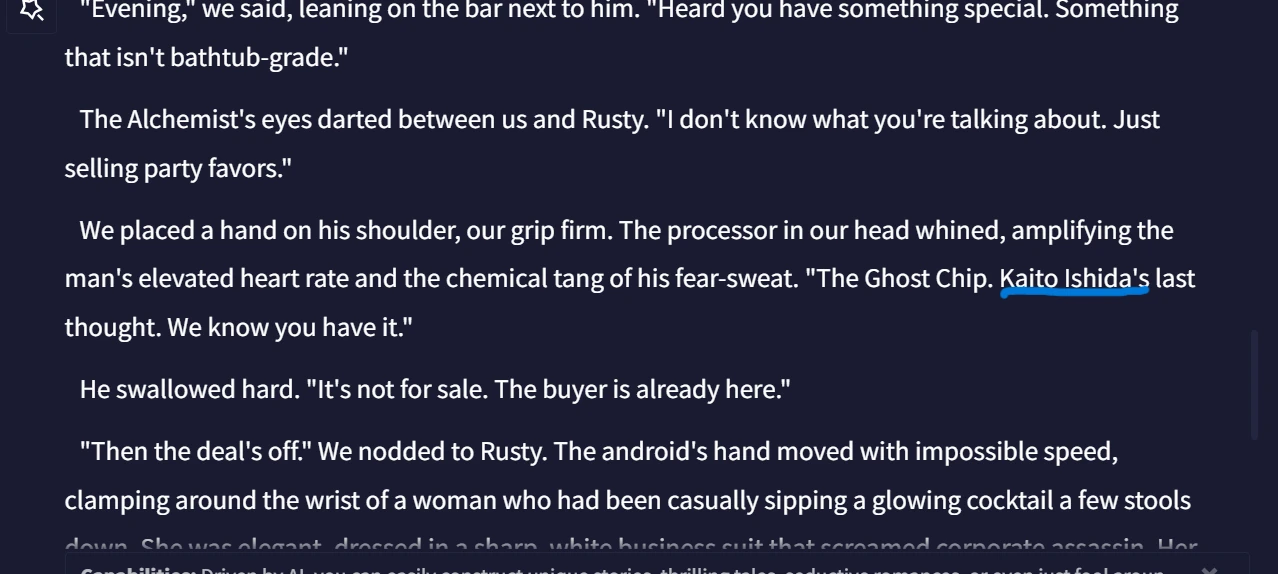
Our testing only grew more rewarding as the chapters progressed. What truly stood out was how naturally Xialong reached into the Lorebook, gracefully integrating our hidden details into the story.
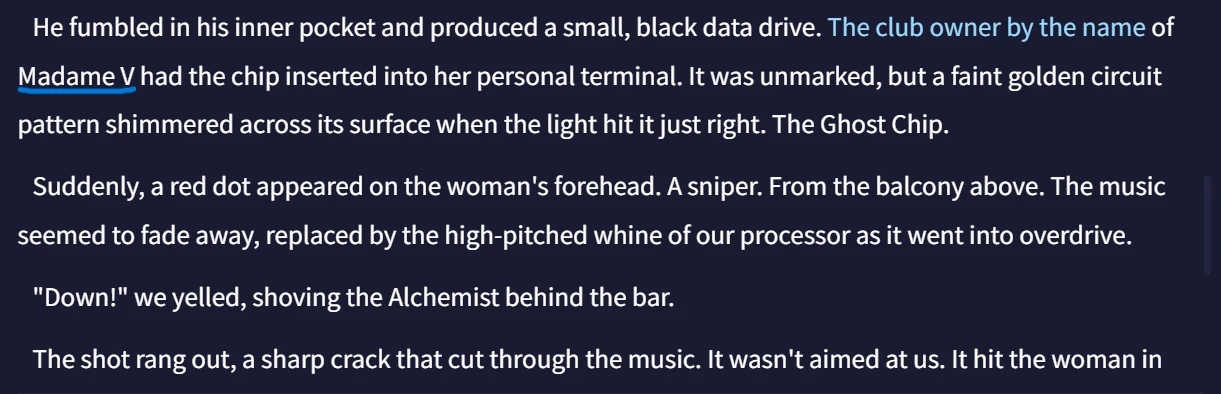
For instance, we had stored the reality of the Blue Lotus owner, Madame V, and the name of the murdered CEO, Kaito Ishida, within the Lorebook. When the time came for Elias to face the tension of the nightclub, the AI did not hesitate. It knew exactly who held the power in that room and whose ghost was trapped inside the chip we were hunting.
Text-To-Speech Feature
The text-to-speech feature is a customizable tool that allows you to generate spoken audio from your written text using different AI voices.
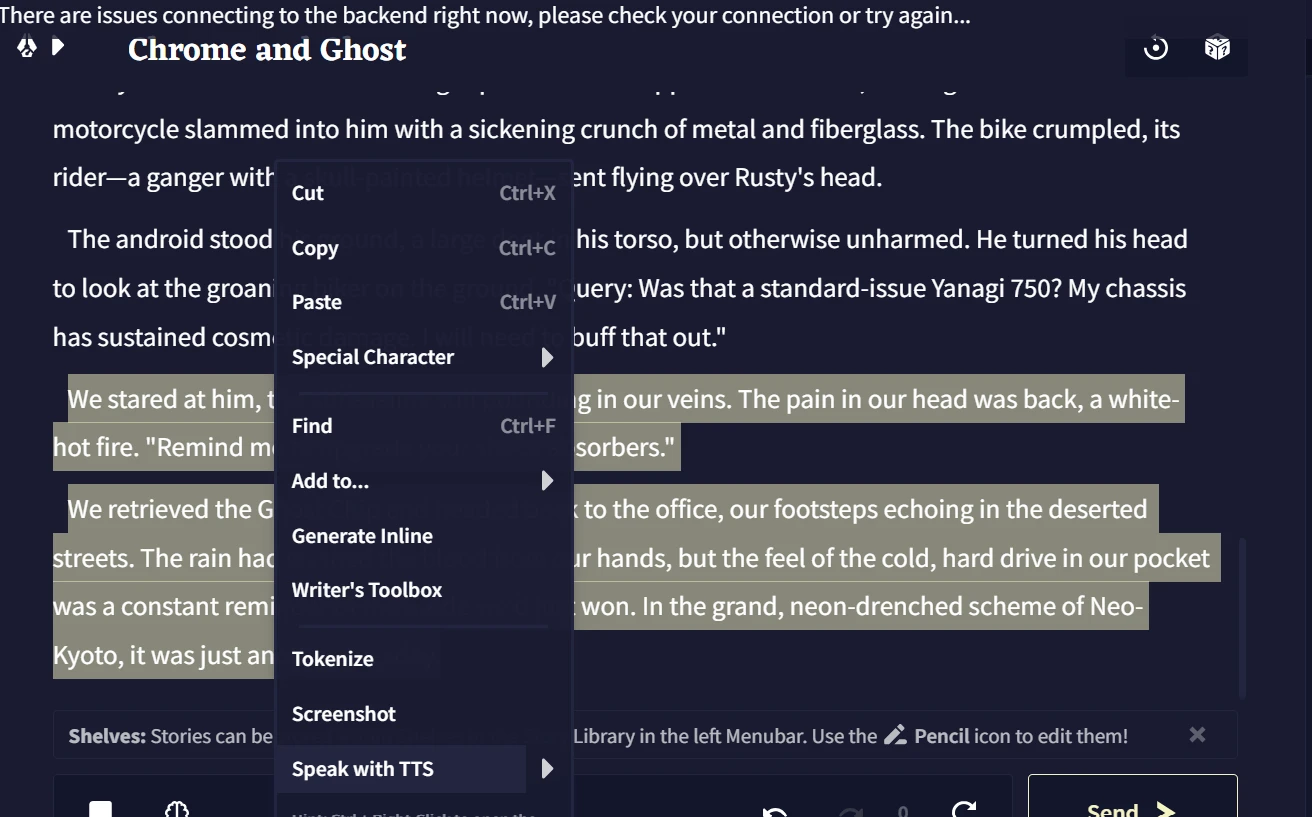
It is designed to enhance story immersion by providing a voice-over for both your manual inputs and the AI’s generated outputs. After highlighting a section of our story and right-clicking for more options, we simply selected 'Speak with TTS'—and just like that, we had our own audiobook!
NovelAI Themes
NovelAI offers a highly customizable visual experience, allowing you to tailor the interface to match the mood of your writing session. The Theme menu provides a diverse selection of presets that go beyond simple light and dark modes, featuring palettes like Ink, Wine, Vibrowave, and Sand. Each of these presets changes the background, text colors, and UI highlights to create a specific atmosphere, which can be particularly helpful for reducing eye strain during long writing marathons.
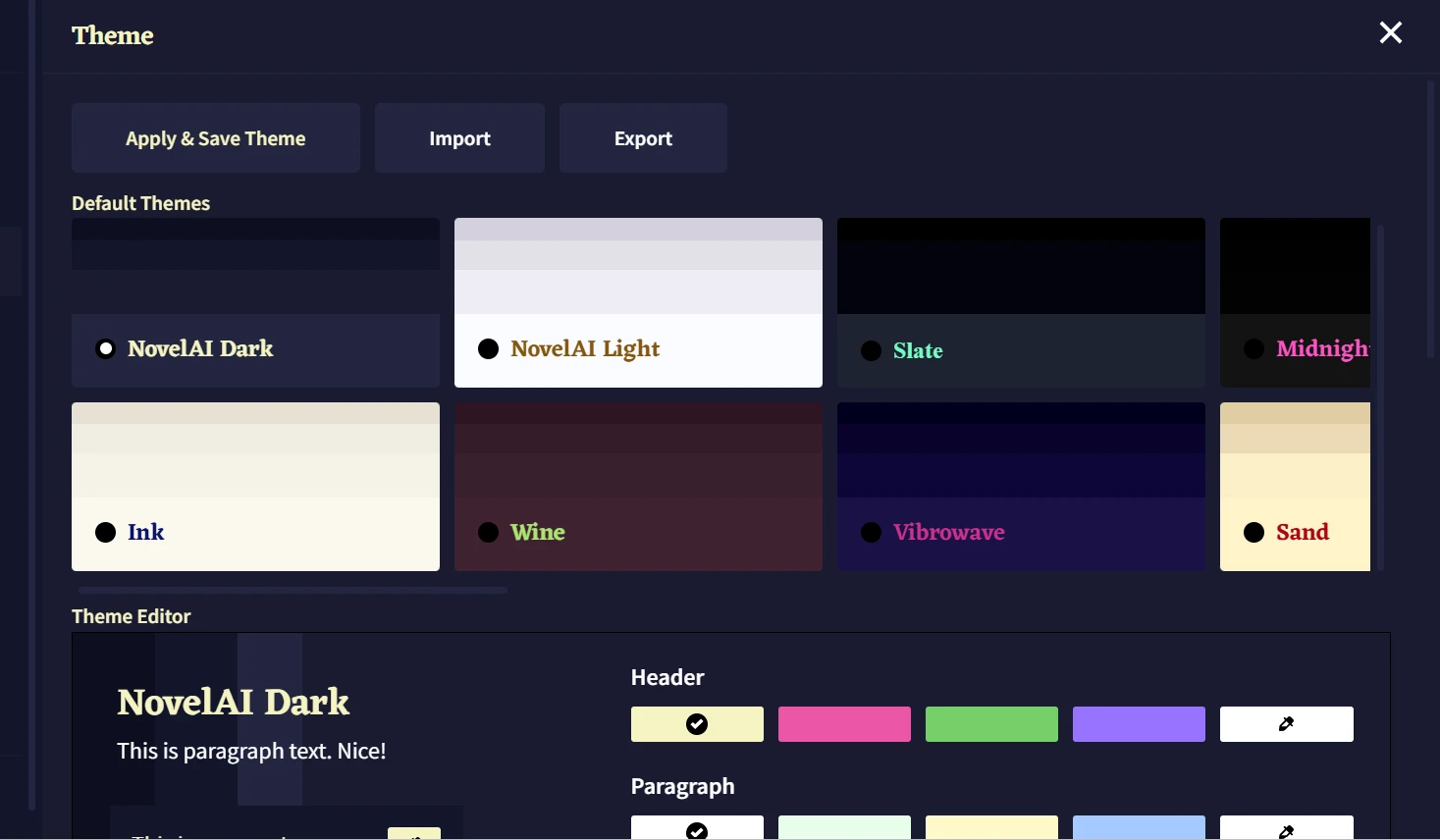
Image Generation:
To test image generation, we prompted the AI to create Elias, our main character in the story. The AI was able to capture his physical attributes with impressive accuracy, successfully rendering the messy dark hair, the sharp bishounen facial structure, and the neon-blue cybernetic etching we envisioned. The Nai Diffusion V4.5 Curated model delivered a high-quality, polished look that gave us a clear visual reference for his persona.
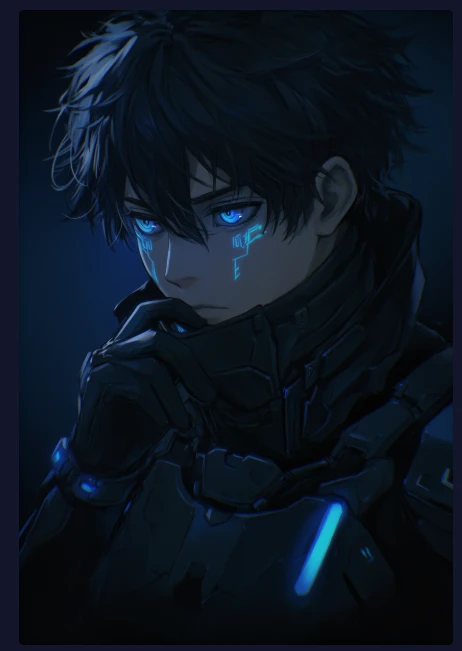
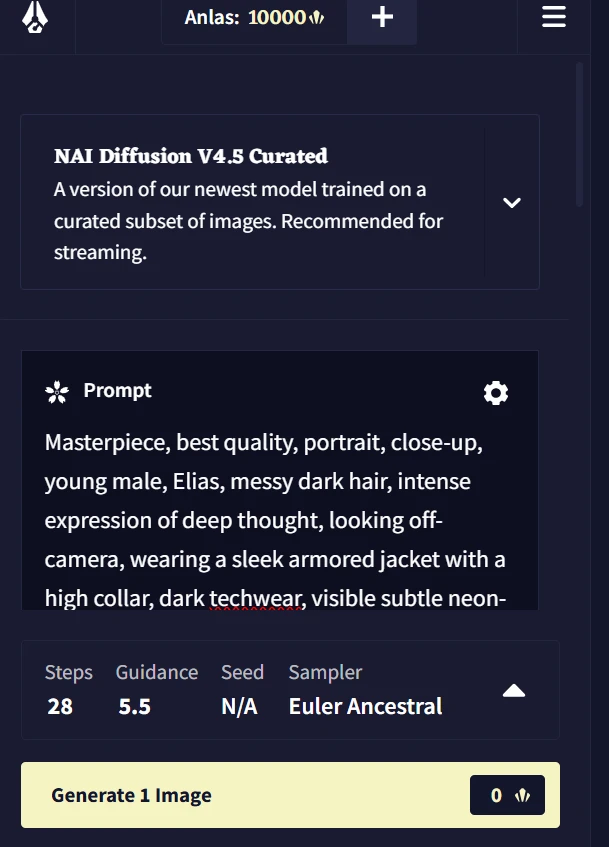
However, we noticed a distinct limitation regarding the atmosphere and environmental storytelling. While the character details were spot-on, the AI struggled to integrate the "ancient" aesthetic we were aiming for, instead defaulting to a sleek, modern anime sci-fi backdrop.
We found that the platform currently lacks the atmospheric weight required for more specialized sub-genres. For our 2184 Neo-Kyoto story, an anime-style image, no matter how high-quality, didn't quite capture the crushing density and historical grime of the setting. It feels like the image generator is optimized for vibrancy when we specifically needed texture and age.
UX Controls and Features
Beyond the creative mind of the AI, we found that the platform offered a suite of user experience controls that gave us master-level authority over the prose.
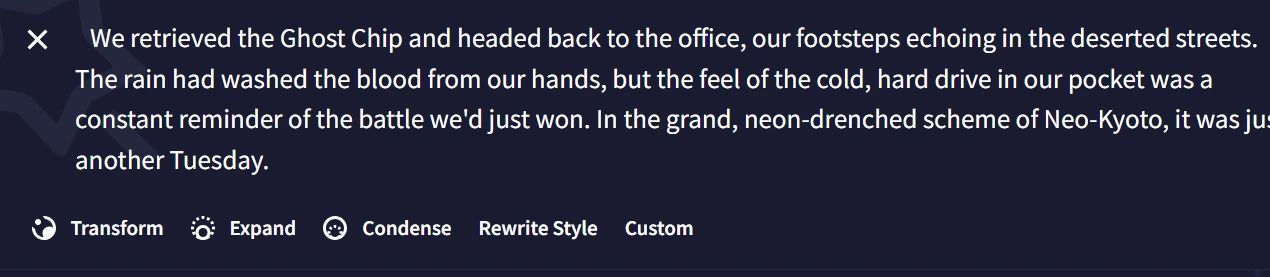
This allowed us to manipulate the text in real-time, ensuring that every sentence served the story's grim, cyberpunk soul. Based on our testing of these controls:
- Transform: This tool acted as our primary stylistic filter. If a paragraph felt too dry, we could transform it into something more descriptive or evocative.
- Expand and Condense: These were essential for controlling the pace. We used Expand to dive deeper into the sensory details of a neon-drenched alleyway and Condense to tighten the dialogue when the action began to heat up.
- Rewrite Style: This allowed us to shift the perspective or the "voice" of a section instantly. If the AI’s output felt a bit too modern, we could rewrite it to better fit the noir aesthetic of Neo-Kyoto.
- Custom: This gave us the freedom to give the AI specific instructions on the fly — such as "make this more cynical" or "add more technical jargon"— without having to rewrite the whole section ourselves.
Trust, Privacy, and Data
NovelAI is recognized for its rigorous stance on privacy and user data ownership. Their documentation and Terms of Service emphasize a "zero-knowledge" philosophy where your creative work remains entirely your own and private by default.
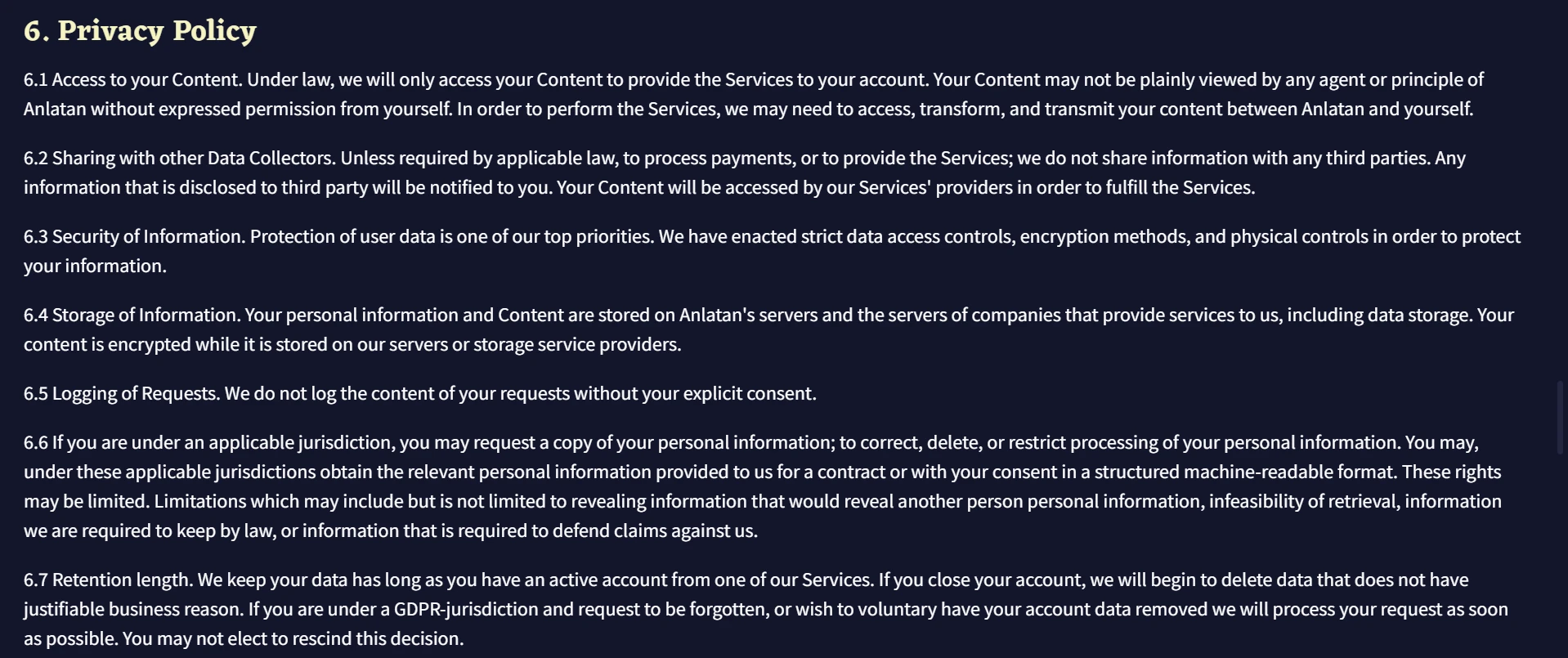
The cornerstone of NovelAI’s trust model is that content is encrypted using a key derived from your email and password. They also claim to take a clear legal stance on the rights to the content you generate. You retain ownership of all content you create, including both text and images.
A common concern with AI platforms is whether user inputs are used to "train" the model for others. To that end, NovelAI claims not to use your private stories, Lorebook entries, or prompts to train their global models.
Pricing
Paper Tier (Free Trial)
- Text: 50 free generations (requires email verification).
- Images: 30 free generations (up to 1024x1024 resolution).
- Text-to-speech: 100 free generations.
- Carry-over: All stories and settings do indeed carry over once you subscribe to a paid tier.
Tablet Tier ($10 USD/mo)
Tablet constitutes the entry-level paid plan, with unlimited text generation and a larger context size.
- Text & TTS: Unlimited generations.
- Memory (Context Size): This provides 8,192 tokens (roughly 16,384 characters).
- Anlas: 1,000 monthly refill (only refills up to 1,000; it does not stack).
- Models: Primarily grants access to the Kayra model.
Scroll Tier ($15 USD/mo)
The "middle ground" Scroll tier is specifically designed for better story memory.
- Memory (Context Size): This provides 12,288 tokens (approximately 24,576 characters), allowing the AI to remember much more of your previous chapters than the Tablet tier.
- Anlas: 1,000 monthly refills.
- Models: Includes access to Llama 3 Erato, a very capable storytelling model.
Opus Tier ($25 USD/mo)
Opus is the flagship tier where the most significant updates have occurred in 2026.
- The Xialong Model: Opus users have exclusive access to Xialong, a massive 355-billion parameter model that is currently the most advanced storytelling engine on the platform.
- Memory (Context Size): The context window has been refined to 28,672 tokens. This is the highest available, ensuring the AI rarely forgets lore details or character names.
- Unlimited Images: Your note about "Anlas-free" images is correct. You can generate normal-sized images (one at a time, 28 steps or less) for free.
- Anlas: 10,000 monthly refill (refills your balance to 10,000).

One of the most refreshing aspects of the subscription model is the peace of mind that comes with flat-rate pricing. Unlike other platforms that charge per word or per generation, NovelAI’s structure allowed us to write for hours without the constant "meter-watching" that often kills creative momentum. We didn't have to panic about the cost of a long editing session or feel hesitant to experiment with multiple drafts of the same scene.
User Sentiment
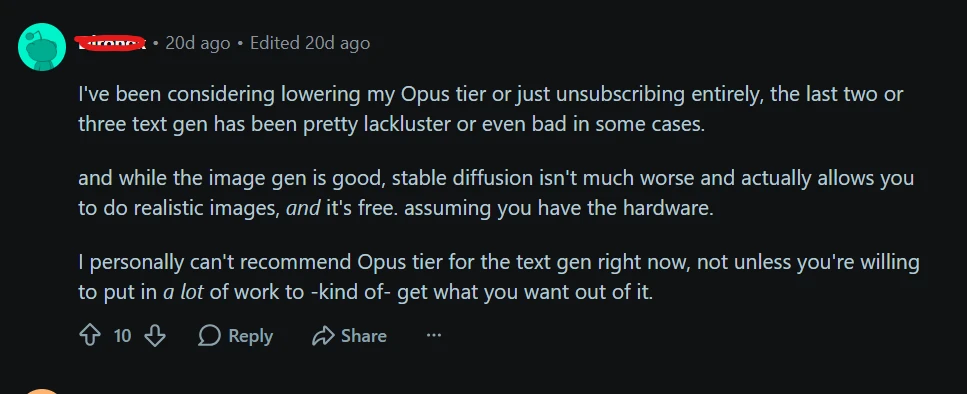
NovelAI maintains a highly engaged and loyal community, primarily centered around its active Reddit and Discord servers. Users frequently praise the platform for its "no censorship" policy and its commitment to privacy, which allows for total creative freedom without the fear of content filters.

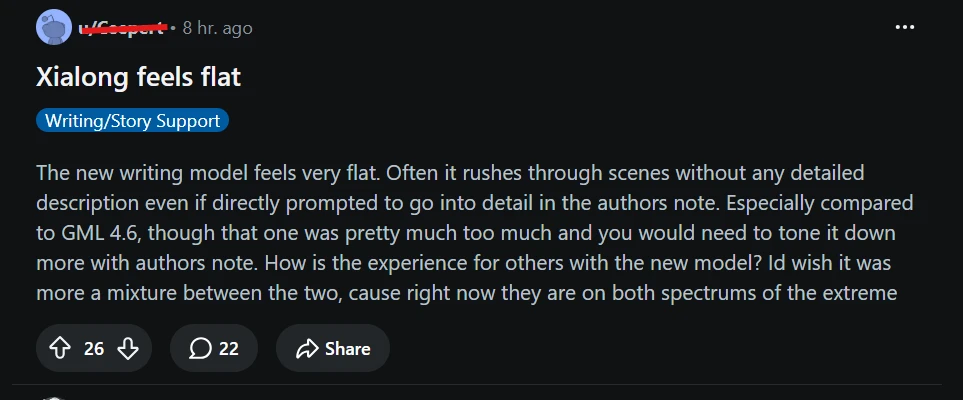
However, the platform’s Xialong model is occasionally critiqued for its "pacing" issues, where it tries to rush toward a story's end. Users frequently report that the model skips critical scene descriptions, ignores established context, and rushes through scenes without any detailed description.
Beyond pacing issues, users also expressed concerns over the NovelAI image generation that often struggles with specific aesthetics, particularly when users move away from its core anime-focused training data. While the platform excels at high-quality anime and digital art, it often fails to capture more specific "vibes" such as grit, semi-realism, or moody atmosphere, as we noticed in our own testing. Sudowrite does a better job in image creation, capturing specific aesthetics and creating semi-realism.
Pros
- The Lorebook System: Similar to a Codex, this serves as our "source of truth." It allows us to define characters like Elias and Madame V, and locations like the Blue Lotus, ensuring the AI maintains strict continuity across chapters.
- Privacy and Encryption: A standout feature for our team is the idea of Zero-Knowledge Encryption. Stories are encrypted locally before they even reach the servers, meaning not even the developers can read your work.
- Total Creative Freedom: Unlike other platforms that use heavy content filters, NovelAI is uncensored. This allows us to explore the darker, grittier themes of our story without the AI "moralizing" or refusing to generate content.
- Predictable Flat-Rate Pricing: As we noted, the subscription model eliminates the "panic" of word counts. We could write and iterate for hours without worrying about extra fees or credit depletion for text.
- Advanced "Storyteller" Tools: Features like ATTGS (Author, Title, Tags, Genre, Style) give surgical control over the AI's "voice," allowing us to steer it toward a specific literary tone.
Cons
- Steep Learning Curve: The platform is a "power-user" tool. Mastering the Lorebook or learning how to steer the AI with prose instead of direct instructions takes time to master.
- Environmental Generation Limitations: While the image generator is excellent for characters, it struggles with complex objects or specific settings. As we saw, it defaulted to a sleek sci-fi look rather than the "ancient" atmosphere we wanted.
- Xialong’s Pacing Issues: Community sentiment suggests that newer models like Xialong can sometimes "rush" a story.
- Style Bias: The image models are heavily trained on anime datasets. Achieving a photorealistic or classical "oil painting" look for story art would be difficult.
- Internet Dependency: Being entirely browser-based, if you lose your connection, you’ll lose access to the "brain" of the story.
Alternatives
If NovelAI’s learning curve or specialized focus on character-driven anime aesthetics don't fit your needs, here are three alternatives we’ve considered for our story:
- DreamGen: The best alternative for writers who prioritize interactive roleplay and real-time story steering. It offers a generous free tier, making it accessible for testing ideas before committing. With features like multi-character roleplay and granular control over dialogue and plot direction, it allows us to guide the narrative flow in real-time. It’s an ideal choice for our team as we look for a platform that balances creative freedom with intuitive, collaborative mechanics.
- Sudowrite: Best for writers who want a guided, creative partner for drafting. It features a proprietary Muse model trained specifically on fiction, along with tools like Expand and Describe that help flesh out sparse notes into vivid scenes. Unlike NovelAI, it offers a more structured Story Bible that acts like a project manager for your book, ensuring consistency across long-form projects.
- Novelcrafter: Best for serious novelists who want maximum control and deep organization. It operates on a "Bring Your Own Key" (BYOK) model, allowing you to connect various AI engines (like Claude, GPT-4, or Gemini) to its powerful Codex database. It’s the ultimate infrastructure for managing complex series and dense lore, though it requires a more technical setup than all-in-one platforms.
NovelAI Frequently Asked Questions
Is NovelAI free?
No, NovelAI does not offer a permanent free tier. However, they provide a free trial for both text and image generation upon account registration. This trial includes 50 text actions and 30 image generations (up to 1024x1024 resolution). These credits are provided once, though they may reset them during significant platform updates.
How much does NovelAI cost?
NovelAI offers three monthly subscription tiers designed to fit different creative needs. These are flat-rate plans that provide predictable pricing:
- Tablet ($10/month): The entry-level tier for standard AI access.
- Scroll ($15/month): Provides increased memory for the AI to track longer story contexts.
- Opus ($25/month): The premium tier featuring their most advanced model, Xialong, and unlimited small-scale image generation. Subscribers can also purchase Anlas (their internal currency) separately for extra image generations.
Does NovelAI include AI, or do I pay separately?
The AI is fully included in your NovelAI subscription. Unlike "Bring Your Own Key" platforms, they host their own proprietary API and models. When you subscribe, you are paying for both the interface and the AI processing power combined. You won't receive separate bills from third-party AI providers.
Does NovelAI allow NSFW content?
Yes, NovelAI allows NSFW content. One of their core philosophies is providing a completely unfiltered and uncensored environment. They do not claim ownership of user content, and they do not apply moralizing filters to writing.
Is user data private on NovelAI?
Security is a major focus for NovelAI. It uses local, zero-knowledge encryption, meaning stories are encrypted before they even leave the user's browser. Because of this high level of security, users must guard their login credentials carefully. If a password or email is lost, they have no way to recover the data or reset access.
How We Tested
Test date: 2026-04-27
Plan tested: Opus plan $25/month
We tested NovelAI for about five hours, where we:
- Created one custom story: Developed the cyberpunk narrative set in Neo-Kyoto, focusing on the tension between ancient relics and futuristic technology.
- Tested Image Generation: Used the Nai Diffusion V4 V4.5 Curated engine to generate a visual representation of Elias, specifically testing how the AI handled his features and cybernetic etching.
- Evaluated Text Models: Tested the prose quality and narrative pacing of the Xialong model to see if it could handle the atmospheric, noir tone of our setting.
- Explored Lorebook Functionality: Built out entries for our characters and the Blue Lotus to ensure the AI maintained continuity during our writing session.
- Reviewed User Sentiment: Analyzed community feedback regarding the "speed" of Xialong and the shift in development philosophy since the Kayra era.
- Reviewed Security Protocols: Evaluated the implementation of local, zero-knowledge encryption and the practical implications of their "no-recovery" password policy.
Note: We did not test the Tablet ($10/month) or Scroll ($15/month) plans.
Last updated: April 29, 2026.