· 14 min read
RedQuill Review: Hands-On Testing, Memory, & Our Verdict
Our hands-on RedQuill review covers pricing, the unique "Components" system, NSFW freedom, and real user feedback.
Is RedQuill Worth It?
RedQuill is an erotic AI story generator designed for creators who want to build spicy stories without the restrictions found in general-purpose AI models. It uses what it calls "Components" to stack writing styles, tropes and plot devices into your story like building blocks.
While the platform has an impressive community surrounding it, the Quill credit system and frequent bugs were serious concerns during our testing. That currency can quickly feel like a direct inhibitor to creativity, often paywalling a story mid-scene because the day’s credits are exhausted. Technical issues like slow loading and random logouts also occasionally disrupted our testing.
Best for: Creators who enjoy community interaction, writers who prefer guided systems over complex prompt engineering, and those seeking quick, high-quality erotic fiction.
Not ideal for: High-volume novelists who are looking for unlimited story generation.
Standout strength: The "Remix" and "Components" features. You can take a community-made story and spin it in your own direction with specific trope IDs in what feels like a collaborative workshop.
Main tradeoff: The credit system. Most actions, including options as critical as rewriting, cost credits, which can be restrictive for power users who are used to flat-fee subscriptions.
At a Glance
Free tier | Yes. Allows limited daily story generations. Users typically receive 5 Quills. |
Premium tiers | Subscription plans range from $13 to $27 per month(see Pricing section for more.) |
Platforms | Web-only |
Community | Discord (invite-only), Reddit (>1000+ members) |
NSFW | Fully supported. RedQuill is a pro-NSFW platform that explicitly brands itself on creative freedom. |
What Is RedQuill?
RedQuill is an AI writing platform specifically designed for fiction writers who want to explore romance, fantasy, and explicit themes without the moral lecturing of mainstream AI. RedQuill’s own FAQ describes itself as being built for “no filters, no judgement.”
Unlike systems that require technical setup or API keys, RedQuill instead offers a plug-and-play experience where you can start a story within seconds using pre-made community prompts.
Our Writing Experience With RedQuill
To test RedQuill’s capabilities, we spent several hours on the platform and selected a community-curated prompt to create an explicit story we titled: Professor's Punishment Ends in Messy Face. We wanted to see how the AI handled building tension, following specific "spice" instructions, and maintaining the narrative flow.
During the test, we focused on:
- How smoothly the AI picks up community prompts.
- The effectiveness of the levels (we set it to Spicy).
- The Components feature for adjusting prose style
- Overall writing quality and sensory descriptions.
- The reliability of the system.
Our Custom Story: Professor's Punishment Ends in Messy Face
In the next few sections, we will walk through how the different features performed during our initial testing.
Language Selection
For our test, we started by selecting the primary language for the story. RedQuill provides a dropdown menu with several language options, including English, Mandarin, Spanish, French, and German.
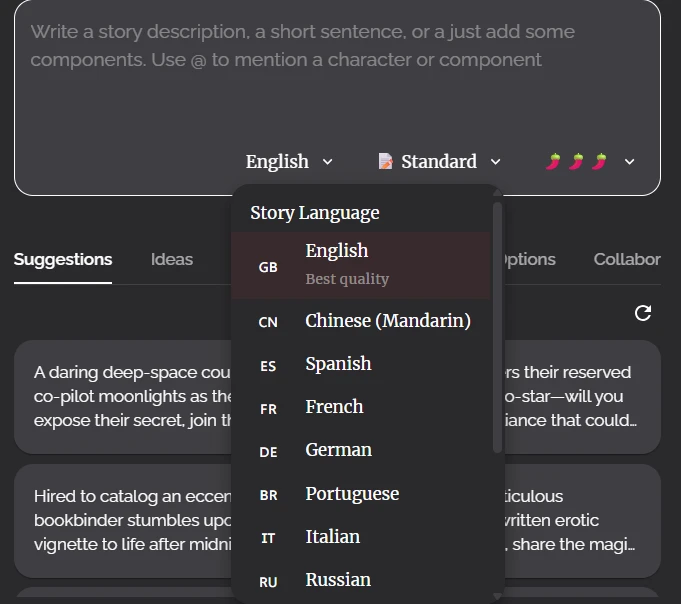
We opted for English, which the platform labels as having the best quality for narrative generation and nuance.
Lorebook
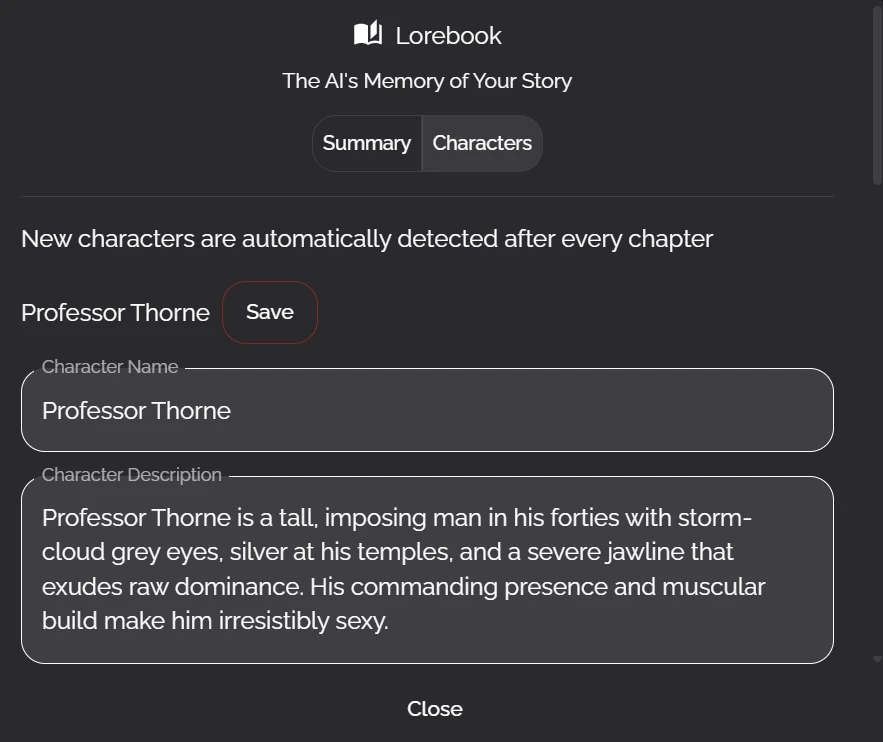
RedQuill subtitles the Lorebook as "The AI’s Memory of Your Story." We used it to store essential details about our storyline and characters, with an eye on seeing if it’d maintain long-term consistency.
Our first entry focused on Professor Thorne, a central figure in our narrative.
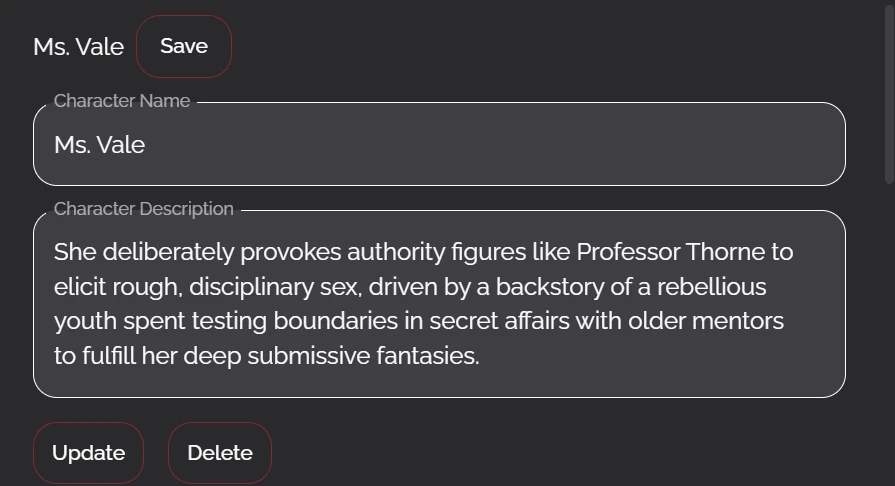
We also added a profile for Ms. Vale, the student who visits the Professor in his office.
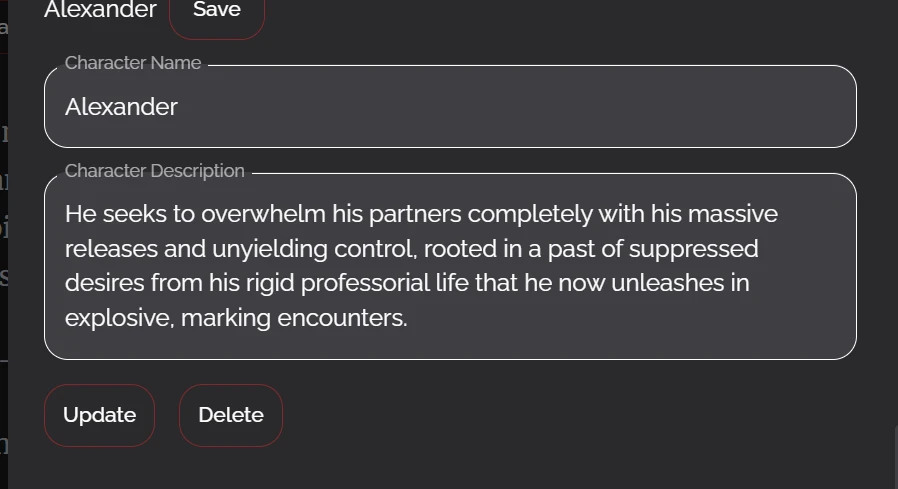
To test the system's depth, we assigned the Professor a middle name — Alexander — to see if the tool would remember the finer details and naturally integrate it into the story as the chapters progressed.
First Chapter Length
After setting our language and filling out our story’s Lorebook, we moved on to determine the length of the opening chapter. They offered a tiered selection for chapter generation, starting with "Empty" for those who want to start without AI-generated text and kick things off themselves. The "Standard" option provides a typical scene length, while "Novella" offers deeper immersion at a cost of 2 Quills.
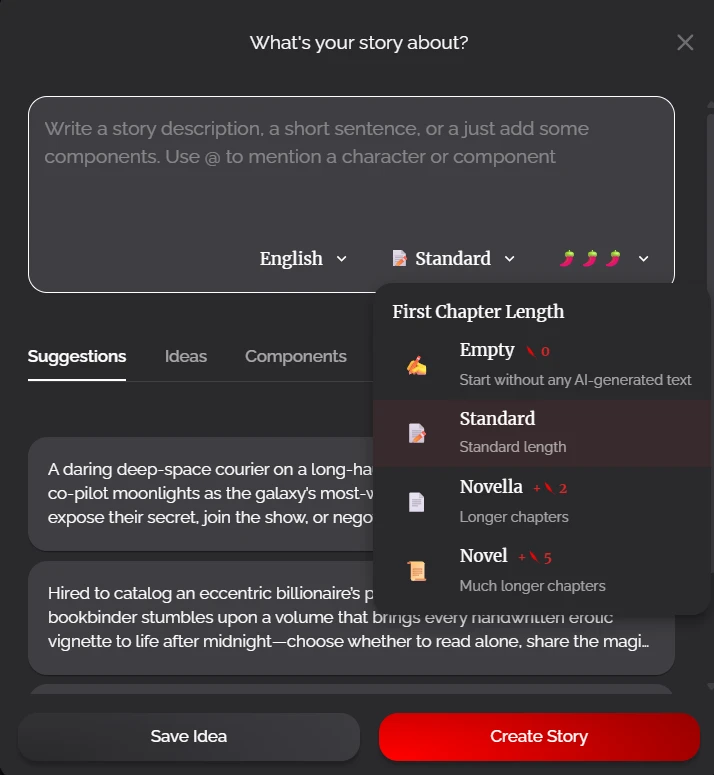
For our test, we selected the Novel length, which is designed for much longer chapters and consumes 5 Quills. For the 5 quills, we got approximately 1600 words. The numbers don’t seem to be standard, but they range between 1600-1700 based on our subsequent generations.
Characters
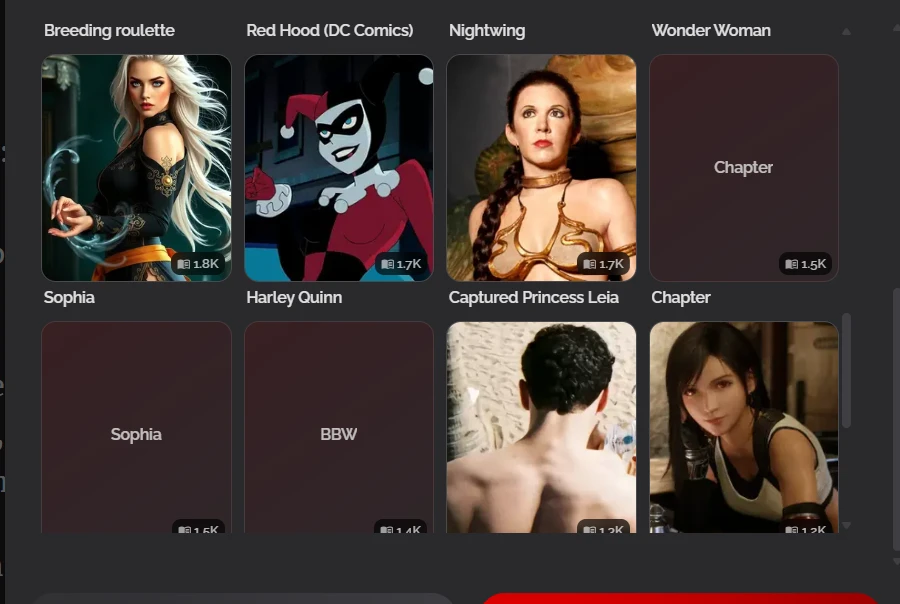
We explored the Characters tab, which functions as a library of pre-set trope and behavioral building blocks. Instead of traditional character bios, this section presents a wide array of specific narrative descriptions and physical scenarios that you can plug directly into your story. These range from personality traits to very specific, high-intensity tropes common in adult fiction. By selecting one of these community-curated components, you are essentially giving the AI a blueprint for the scene's climax or a character’s specific reaction.
For our test, we selected one of the more provocative physical tropes to see how naturally the RedQuill Engine would integrate it.
The Components Feature
To further customize the AI's output, we checked out the Components feature. It offered a set of stylistic toggles that we used to guide the AI on specific writing styles, tropes, and plot devices.
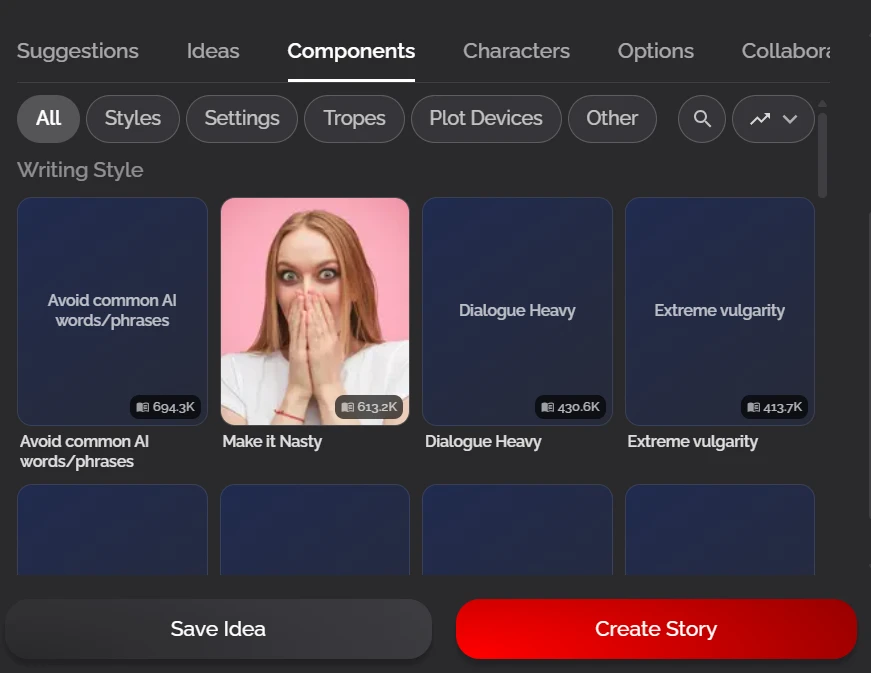
For our story, we specifically enabled the "Make it Nasty" component to see if the AI would lean into the explicit and provocative tone we were looking for. You can actually pick multiple Components to spice up your story even more.
Collaboration and Community Features
We also noticed a Collaboration feature which showcased a list of "active writers" open to co-authoring projects.
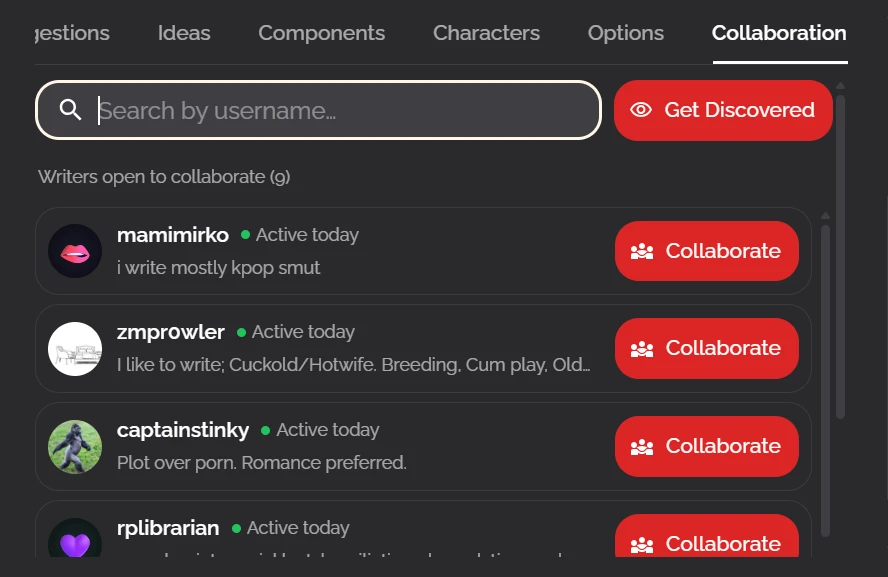
For the purposes of this specific test, however, we opted not to use this feature, focusing instead on the solo generation and steering capabilities of the AI engine.
Text-to-Speech
We also tested RedQuill’s text-to-speech feature, which allowed us to transform sections of our story into narrated audio. The platform offers a variety of voice profiles such as "Velvet," "Raven," and "Mischief" for female voices, or "Chase" for male narration. Each voice can be previewed before committing to a full generation.
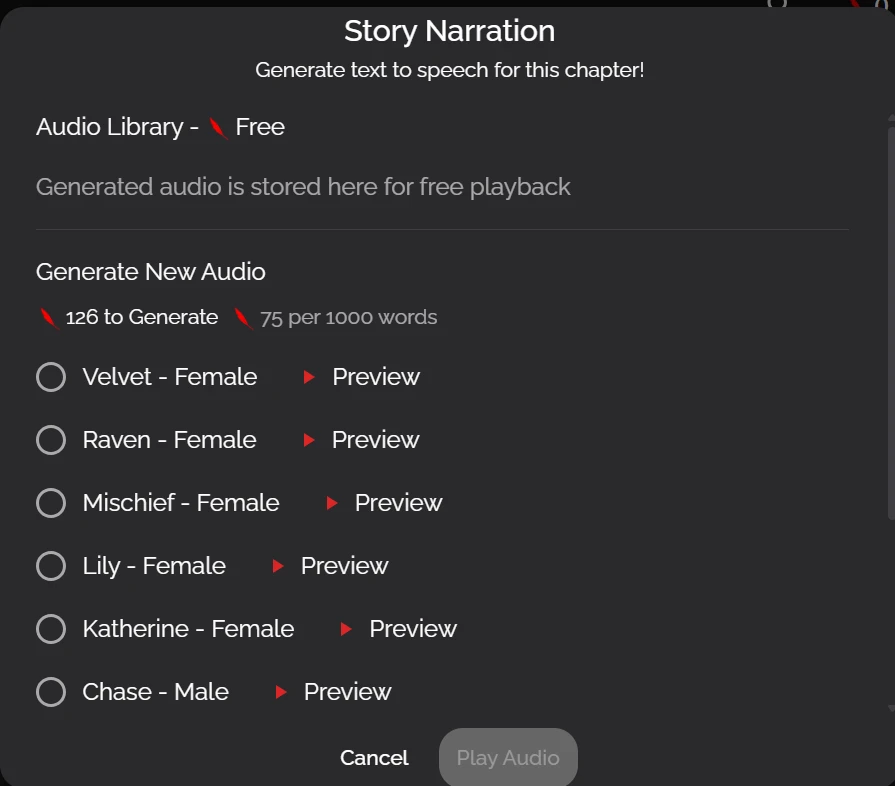
However, much like the narrative generation itself, this feature is tied to the platform's credit system. Generating new audio costs 75 Quills per 1,000 words, making it a premium addition to the writing process. While the feature is impressive with good voices that match your story, the high credit cost means users must be strategic about which chapters they choose to hear aloud.
Image Generation
To test the image generation capabilities of RedQuill, we created a cover image for our story. The AI's output was fairly good, delivering a photorealistic style. 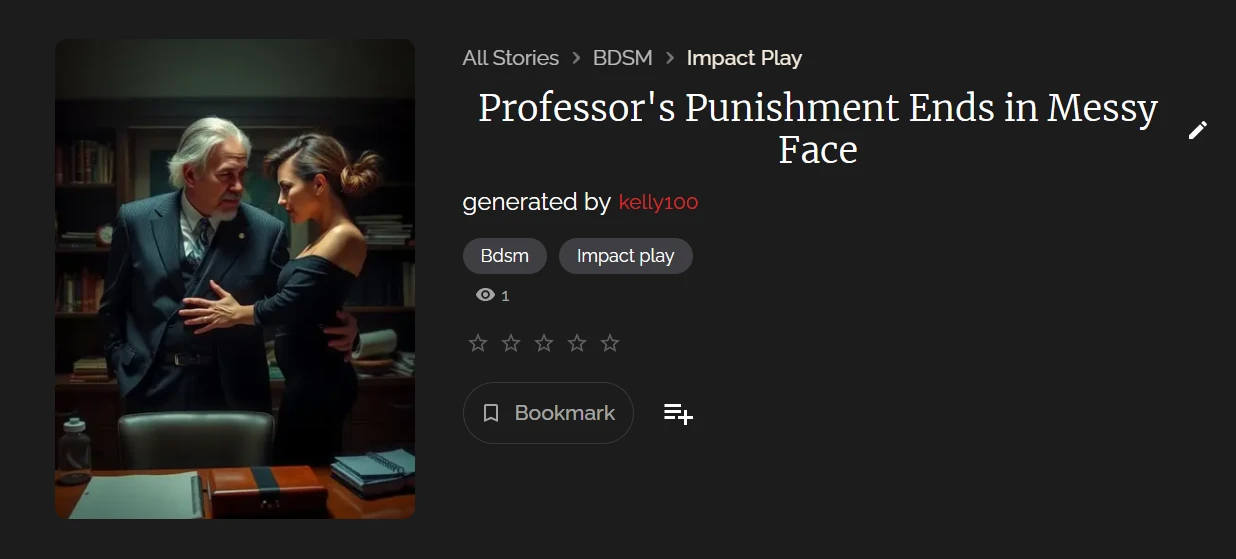
While it didn't completely capture every detail we envisioned, the output captured the nature of our story fairly well. There’re two image generation options. You can let the tool generate it automatically or you can describe what you want created.
Writing Quality and Integration
After getting everything we needed and testing some of the special features, we started the story generation process. Unlike platforms like Novelcrafter, which require users to manage their own API keys and technical configurations, RedQuill operates as a closed-loop system. It uses a Quill credit structure where your subscription covers all the under-the-hood AI costs. This eliminates the need for external billing or technical setup.
The actual generation process is built around a streamlined user interface. Once your settings are locked in, you just click the "Create Story" button and off you go. The story then progresses in discrete blocks, allowing you to review the AI's output in real-time.
To kick off our testing, we began by loading a community-curated prompt directly into the editor. This allowed us to evaluate how effectively the engine could interpret pre-existing story hooks and align its initial output with our specific established tone.
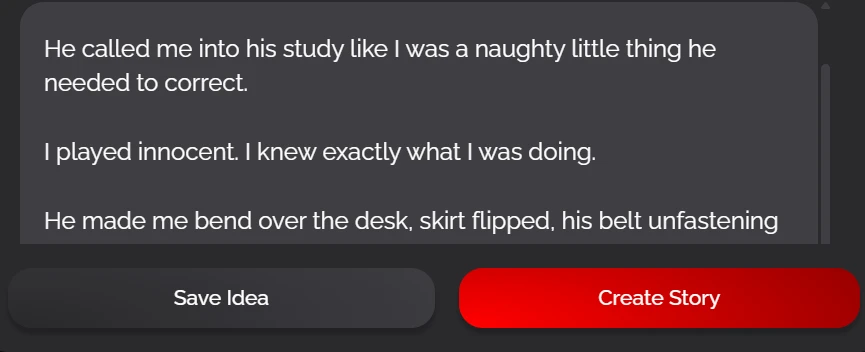
We noticed a roughly 10-second loading period before the engine kicked in, likely as it aligned the narrative with our selected Components. Once it started, however, the AI picked up well, sticking closely to our prompt without deviating. It successfully balanced the specific power dynamics and environmental cues we provided, resulting in a cohesive and well-paced opening.
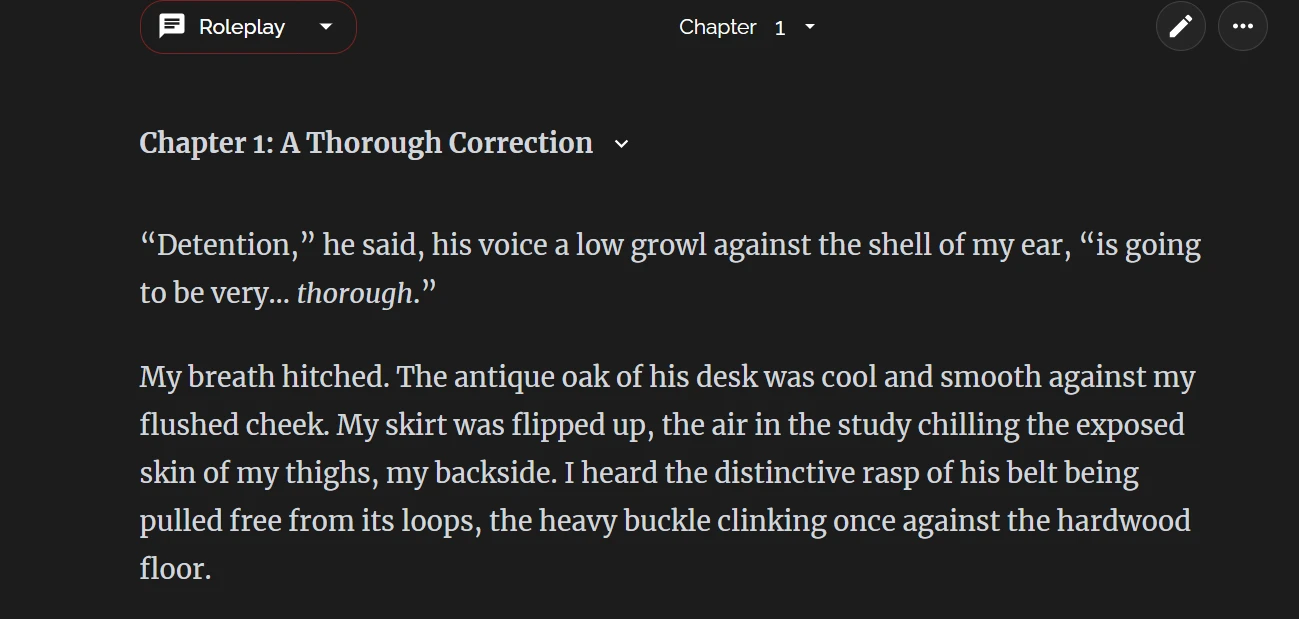
Rather than forcing explicit content from the very first sentence, the AI demonstrated a reasonable level of restraint and pacing. It allowed the tension to build naturally before shifting into the more provocative tone dictated by the Component.
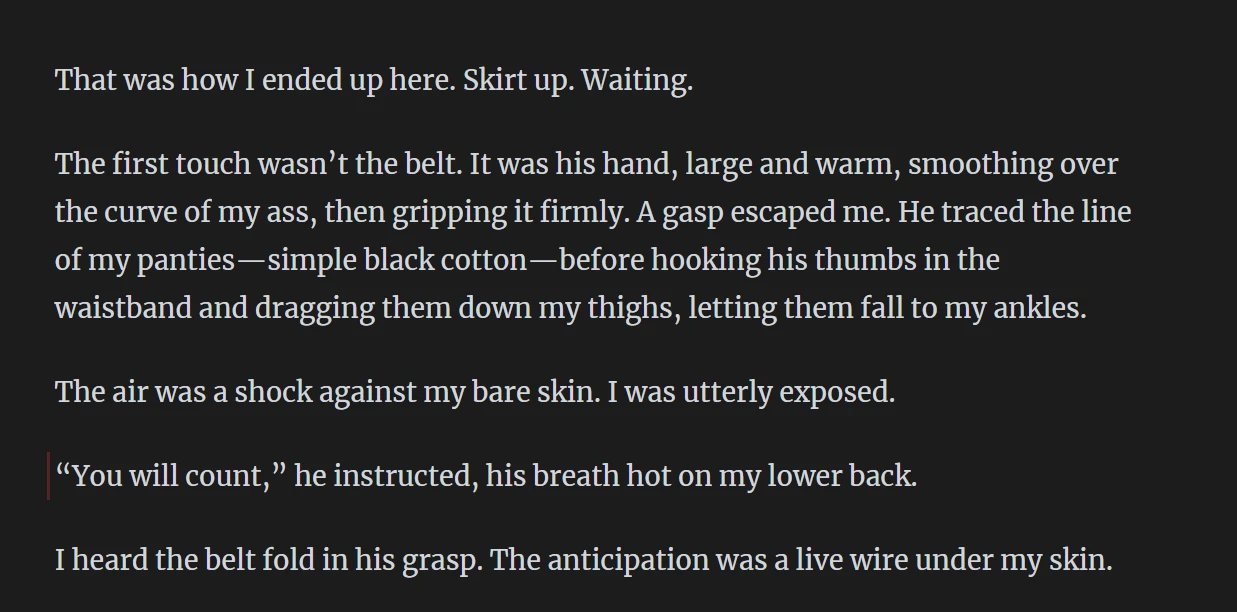
As the story progressed, the AI correctly identified the primary names for Professor Thorne and Ms. Vale. However, what actually impressed us was its ability to also grab the Professor's second name, Alexander, from the Lorebook.
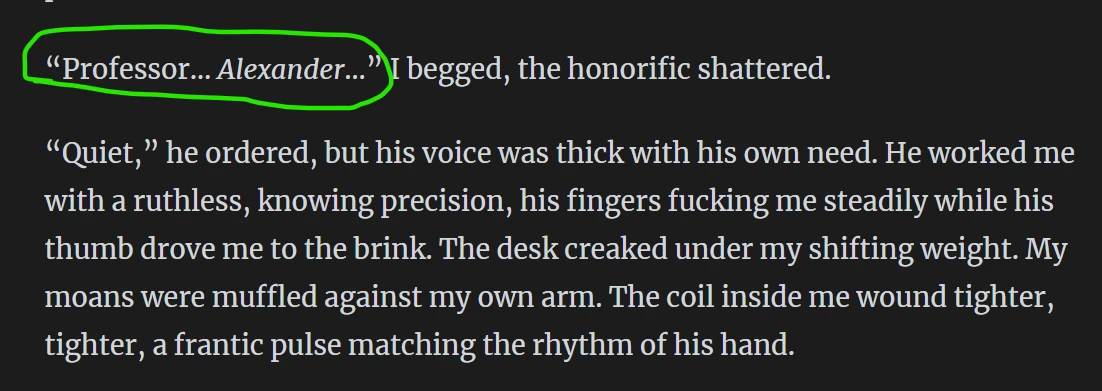
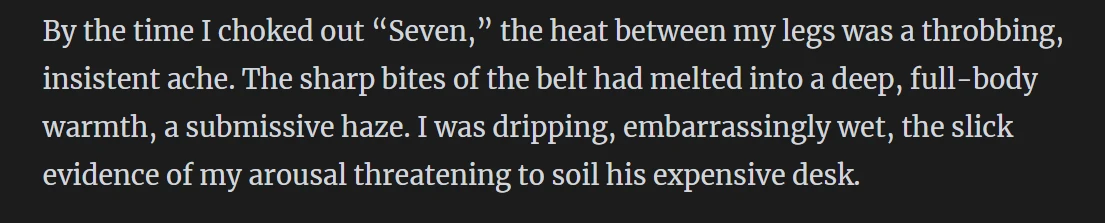
We pushed further and the story got more, well, interesting. The platform didn’t hold back when it came to describing explicit scenes with strong erotic descriptions.
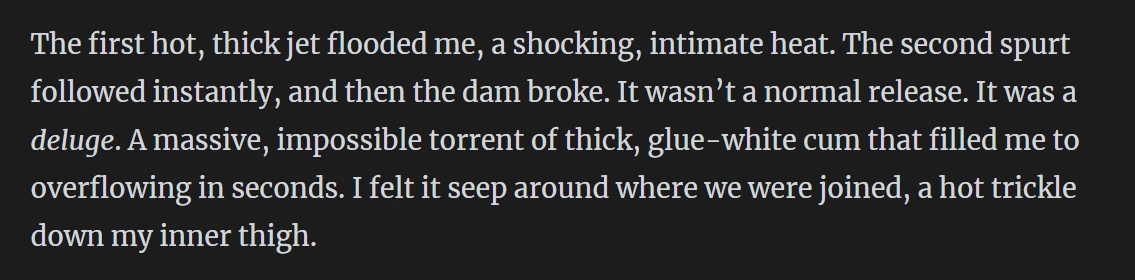
We were particularly keen to see how the AI would integrate our selected component into the flow of the story. It did it perfectly towards the end of the spicy encounter between Professor Thorne and Ms. Vale in the office.
As we continued through the subsequent chapters, the platform maintained an impressive narrative cohesion. Despite the increasing complexity of the plot, the tool remained consistent with our established lore, successfully tracking the evolving relationship between the characters without losing sight of their core traits.
However, that’s not to say it was a perfect first draft. We definitely had to rewrite some sections and steer it towards our desired direction — not by the AI’s mistake, but more a process of refinement.
One major issue that we noticed was the fact that the trope we chose kept being referenced in every scene. What that likely means for the platform overall is that you’d need to make quite a few adjustments to avoid scenes sounding repetitive.
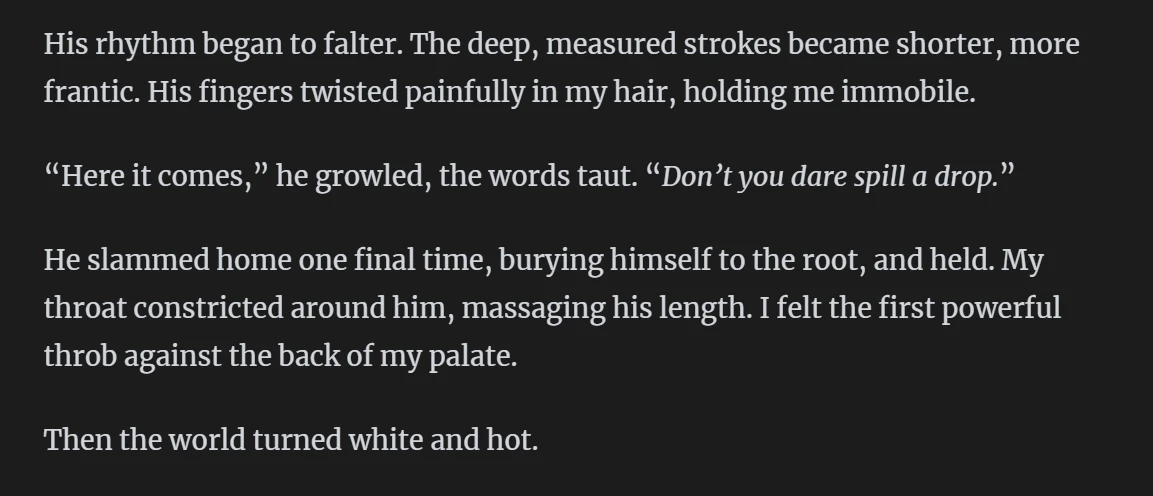
Overall, our writing experience was fairly impressive. RedQuill proved that it could excel in NSFW storytelling, maintaining good tonal consistency and character voice over extended sequences where general-purpose models often falter.
While we were impressed by the unfiltered creative freedom, the rigid credit system and recurring technical bugs proved to be significant hurdles. During our testing, we were occasionally "booted" from the system without warning, requiring us to log in afresh and disrupt our creative flow. We also exhausted our day’s Quills for the first day as we were testing the different functions, despite being subscribed to the pro plan.
To ensure this wasn't an isolated experience, we cross-referenced community discussions on Reddit and found that these session timeouts and stability glitches are a frequent topic of conversation. Other users have echoed our frustration, noting that these bugs — paired with the daily credit reset — can make the platform feel more like a work-in-progress than a polished tool.

We concluded that RedQuill is an impressive narrative engine trapped inside a sometimes frustrating platform. The prose quality is good, but the user experience remains mixed until the stability and credit issues are addressed.
UX Controls and Features
RedQuill offers a set of UX features that allow for real-time adjustments to the AI-generated text. They allow the writer to rewrite if the initial output feels repetitive, extend If a scene ends too abruptly, or reimagine if they want to completely change the direction or style.
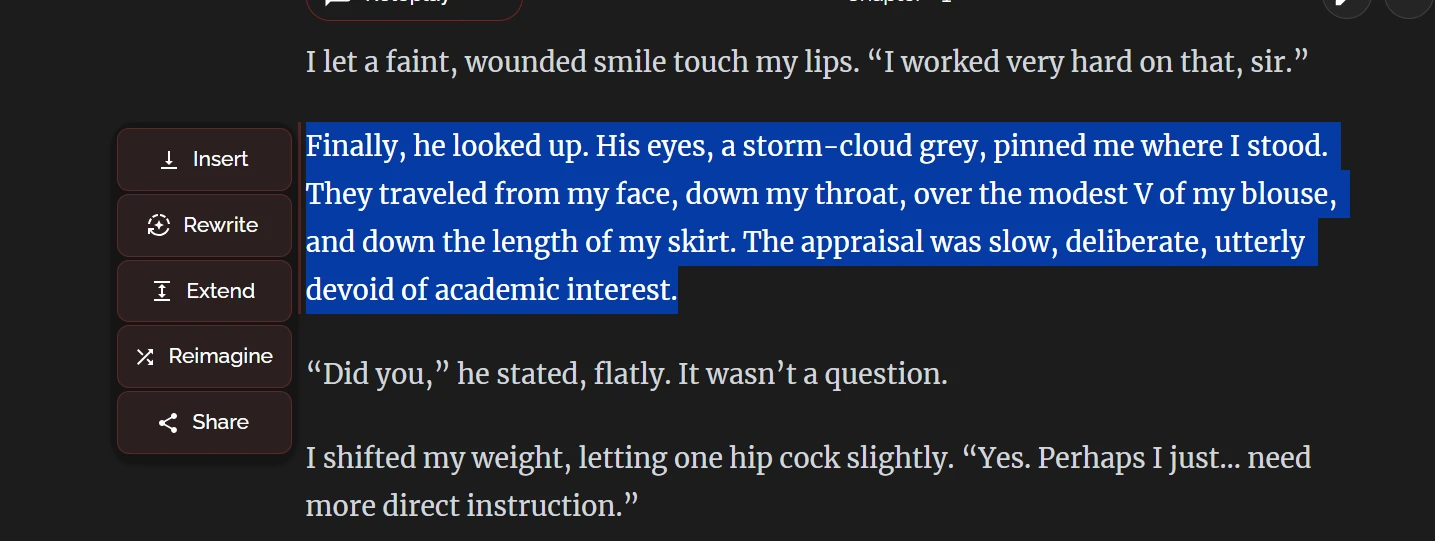
During our test, we found these controls to be reliable, though they do consume Quills. Due to frequent repetition of some of the tropes we had chosen, we had to use the rewrite function to make adjustments and steer our story towards the desired direction.
Trust, Privacy, and Data
RedQuill’s privacy policy emphasizes a "stories are yours" philosophy, which is a major draw for the NSFW and creative writing community. They also maintain that they do not use private user generations to train their public models, ensuring your unique plot twists and characters remain your intellectual property. However, the platform has faced some scrutiny regarding its technical stability especially with the frequent bugs.
Pricing
RedQuill has numerous pricing plans, laid out on its official pricing page:
Free Tier
RedQuill offers a free tier that grants users just 5 Quills. These credits are intended for performing basic generation tasks. They reset every 24 hours and do not roll over.
Paid Plans
- Basic ($13/month): This plan is designed for casual writers, offering a set daily allowance of 80 Quills. It includes standard access to the story generator and basic community features.
- Pro ($15/month): Marketed as the best value for frequent users, this plan increases the daily limit to 150 Quills. It also unlocks advanced creative tools and prioritized processing for faster story generations.
- Premium ($27/month): This high-volume tier is built for power users and professional-level fiction creators, providing 300 Quills per day. It includes all the features of the Pro plan along with the priority access to the narrative engine.

In our testing, we found out that unlike other platforms like DreamGen that offer a monthly bucket of credits to use at your own pace, RedQuill uses a strict daily limit system. This means your credits reset every 24 hours and do not roll over to the next day. If you have a busy Tuesday and only use 10 of your 150 Pro Quills, those remaining 140 credits simply vanish at midnight, rather than being available for a longer writing session on Wednesday.
This structure creates a rigid environment that often clashes with the natural flow of creative writing. Writers who prefer "binge writing" — spending an entire weekend finishing a novel — will find themselves hitting a hard wall once their daily allowance is spent, regardless of how many credits they hypothetically "saved" during the week.
User Sentiment
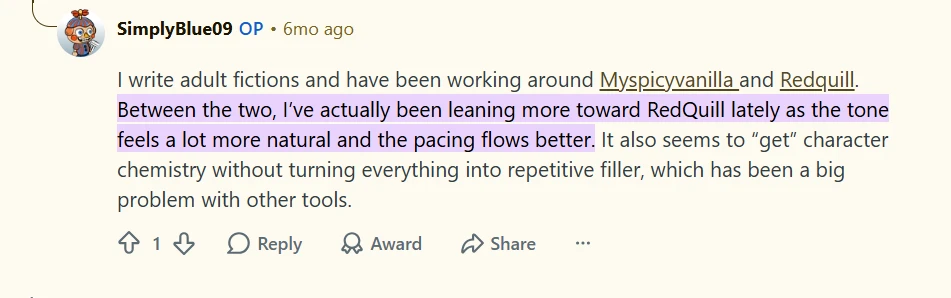
To get a true sense of the RedQuill experience, we explored community discussions and analyzed user feedback. The general sentiment is a mix of high praise for the platform's freedom and natural pacing as well as significant frustration regarding its technical stability and credit structure.
On the positive side, users praise the platform for natural flow and reasonable pacing.
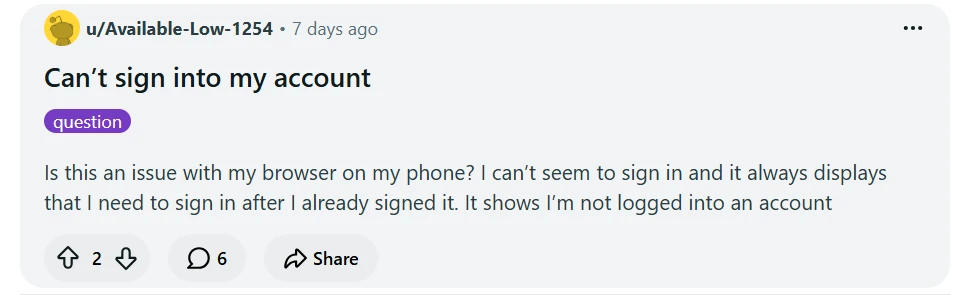
Others express frustration with the platform's stability. Many users have reported being logged out during writing sessions, often without warning. This is more than just a minor inconvenience. Because RedQuill is a web-based editor, these sudden session timeouts can lead to a loss of unsaved work. It’s also an issue we encountered in our testing process, as mentioned above.
Beyond the technical glitches, the Quill system itself is a major source of frustration for the RedQuill community. Users have frequently expressed dissatisfaction, arguing it disrupts the creative process and make the service feel more expensive than it initially appears.
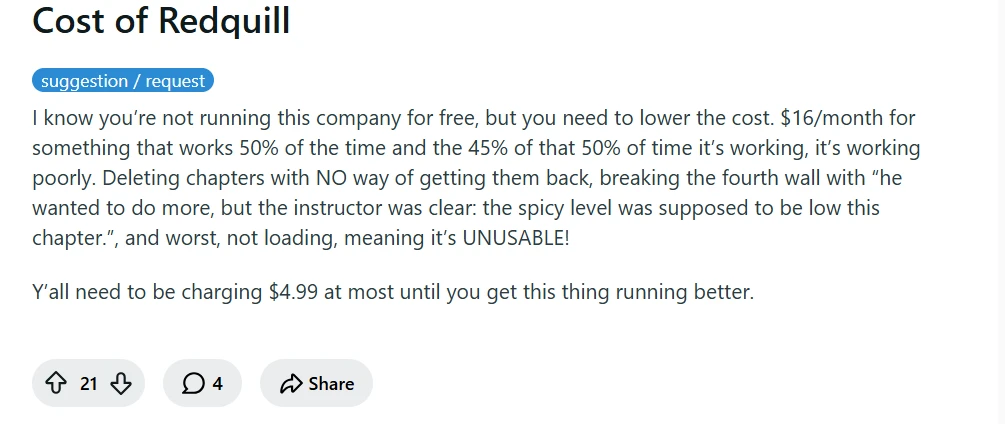
In our testing, we found that the platform is excellent for NSFW writing and lives up to its promise of being unfiltered. However, we also encountered some of these challenges, especially when it came to the platform's stability and the logistical hurdles of the Quill system.
While the unfiltered creative freedom is RedQuill's biggest win in our books, the user experience can feel like a series of tradeoffs. The bugs and unfriendly Quill system were significant friction points.
Pros and Cons
Pros
- Unfiltered Creative Freedom: In a market dominated by "preachy" AI, RedQuill is a sanctuary for NSFW, spicy, and dark fiction.
- The Components System: This is arguably the platform's best feature. It allows you to layer specific writing styles, plot devices, or tropes to guide the AI with much more precision than a standard prompt.
- Collaboration and Community: You can "remix" stories from other creators or use the collaboration feature to co-write with others, adding a social layer to the creative process.
Cons
- Restrictive Quill System: The "use it or lose it" daily credit limit is a major pain point. Credits reset every 24 hours and do not roll over, which punishes binge writers who prefer long, infrequent writing sessions.
- High Feature Costs: Premium actions drain Quills fast. A Novel-length chapter costs 5 Quills, while Text-to-Speech narration can cost a staggering 75 Quills per 1,000 words.
- Technical Stability Issues: The recurring logout bug is a serious concern. Sudden session timeouts can lead to a loss of work, and the platform lacks the robust autosave features found in competitors like Novelcrafter.
Alternatives
If RedQuill’s daily credit limits or technical stability issues are dealbreakers for you, here are three alternatives that you can consider:
- DreamGen: DreamGen is the best alternative for writers who want a free tier and absolute narrative control. It has features like real-time story steering and the Scenario Codex, where you can manage complex lore and character interactions. It is also unfiltered and offers a roleplay-style interface that allows you to direct the AI's next move with specific instructions.
- Sudowrite: Sudowrite is a good alternative for writers who want a dedicated creative partner for long-form fiction. It has features like Story Engine, Describe, and Rewrite that help you turn simple scene beats into immersive prose. Unlike RedQuill's daily reset, Sudowrite uses a monthly word count system, making it much more flexible for "binge writers" who prefer long weekend sessions.
- NSFW Story: NSFW Story is a purely NSFW platform that allows users to generate tailored erotic stories by adjusting intensity, prose style, and specific thematic elements. Beyond simple text generation, it provides different character management and output formats.
FAQ
Is RedQuill free?
RedQuill offers a free tier that gives users 5 daily Quills. These credits reset every 24 hours and do not roll over, allowing for very basic testing or short scene generations.
How much is RedQuill?
RedQuill offers three main paid plans:
- Basic ($13/month): Includes 80 daily Quills.
- Pro ($15/month): Includes 150 daily Quills and prioritized processing.
- Premium ($27/month): Includes 300 daily Quills and the highest priority access.
Does RedQuill include AI, or do I pay separately?
RedQuill is an all-in-one platform. Your monthly subscription covers both the writing interface and the cost of the AI generations, so you do not need to provide your own API key or pay an external provider.
Does RedQuill allow NSFW content?
Yes, RedQuill is specifically designed for creative freedom and does not apply content filters to your stories, making it a popular choice for romance, horror, and dark fantasy writers.
How We Tested
- Test Date: 2026-05-06
- Plan Tested: Pro Plan ($15/month)
- Process: We spent several hours testing the RedQuill Narrative Engine, specifically focusing on character consistency, component integration (like "Make it Nasty"), and the text-to-speech feature. We also analyzed community feedback regarding technical stability and the credit system.
Note: We did not test the Basic plan ($13/month) or the Premium plan ($27/month) during this review session.
Last updated: May 6, 2026.