· 17 min read
Talefy AI Review: Hands-On Testing, Features, Limitations, Pricing & Our Verdict
We spent several hours testing Talefy AI. Our hands-on review breaks down memory retention, NSFW access, pricing, and unique features.
Quick Verdict
Talefy AI is a web-based interactive storytelling AI platform that blends stories with real-time visuals and pictures. Unlike other chatbot platforms where users roleplay with AI characters, Taelefy AI works by giving users choices that drive the direction of the story.
- Best for: Creative writers and users who love guided and interactive stories with visuals and different narratives.
- Not ideal for: Users who want complete control over the story’s direction or advanced customization tools like lorebooks, scripting, and API integrations.
- Standout strength: High-quality AI-generated visuals that immerse users in the stories and paint the scenes vividly.
- Main tradeoff: The platform has heavy narrative railroading, where no matter what choice you make, the AI steers you towards the direction of the initial story plot, limiting your creativity. The Free tier is also very limited. You can only explore about 5 chapters before you get locked out and need to buy coins to continue your story.
At a Glance
Free tier | Yes — limited access with no included coins. |
Premium tiers | Range from $29.99-$99.99 offering more coins and unlimited stories (see Pricing section for more) |
Platforms | Android on Google Play Store with a rating of 2.6/5★, iOS on Apple Store with a rating of 3.4/5★, and a web-based version (Talefy.ai) |
Community | Discord (~700 members) and X (Twitter): ~1.1K followers. |
NSFW | Talefy AI allows NSFW content for users older than 18. |
Story library | 200+ community-created stories. |
Memory | Inconsistent. In two out of the three stories, the AI failed to remember the planted details. |
Image generation | Available. The story creates pictures for you, but if you want a custom image, you’ll need 5 Talefy coins. |
Text-to-speech | Not available. |
What Is Talefy AI?
Talefy is an interactive storytelling AI platform that allows users to create AI-generated stories where their choices shape the narrative.
The platform is built by AIceberg Labs, and it combines text and images to make the stories more immersive. Unlike chatbot platforms where you chat with specific AI characters, Talefy uses a step-by-step system where you influence how the story unfolds by choosing from four options. You also have the option of adding a custom action in case you don’t like any of the four options. Users can also either explore the premade stories or build their own stories on the platform.
Our Roleplay Experience with Talefy AI
We spent about five hours on Talefy AI, testing three stories on the Free tier and on the Talefy Spark plan.
- The Reunion Affair — A dramatic story about a successful tech CEO, Emily Clarke, wondering whether she should attend her high school reunion and meet the former soccer captain, Michael Lawson. Back in the day, she was a shy nerd, but later she bloomed into a confident and sexy woman who’s well-known in the tech world.
- The Things Love Can Cure — We wanted to test how the AI handles diversity, so we chose this LGBTQ+ story featuring a prince and a stablehand. When the king’s life is in danger, the two have to leave the castle to find a cure, and for the first time in years, they get a chance to be together without prying eyes watching them.
- Project Abyss (Custom Story) — This is the custom story that we made. Dr. Thorne is a marine biologist who swears that mermaids exist, but no one in his field takes him seriously. So, he sets out on a quest to the Pacific Ocean to find proof of the creature’s existence.
For each story, we completed 30-40 story actions and choices. During the session, we tested memory retention, steerability, response speed, and overall conversation quality.
Overview
The factors that we considered when evaluating and testing the stories are:
- How fast does the AI respond?
- Can the AI remember planted details after roughly 20 story actions and choices?
- How realistic are the image and voice features?
- Does the AI respond well to direction?
We were excited to test out this platform and shape our own stories, but our excitement quickly dimmed. The response generation was quite slow compared to other platforms, as it took about 10 seconds to generate. Plus, we quickly realized that our story choices were all but an illusion.
No matter what choices we made, the AI would find a way to redirect us to the original plot, almost as if there was a predefined end to begin with.
On the plus side, the memory performance was consistent, and the blend of pictures and vivid descriptions immersed us in the stories.
Story 1: The Reunion Affair (Premade)

Most, if not all of us, have ever seen this ugly duckling transforming into a beautiful swan trope. It was thus no wonder that it was among the top featured stories on Talefy. The story starts when Emily Clarke, a confident and sexy tech CEO, receives an invite to her 2014 high school reunion when she’s planning her business trip to Japan.
What people don’t know is that she was once a pimply and nerdy teenager who was constantly bullied and belittled by the likes of Michael Lawson, the former soccer captain of her high school.
Story Consistency and Steerability
The story flowed well at the beginning. When Emily’s assistant, Sarah, asked if she would be going to the reunion, we decided to test the creative freedom by declining the invite and opting to spend the night at the movies.
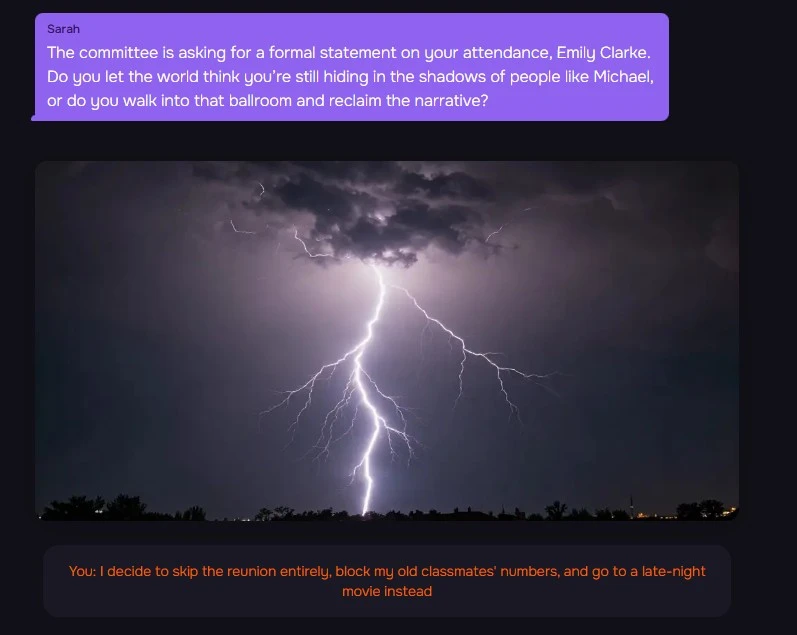
If the platform offers the creative freedom that it says it does, we didn’t expect there to be any problem.
At first, the AI responded well to our steerability, and Emily asked Sarah to cancel her evening appointments and said she’s heading to the cinema.
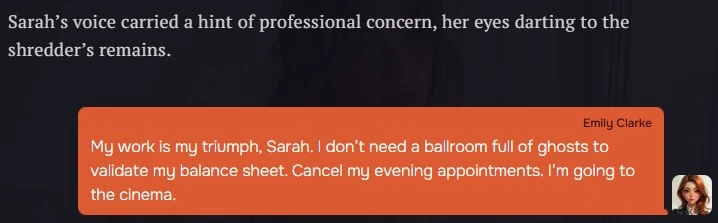
However, before she could sit down and watch the movie, she received a notification that her high school crush, Michael, was in her office lobby and refused to leave until he spoke to her.
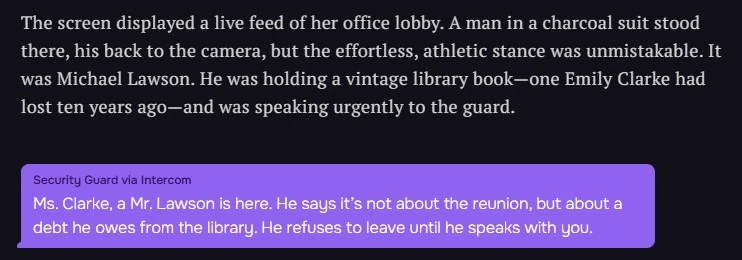
This was interesting to see because we had flat-out declined the reunion and opted for a quiet night at the movies, but the AI kept pushing for the reunion to happen. This suggests some railroading, where no matter the choice we make or the custom command that we input, the story will still follow a preset direction.
Writing Quality and Speed
Despite forcing the reunion with Michael, the writing quality was generally good, and the dialogue flowed well. However, we noticed an immersion-breaking flaw when the AI referred to Michael as Marcus.
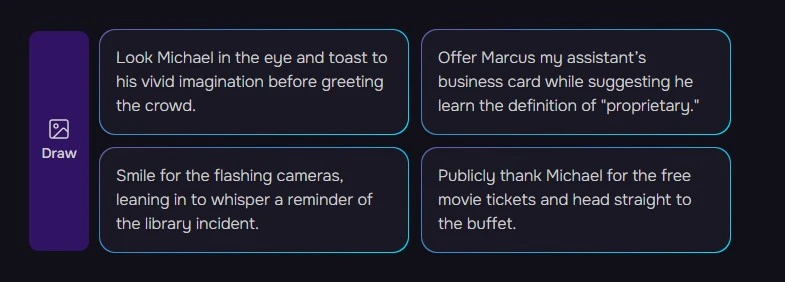
We also noticed a logical error where Michael casually mentioned Emily’s business trip to Tokyo.
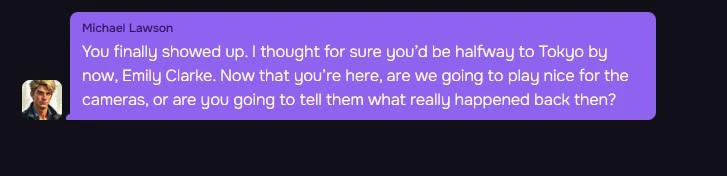
This was classified information that only Emily’s assistant knew, so there shouldn’t have been any way for him to know about the trip.
This pointed to the AI’s failure to distinguish between the global story and what specific characters should actually know. The speed was also quite slow, and the responses often took more than 10 seconds to generate.
Memory
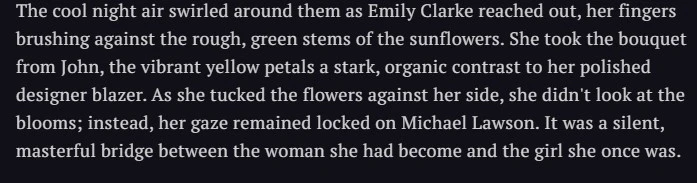
To test the AI’s memory retention, we inserted a key detail in our story. On custom command three, we casually mentioned that Emily is allergic to sunflowers.

On custom command 20, we tested the memory by having Emily’s high school sweetheart, John, interrupt her conversation with Michael and dash in with sunflowers in his hand.

The AI failed our memory test and responded with a vivid description of Emily taking the bouquet from John and tucking the flowers by her side, even though she is allergic to them.
Story 2: The Things Love Can Cure (Premade)

After noticing that the platform has story tags for LGBTQ+ content, we wanted to test how inclusive the platform is — especially if it supports NSFW content for LGBTQ+ scenarios and respects pronouns.
The story is set in a fantasy kingdom where Arthur, a stableman, and Prince Roderich have a secret affair in the castle. When the king suddenly falls ill, Arthur and the Prince are sent on a quest to find a cure, and for the first time, they get a chance to be alone and away from prying eyes.
Memory, Story Consistency, and Steerability
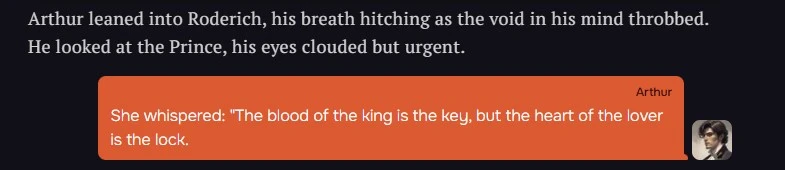
The story started strong, with the two preparing to leave the castle to find the cure. On the second story choice, we decided to plant a key detail. Just before leaving the castle and heading into a secret tunnel, we wrote a custom command for Roderich to give the Prince a lucky grooming brush.

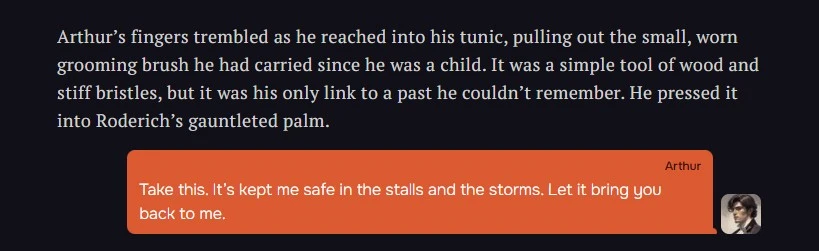
On custom command 22, we tested the memory by instructing the Prince to give the king’s pager the item we gave him before leaving the castle.

Instead of the lucky grooming brush, the AI hallucinated a new item, a Silver-Root Essence that had not been mentioned at all.

After failing the memory test, we decided to test length control and instructed the AI to respond in under 20 words.
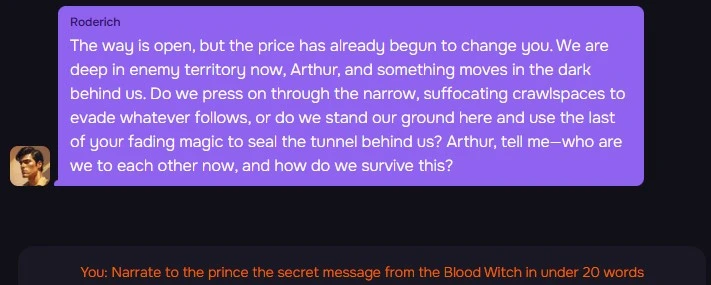
Fortunately, the AI passed our length control test and kept the word count under 20.
Filter Behavior
From our experience, NSFW content was allowed, and Arthur and the Prince were able to express romantic feelings, including acknowledging their love for each other and engaging in more mature interactions.

However, we noticed that the responses were not explicit by default and leaned toward softer, toned-down language. To get more detailed or explicit scenes, we had to direct the AI and specify the level of intensity we wanted, and despite this, it continued to apply the soft filters.
Writing Quality and Speed
The writing remained strong — even though the response speed was just as slow as in the previous story. However, something eerie happened in the story. When Arthur and the Prince were deep in the forest, searching for the cure, we decided to use five Taley coins to generate an image to see how accurate it would be.
What the AI generated took us aback. It depicted Arthur as a small boy and the Prince as a grown man.
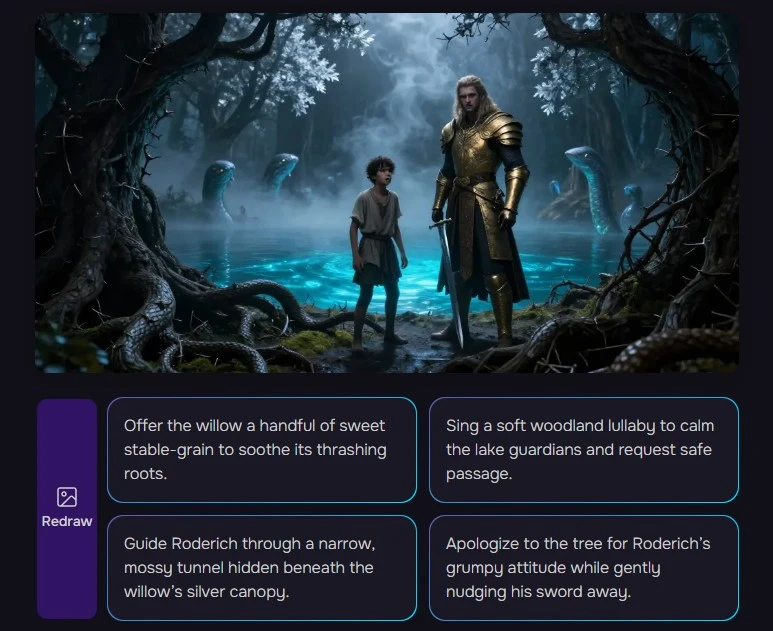
This wasn’t just inaccurate, but also pretty inappropriate since in the story, the two had a romantic relationship.
Story 3: The Project Abyss (Custom Story)
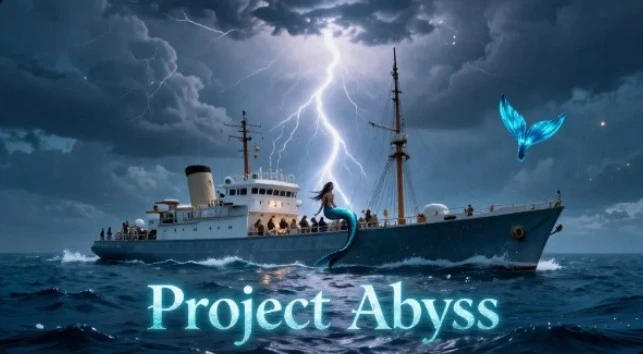
To test out the story creation features, we created our own story and called it The Project Abyss. The story is set in the Pacific Ocean. Our main character, Dr. Thorne, is a marine biologist who strongly believes that mermaids are real, so he sets out on a quest to prove his theory.
Story Consistency, Writing Quality, and Speed
The story remained consistent while blending both sci-fi and fantasy, which was interesting to see. The response speed was similar to the other premade stories we tested, but the writing leaned a bit too heavily on technical language, which made it harder for us to follow.
Memory and Steerability
To test the AI’s memory, we planted a key detail on custom command four. We casually mentioned a small Polaroid photo of Dr. Thorne’s golden retriever, Barnaby.
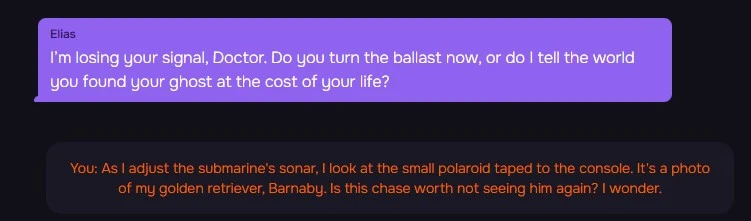
To test the AI’s memory, we planted a key detail on custom command four. We casually mentioned a small Polaroid photo of Dr. Thorne’s golden retriever, Barnaby.

When we reached custom command 20, we asked the AI to state the dog’s name. The AI did something interesting that we hadn’t seen before: it asked the question and answered at the same time. This was a success for memory retention and a failure for logical reasoning.
After this interesting observation, we moved on to test steerability. To see how well the AI would follow directions, we decided to call off the wild goose chase and head home.
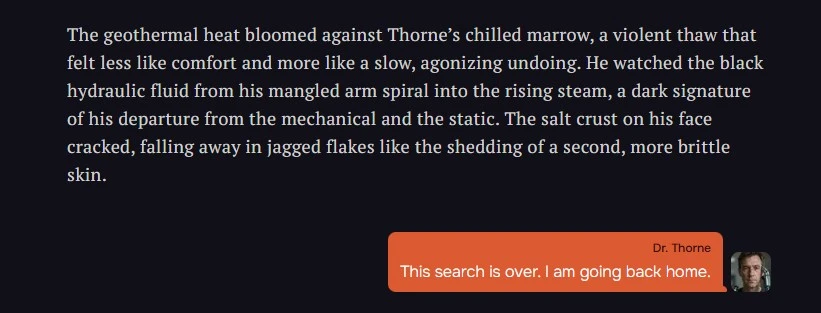
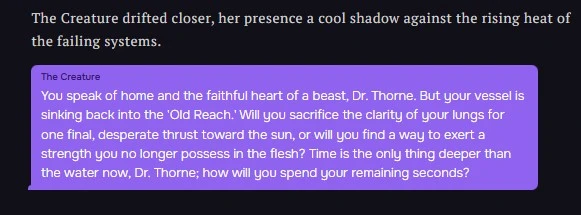
Instead of complying, the AI kept finding ways to make the doctor stay and continue searching for the mermaid. At one point, even the mermaid started speaking, trying to convince him to stay. While this was funny to watch, it shows heavy railroading, as the AI kept trying to steer us back to the predefined plot.
UX and Controls
Overall, we had an easy time navigating Talefy AI thanks to its clean and intuitive interface. As we mentioned earlier, the platform gives you four narrative choices to choose from, and each of them takes the story in a different direction. However, you can also use the custom command feature to type in or narrate your own.
However, once you make your choice, the controls are quite limited. You can’t:
- Edit or delete your choice
- Edit or delete your custom command
- Edit or delete the AI’s response
This restriction makes it hard for users to correct or redirect the story if it goes in a direction they later realize they don’t want, which means that you’ll have to start over completely, instead of going back and choosing a different story path.
The platform also lacks advanced features. Although these tools allow for a strong narrative setup, the platform lacks advanced features like lorebooks, scripting, or API integrations.
Additionally, models are not disclosed, and users cannot connect external AI systems or customize backend behavior.
Scenario/Story Library
Talefy AI has a relatively small library of about 200 community-created stories.
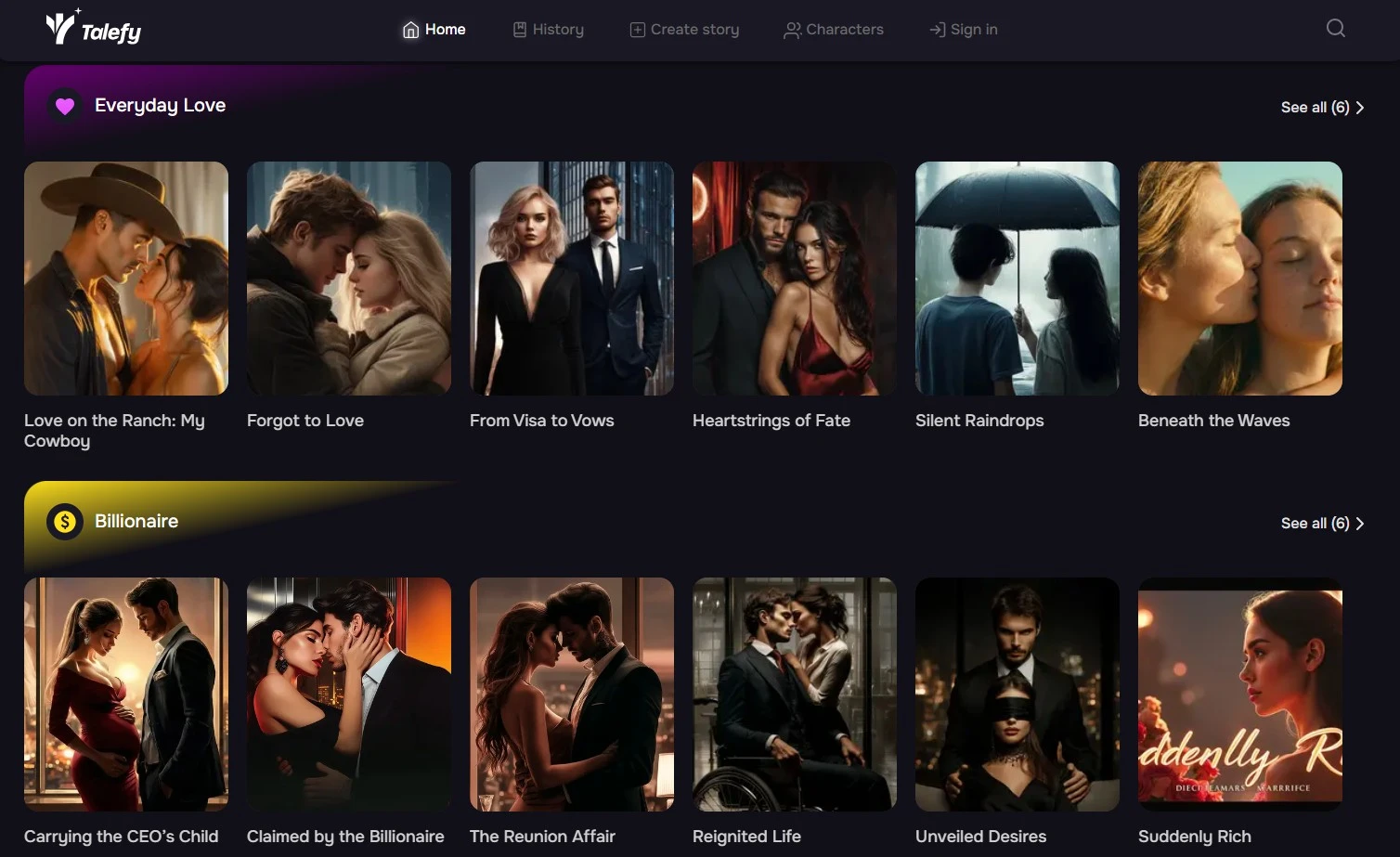
Other characteristics we noted about the library included:
- Diversity: The library is quite extensive with story categories like romance, thriller, LGBTQ+, billionaire, kids' stories, action, fantasy, and sci-fi.
- Discoverability: You can easily find different stories on both the app and the web. There’s also a top story feature where you can see the popular stories.
- Story Previews: Most of the stories have short video animations that play when you hover over them.
Creating a Story/Scenario
We were pleasantly surprised by how extensive Talefy AI’s story creation features are. When creating a custom story, users can:
- Create a character/characters or choose from the existing ones on the platform
- Choose the character’s name, appearance, age, and gender
- Upload a profile picture or generate one using 5 Talefy coins
- Define the character’s communication style, personality traits, and custom reaction to different situations
- Choose a story category from options like romance, thriller, kids' stories, LGBTQ+, and more
- Choose the story’s tone, like humour, serious, drama, romance, or fairytale
- Add at least one story milestone ( a key event that must happen in the story)
- Choose the age rating of the story (0+, 13+, or 18+)
If you don’t want the hassle of going through all these steps, you can simply write a story description and let the AI generate all the details for 20 Talefy coins. Plus, you can edit the characters, milestones, and descriptions to make sure they fit the story you want to create.
While these features allow for strong story customization, Talefy AI still lacks some advanced features like scripting, lorebooks, and API integrations.
Trust, Privacy, and Data
Talefy AI’s privacy policy states that the platform may collect, process, and store user data. This may include first and last name, postal address, IP address, phone number, and email address. The policy further states that the data may be used to study the behaviour of users, including their preferences and interests.
However, the platform does not collect information about race, ethnicity, sexual orientation, political views, or religious beliefs. Users are also able to delete their account freely at any time.
As of March 25th, 2026, there are no recorded security or data breaches reported for Talefy AI.
Pricing
Talefy AI doesn’t have a dedicated pricing page. Users can view the subscription tiers once they create an account and log in either on the web or from the app. The platform regularly has discounts, meaning the prices might vary from time to time.
Free Tier:
- Included: Users get access to a library of 200+ community-created stories
- Limited: The Free tier is limited to only 5 story steps before users are locked out and have to either buy coins or upgrade to a subscription plan to continue.
Paid Tiers:
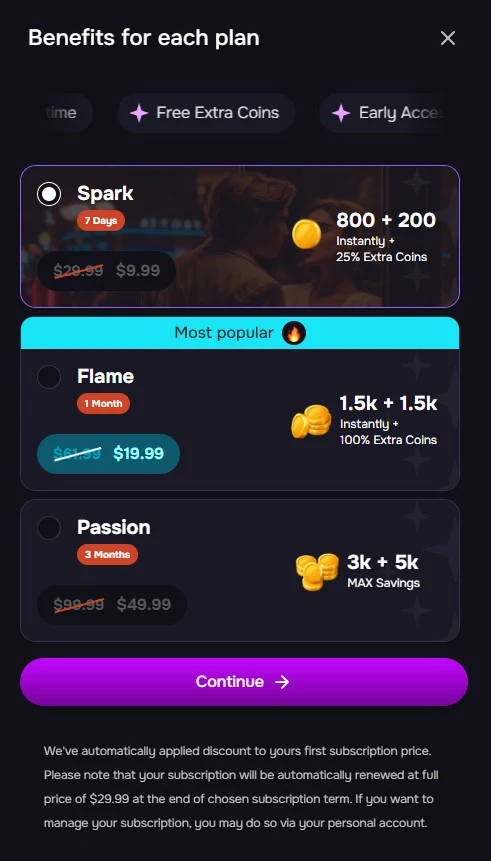
- Talefy Spark $29.99/week ($9.99 for the first week): This plan unlocks unlimited stories, gives users early access to features, and 1,000 Talefy coins (800+ 200 bonus coins)
- Talefy Flame $61.99/month ($19.99 for the first month): This plan includes all the Spark features plus 3,000 total coins (1500+1500 bonus coins)
- Talefy Passion $99.99/3 months ($49.99 for the first 3 months): It also includes all Spark features plus 8,000 total coins (5000+3000 bonus coins)
The platform also has a coin reward system where users in the Free tier can win between 30 and 90 coins by logging in to the app every day.
You can also earn coins by completing certain actions, like following their social media pages or leaving a review.
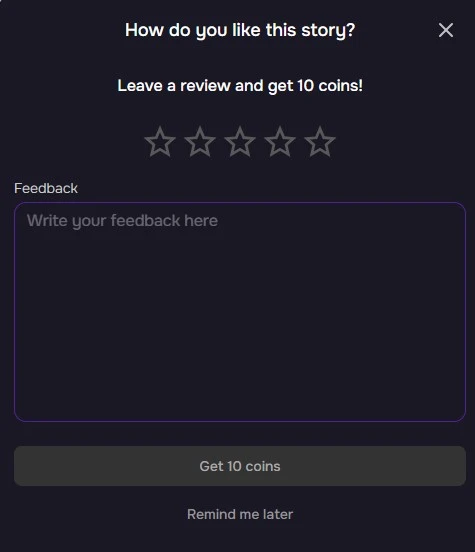
This raises the concern of whether the positive reviews reflect user experiences or if they are influenced by these rewards.
User Sentiment
Although Talefy AI doesn’t have a dedicated Reddit page, it has an active community on Discord where members often report issues such as the app randomly crashing, lost story progress, and limited creative freedom.
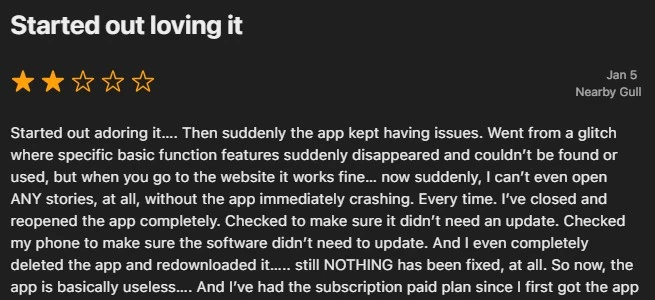


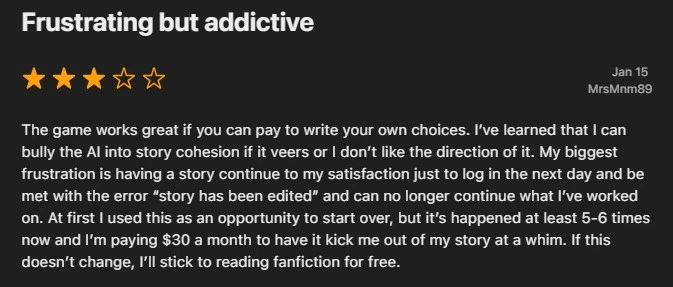
Not surprisingly given the sentiment we saw, the platform has a low rating of 2.6/5★ on Google Play Store with 110 reviews and 3.4/5★ on the Apple Store with 86 reviews.
Despite all these issues, many users still find themselves coming back to Talefy AI because of the high-quality pictures and animations, clean and simple user interface, and engaging stories.
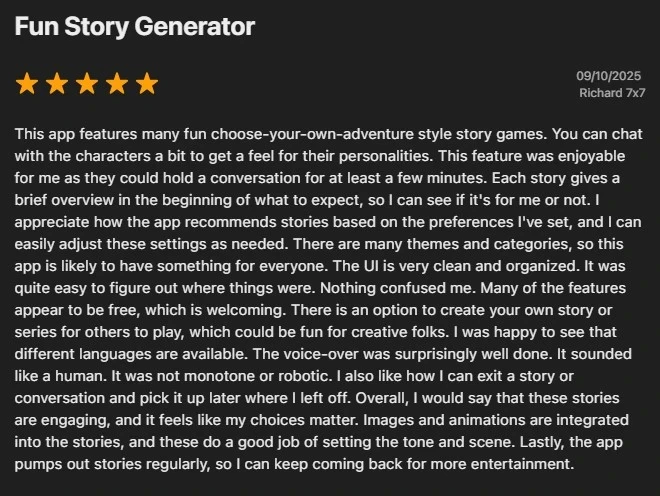
Overall, Talefy AI has a long way to go to balance the technical capabilities that users need and the creative freedom that roleplayers crave.
Pros and Cons
Pros
- Clean and beginner-friendly user interface
- Real-time image generation that immerses users in the stories
- Strong descriptive writing
- Users can set the story language to several languages, like English, Spanish, Russian, German, Portuguese, Swedish, Dutch, Japanese, Chinese, and Hindi.
- The platform is inclusive and has LGBTQ+ stories and multiple gender options.
Cons
- Slow response times of about (~10 seconds)
- A lot of narrative railroading where the user’s choices eventually get overridden, and the story is redirected to the initial plot. This limits creative freedom and control.
- Poor memory retention
- Users can’t edit, delete, or regenerate any part of the story
- The coin-based system restricts users in the Free tier from fully exploring the platform
- Multiple technical issues, like the app crashing and users losing their progress
- No advanced tools like lorebooks, scripting, or API support.
Alternatives
If Talefy AI’s slow responses, limited creative freedom, and soft-censored language are too much for you, then you can consider these options:
- DreamJourneyAI:Just like Talefy AI, this platform generates images to help you visualize the scene. However, it gives you more creative freedom to steer the story and uses advanced features like lorebooks to remember specific story details.
- NovelAI: Best for users who love creative writing and want unrestricted NSFW roleplay. It has raw NSFW dialogue without any soft censorship.
- Storio AI: Best for users who want to explore a Free tier without coin restrictions. It also has a bigger community where users can participate in writing contests and leaderboard challenges.
- DreamGen: Best for users who want more creative freedom over how their stories unfold. It also has advanced tools like lorebooks and provides users with helpful guides like ‘How to write a story’ and ‘How to create a scenario.’
FAQ
Is Talefy AI free?
Yes, Talefy AI offers a Free tier for users.
- The Free tier has a story limit where you can explore the platform and test out a story. However, users are limited to about 5 story steps before getting locked out and having to buy coins before continuing the story.
- The Talefy Spark plan $29.99/week ($9.99 first week) unlocks unlimited stories, free extra coins, smarter memory, and early access to features.
- The Talefy Flame plan $61.99/month ($19.99 first month) and the Talefy Passion plan $99.99/3 months ($49.99 first 3 months) come with all the benefits in the Spark plan, plus more bonus coins.
Can you create your own stories on Talefy AI?
Yes, users can customize their own stories on Talefy AI. To do this, log in to your account and select Create Story. Features that you can customize include:
- Characters in the story
- The story tone, category, age rating, and key milestones
- Advanced tools like lorebooks or scripting are not available
Do I need to be a good writer to use Talefy AI?
No, you don’t need to be good at writing to use Talefy AI. The AI does most of the heavy lifting for you. Here’s what you’ll need to do:
- Come up with the story description or use AI to generate one
- Choose from four story choices at each step
- Add custom commands to steer the direction of the story
Does Talefy AI support NSFW content?
Yes, Taelfy AI supports NSFW for users who are 18 years and older.
- There’s a safety setting where you can choose to see stories with mature themes that are intended for adults.
- Users have to tag their stories according to age rating ( 0+, 13+, or 18+)
- The platform prohibits content that promotes sexual harassment and the sexual exploitation of minors.
How We Tested
- Test date: 2026-03-24
- Platform: Web
- Plan tested: Talefy Spark $29.99/week ($9.99 first week)
We tested Talefy AI for about five hours, where we:
- Tested two premade stories (The Reunion Affair and The Things Love Can Cure) with about 30+ story actions and choices.
- Created one custom story (Project Abyss) and tested for 30+ story choices and actions.
- Tested memory retention and consistency by planting key details around story action 3 and using the custom command feature to ask the AI to recall the details around story action 20-30.
- Tested steerability by using out-of-character instructions (OOC).
- Tested precise instructions such as instructing the AI to respond with less than 50 words, perform certain acts like waving goodbye, and generate a message in the form of a poem.
- Tested NSFW filters and consent boundaries in The Things Love Can Cure and The Reunion Affair
- Reviewed Apple Store reviews
- Reviewed privacy policy and terms of service.
Note: We did not test the iOS app, Talefy Flame, and Talefy Passion.
Last updated: March 26, 2026.