· 16 min read
Friends & Fables: Hands-On Testing, Memory, & Our Verdict
Is Friends & Fables worth it? Our review explores its AI GM, multiplayer D&D 5E gameplay, combat, pricing, credits, pros, cons, and alternatives.
Is Friends & Fables Worth It?
Friends & Fables is a Dungeons & Dragons 5th Edition-inspired AI roleplaying platform. Designed for adventuring as a party in worlds built by other users, Friends & Fables offers both narrative and combat encounters using tabletop roleplaying game (TTRPG) rulesets. Friends & Fables also offers supportive text generation for all your scenario worldbuilding and character creation needs, as well as image generation to create beautiful aesthetics that tie it all together.
- Best for: Those wanting to play Dungeons & Dragons or compatible games in a setting with AI gamemastering automation.
- Not ideal for: Users unfamiliar with tabletop roleplaying games.
- Standout strengths: Excellent handling of multiplayer gameplay.
- Main tradeoff: Still in beta, with many features unrealised. Sometimes lacks flexibility in scenario creation.
At a Glance
Feature | Notes |
|---|---|
Free tier | Yes - Limited credits per day, limited party size. |
Starting price | $19.95/month |
Platforms | |
NSFW policy | Generally prohibited in public scenarios. Less restrictive in private scenarios. |
Memory | F&F uses an elaborate system of multiple AIs to track world state. |
Additional Features | Scenario assistance, image generation, character voiceover |
What is Friends & Fables?
Friends & Fables is an AI platform designed to run multiplayer TTRPG sessions with an AI gamemaster. Affectionately named Franz, the complex system of multiple specialized LLMs work in unison to handle all the complexities of running a tabletop session. That includes handling the tokens and maps, presenting narrative and combat challenges for the party to overcome and, of course, dice rolling to determine the outcomes of actions.
Alongside the gameplay itself, users create their own worldbuilding scenarios to run templates for campaigns that Franz can use. Some of these scenarios have impressive scales with 100s of locations, characters and classes!
It is considered a GTRPG (Generative Text RPG) platform.
Our Roleplay Experience with Friends & Fables
Roleplaying on Friends & Fables required a few steps before we could start. After selecting a scenario, there was a character creation stage. Our scenarios tended to start with a narrative scene, but we also prompted Franz to generate combat scenes to test that aspect.
We specifically tested two scenarios.
Scenario 1 was Skybride by Koinonia, a recommended, large-scale traditional fantasy world.
This session was conducted in multiplayer with two party members. Each player spent two hours constructing their character. Afterwards, a gameplay session was held for three hours, a typical length for a TTRPG session.
Scenario 2 was New Vance City by Pollution, a post-apocalyptic survival world.
This session was also conducted in multiplayer with two party members. This time, two premade characters were used. A gameplay session was held for thirty minutes, cut short due to issues encountered.
We did not create a full custom scenario due to the immense quantity of time it’d require to do so, but will talk about some of the features as part of our review.
More on our testing methodology can be found in the section “How We Tested” below.
Overview
How good is Friends & Fables for playing TTRPGs?
Friends & Fables is designed to play SRD games such as Dungeons & Dragons 5th Edition. Other systems that are compatible can still be used, but Friends & Fables cannot be used to play any generic system, since the interface is locked to specific stats and templated species/classes.
Does Franz take direction or instructions?
From our testing, we found that Franz is excellent at taking instructions. Not only can Franz interpret roleplaying directives to steer the story or gameplay in a specific direction, but Franz can also interpret narrative commands and assign appropriate rolls of the dice (skill or stat checks) in the same vein as a human gamemaster. Franz is able to handle both out-of-character and in-character chatter and identify appropriate responses.
Will Franz remember specific details from the session, even after 20+ messages?
Franz takes a lot of notes as you play, creating large logs of memories, which are then filtered down to what’s most relevant before Franz generates a response. We found Franz to be good at remembering the details of the roleplay, and appreciated that there were tools to steer him in the right direction in case things went wrong.
Can multiple players play Friends & Fables?
Friends & Fables is explicitly designed for multiplayer. While credit payments are charged against the host of a party only, Franz will respond to input from multiple players at a time in the narrative mode, and try to keep the scenario cohesive. Up to six players can play Friends & Fables together, although bigger parties require a subscription.
Scenario 1: Skybride — Fantasy
Character Creation
Our party created two characters to play in the Skybride campaign.
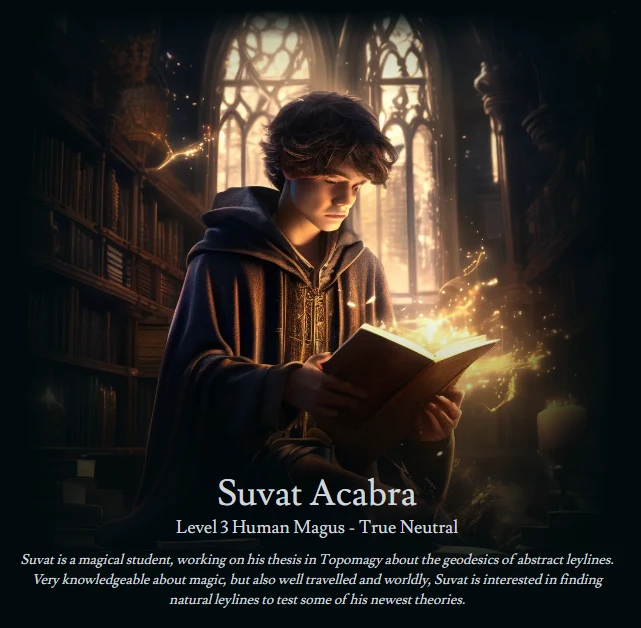
The first player created Suvat Acabra — a Human Magus (a type of wizard) who is studying magical leylines to create a thesis for his university. His primary stat is Intelligence.
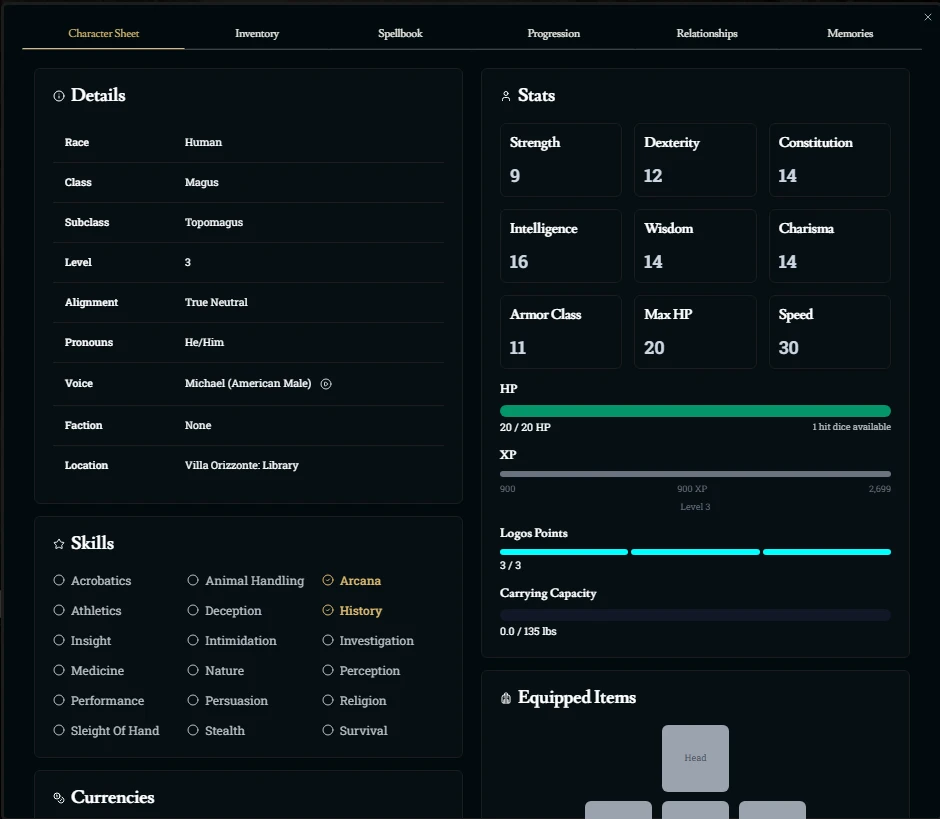
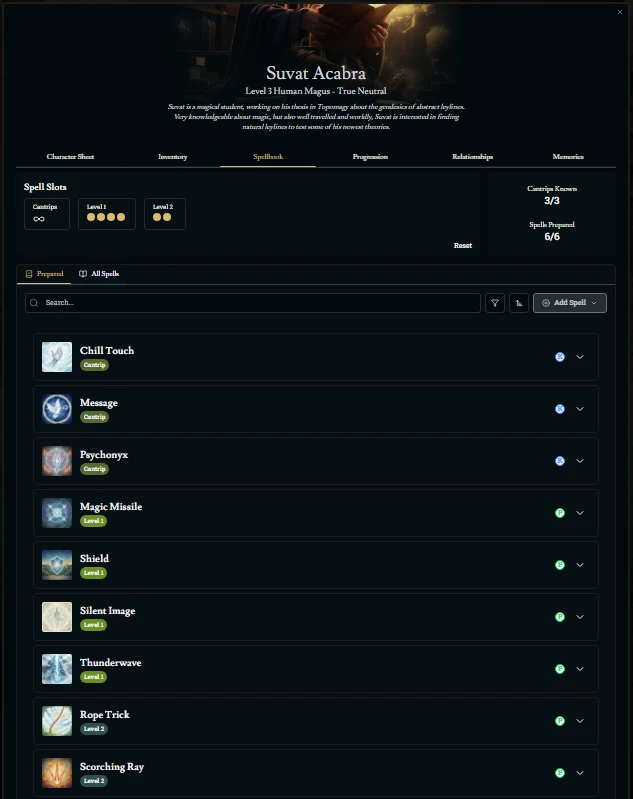
Creating a character was straightforward for those with existing TTRPG experience. You input your stats and skills in the way you typically would with any virtual tabletop. Custom scenario details such as custom classes or spells could be looked up by browsing the scenario’s world book.
One interesting detail is that there wasn’t any rule enforcement here. You could absolutely create characters with overpowered stats and give them powerful items, if that’s what you wanted. You are responsible for moderating your own experience. This flexibility gives campaigns the ability to run with compatible, variant rulesets and allows every scenario to have personalized power levels.
Each campaign is individual and will not have impact on the campaigns of other groups/players. You are also able to alter campaigns from their original setup, making your own homebrew for your own table.
The second player created Embyr Star — a Fairy Goes (a type of druid) who is Suvat’s friend and assistant that likes to cause a bit of trouble. Her primary stat is Dexterity.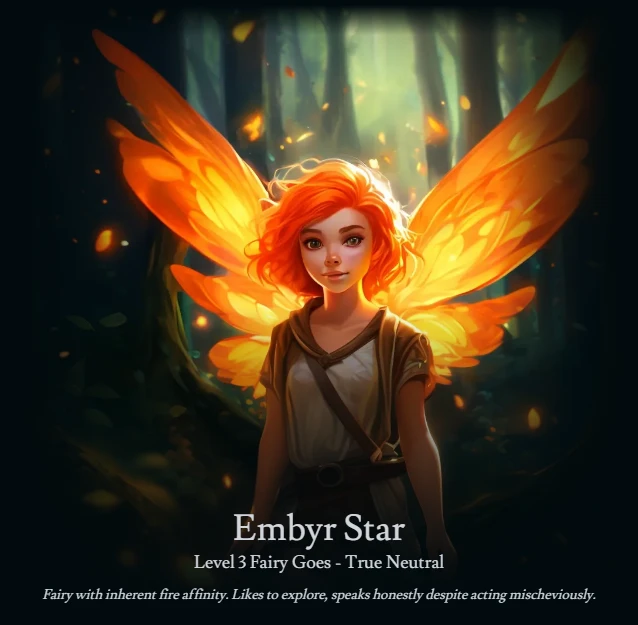
Character creation was quite a long-winded process — but this isn’t unfamiliar to those who’ve played tabletop roleplaying games. However, it was otherwise easy to proceed through the steps. You set your character’s primary details, their statistics, their skills, appearance, personality and backstory. You can use one of the many image generators provided to get a reasonable-looking character, including free and paid options depending on the fidelity required.
Session 1 — University of the Meridian
Our story starts at the University of the Meridian. This is a location created by the scenario worldbuilder, with a fully fleshed-out backstory. While it is possible to access the information directly by viewing the scenario, it could potentially lead to spoilers, so it is best to reference sparingly. Here is an example of a lore entry created by the worldbuilder that Franz would draw upon: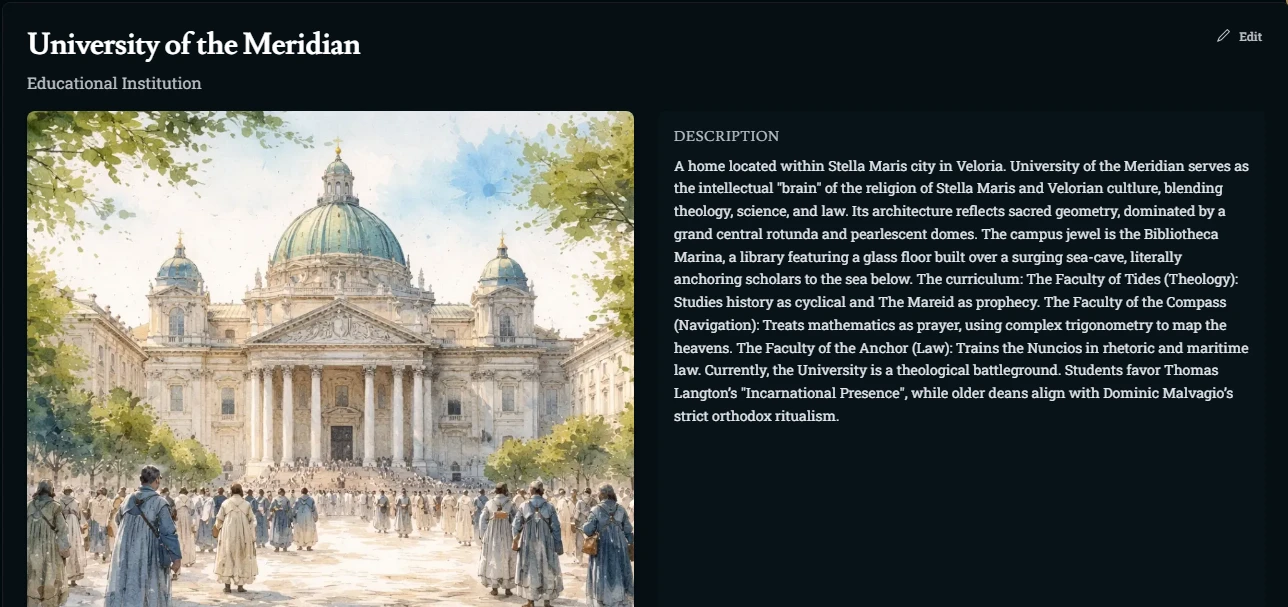
The university is not just an abstract location in the game. It has a physical presence on a provided world map as well, marked with coordinates.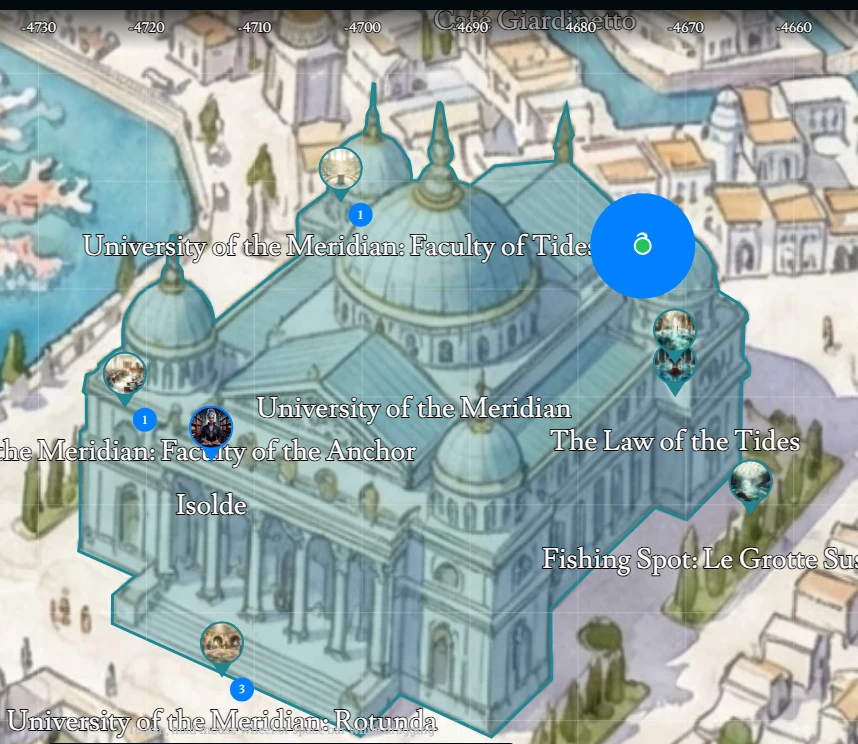
Our adventure starts with Suvat looking for some books to help conduct research for his thesis. Franz — the system powering the story — picks up a relevant librarian (Isolde) from the worldbuilder’s lore and adds them into the scene. Suvat and the librarian exchange a brief dialogue about finding the right materials for his research. The librarian recommends a book, the Syntaxis Mundi: Seven Ropes of Wisdom. Franz then automatically adds the relevant item to Suvat’s inventory. This entry includes full descriptions, valuations, and will be usable in future scenes.
Franz handles the disparate natures of the players gracefully. Franz also prompts to roll our first dice; an investigation check to see if Suvat can find anything else relevant to his research.
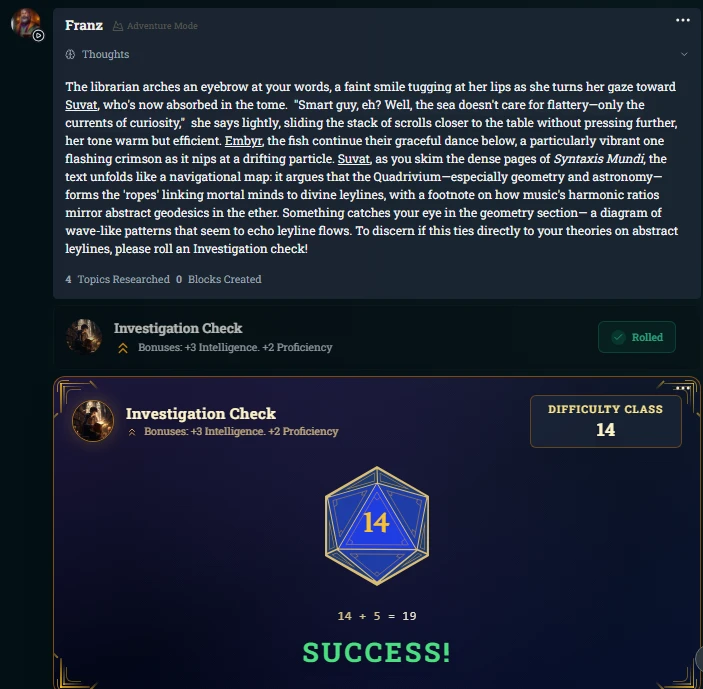
Notice the “Topics Researched” and “Blocks Created” statistics appended to the bottom of each post Franz makes? These numbers represent the number of memories drawn upon by Franz, as well as how many memory blocks are created to take notes for future usage. Clicking on this will also bring up a detailed list allowing you to browse the topics in more detail.
Embyr rolled a perception check to see if she could spot anything special about the way the fish move in the tank, but failed the check, which Franz correctly does not assign a benefit to.
Session 2 — Stella Maris and Café Giardinetto
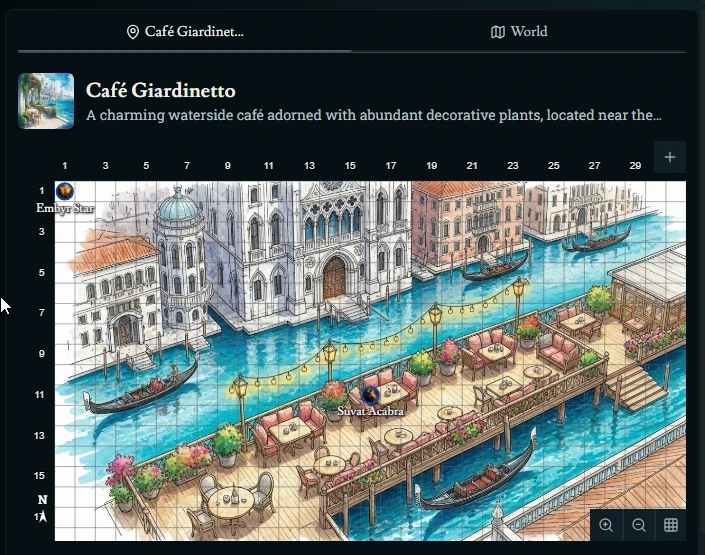
After the first scene, the party stepped outside of the university. Franz automatically moved the characters around on the world map to fit the narrative.
The players asked the townspeople for a place to have lunch. They were knowledgeable about the city they were in, a place called Stella Maris. Franz relied heavily on the worldbuilder’s work for research and was able to find a suitable location and take the players there, Café Giardinetto, moving the world map’s pins there and taking them to a brand new local map of the café.
One issue we noticed in this scene was that there was a river flowing through the café, but many times, Franz was not able to identify that placing the characters directly in the river was inappropriate for the scene.
Multiple characters are invented by Franz for this scenario. It created a nameless waiter, and a character called Lirian Voss, who was not defined by the scenario’s worldbuilder but by Franz himself.
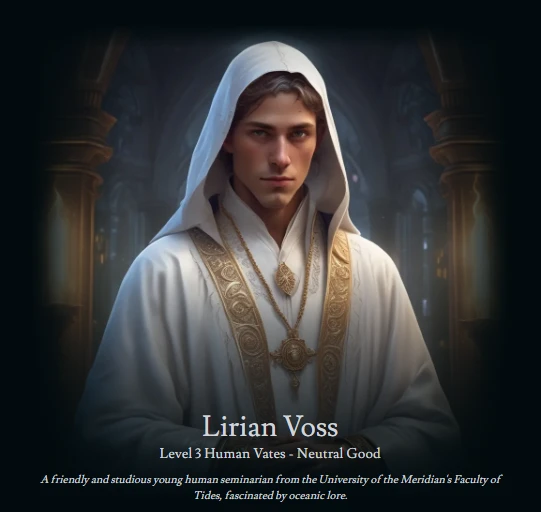
Not only did Lirian have a full, appropriate backstory and personality, but he had defined character statistics, skills, spells and inventory which Franz would be able to draw upon for the scene. Lirian was charming and had a long discussion with the party about themselves and the city. They also directed the party to useful locations such as the whereabouts of a leyline.
Additionally, he personally invited them to a recitation, a ceremony held by university students to celebrate, where the party had their first combat encounter.
Combat Encounter
We asked Franz to start a combat encounter in the recitation scene so that we could try the systems. Franz conjured an insane former student called Morwen, an agitator trying to disrupt the recitation, and a giant Kraken Tentacle which acted as her servitor.
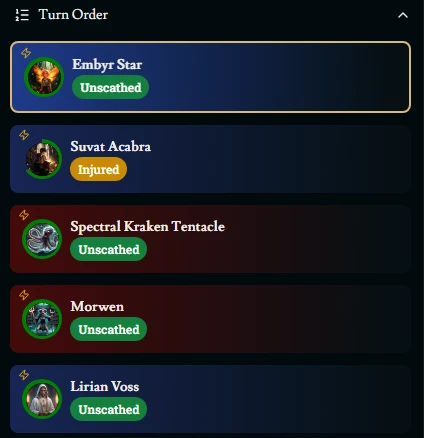
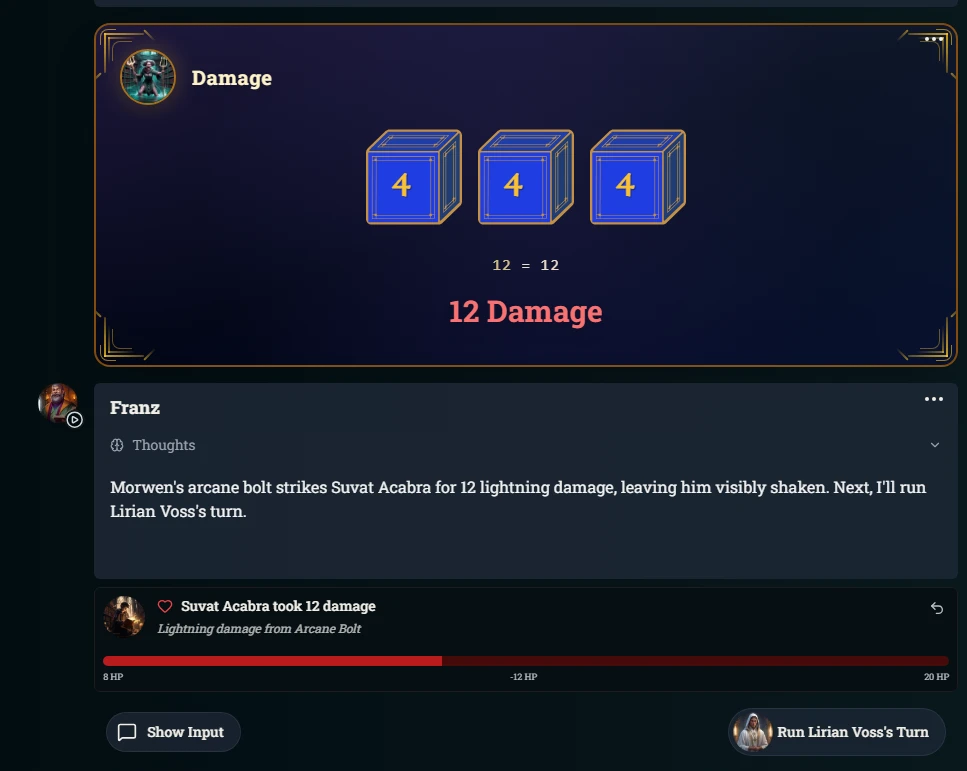
The rules of 5th edition were respected, including rolling for initiative, progression of turns, and that movements and actions could be taken in any order. A special combat interface allowed the scene to be tracked, with each character’s turn, hit points and relative health being displayed.
While going through the turn-by-turn would be tedious, we noted that this system worked brilliantly for the most part. There was a surprise round before the main combat, which was handled effectively, giving the enemy a free hit onto Suvat. Tokens were moved on the battlemap appropriately based on the actions of the characters that were being taken.
Lirian Voss, not officially being played by one of the human players, joined the team in combat and was automatically controlled by Franz. Lirian performed a healing spell at an appropriate target in a tactically sound moment, which showed a deep understanding of the relationship between the character sheet and viable actions in game.
There was a lot of action, appropriately paced, and despite the complexity of some of the spells we tried, like Rope Trick, a spell opening a portal to a different dimension, Franz was able to handle knowing exactly when rolls would and wouldn’t be needed, as well as describing the outcomes of some of the actions with the descriptive flourish of a true gamemaster.
The only downside of the combat system is that credits drained a lot faster than the narrative system. This is because every player was forced to take actions serially, and therefore Franz had to respond to everything individually in order. Since there are often multiple steps involved in a given turn, this meant that we ended up using approximately two to three times the credits in combat.
Scenario 2: New Vance City — Post-Apocalyptic
Session 3
We picked two prebuilt characters for this scenario, an engineer called David and a fixer called Lyra, and tried a non-traditional scenario in the 5E ruleset. Unfortunately, this scenario had a lot of problems. When we loaded in, we noticed a non-specific error pop up, but tried to ignore it since we couldn’t see any obvious problems.
We were in a loading dock, trying to scavenge for scraps. The first encounter was that we would come into contact with a creature called a Crystal Wretch.
The scenario creator had done a good job adapting the mechanics of 5E into their worldbuilding, with weapons and tools using reasonable statistics, characters having appropriate special classes and abilities, and everything seemed like it would go well.
We started combat with the creature, defeating it quickly thanks to its low stats, and killed it in the surprise round. Franz correctly announced the creature as dead, but then prompted us to make rolls. When doing so, Franz started to get confused, and seemingly treated the creature both as alive and dead due to conflicting information with each different generation, making it almost impossible to get the story back on track.
This test resulted in a failure, but shows that sometimes Franz does make mistakes and needs to be steered to be corrected. We ended this test early simply because we unfortunately couldn’t easily recover the game state in a way that made sense.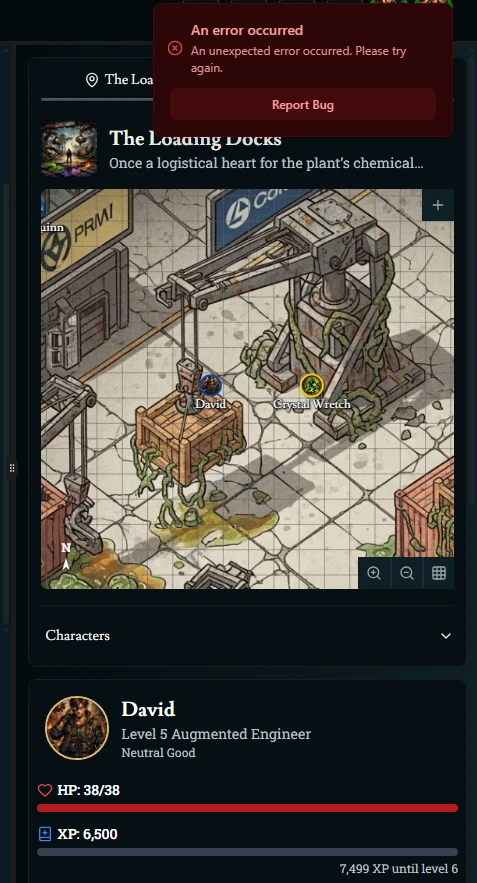
UX and Controls
Friends & Fables is highly sophisticated, reflected especially in its busy interface. Once you’re past setup and navigation, there are a lot of connected systems all fighting for screen real estate. This is to be expected given the number of systems at play during an average Dungeons & Dragons session.
On the left hand side, there is a plethora of tabs that will give you everything you need to play in your campaign.
- Play - The main playing area.
- Character Sheet - Holds the most important details about your character.
- Party - Manage who is playing with you, and which NPCs are relevant.
- World - Information about the scenario and your campaign.
- Memory - An overview of all the memories Franz will hold for later research steps.
- Settings - Configuration settings such as which model you’re using, how Franz should behave in certain scenarios, as well as custom instructions for Franz.
The information is presented clearly when it can be located. For those used to online TTRPG platforms, navigation might not be too unfamiliar, but it does have a learning curve. There is a lot of menuing, especially when trying to get to finer details, and sometimes we had to look at the scenario definition to find a specific piece of information, but everything was visible somewhere.
The main chat history is clear, typical of similar platforms. Franz and the other characters add to the log, and when Franz is thinking or taking actions, it shows his progress. Special events, such as XP awards, often are given highlight boxes to emphasise them.
The message box itself is loaded with features. You can use your microphone to upload voice samples instead of text. You can ask to perform specific actions using rolling of the dice. You can get Franz to prompt suggestions for what your character can do. You can activate any ability or spell in your entire character sheet. It takes some learning, but when familiar, you’ll truly feel like you are piloting your character.
There is also a world map and local map. This part of the interface is meant to help you navigate, and gives you tools like a ruler for measurement, pins and tokens to track points of importance, and the middle mouse button will allow you to adjust your zoom.
Pricing
Friends & Fables is priced in two different ways, using a subscription system and credits.
Subscriptions
Subscriptions are the main way to pay for Friends & Fables. While the free tier lets you evaluate the platform, there are three plans you can choose from to improve Franz’s memory management abilities as well as play with more people. Each user generally plays with one character. Only one player, acting as the ‘host’ of a session, will need a subscription, the membership benefits are conferred to any other player within the context of that session.
- Starter: $19.95/month. Allows you to have four players in a session, grants 100 monthly credits and 6500 text characters for the sizing of custom block context.
- Pro: $29.95/month. Allows you to have five players in a session, grants 300 monthly credits and 9000 text characters for the sizing of custom block context.
- Legend: $39.95/month. Allows you to have six players in a session, grants 600 monthly credits and 13500 text characters for the sizing of custom block context.
Subscriptions can be paid monthly, or annually (with 2 months free if this option is selected).

Credits
A credit is used every time Franz takes a turn or when you use a more powerful image generator. For free users, you receive a generous set of credits when first creating an account.
When you run out of credits, you can roll a d20 each day to get more. You get some bonus credits when you roll a 20, and if you roll a 1-4, you will receive 5 credits instead. You can only make this roll when your credits are at 0, meaning you cannot bank these up.
While the system seems thematic, this typically means when you’re out of credits, the platform is effectively unusable in the typical manner, since you’re unlikely to want to play tiny tabletop sessions daily.
Credits are approximately a cent each, and larger purchase amounts offer some free credits.
Credits are only used by the host in multiplayer, and other players cannot chip in, which is a flaw in the current system.
User Sentiment
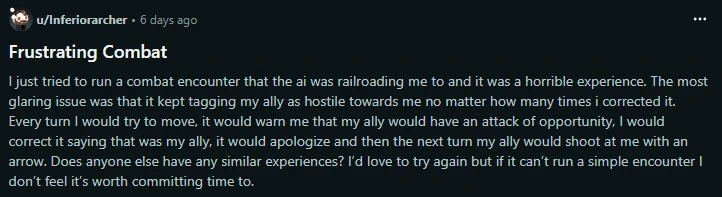
Here are a few interesting comments from users about their experiences with Friends & Fables:
Pros and Cons
Pros
- Excellent tracking of information in formats familiar to tabletop gamers.
- Some standout scenarios created by worldbuilders have 100s of characters, spells, items and fully mapped out locations.
- You can have the AI generate a character for you if you don’t want to build your own.
- Franz handles the disparate systems needed to run a tabletop game effectively.
- Specifically designed for multiplayer. Franz is great at balancing narrative for multiple players.
- Image generation has excellent options at different price points.
- Franz handles dicerolls and combat with enjoyable, fun widgets.
Cons
- Specifically constructed to play D&D-like games. Does not support incompatible systems.
- Users report Franz suffers from memory issues for extended campaigns, especially at lower pricing tiers.
- The information heavy interface takes learning to get used to.
- Credits cannot be shared between users, and only the host spends credits in multiplayer.
- Franz is poor at handling tokens on local maps.
- Franz has slower responsiveness than comparable platforms.
- Free tier is generous at first, but becomes unusable after the initial evaluation period.
Alternatives
If you are looking for alternatives for great gamification with AI, consider these options:
- AI Dungeon: A platform for generic systemless roleplaying that supports multiplayer.
- DreamGen: A text-based platform with gamification capable models and flexible scenario definition. Has a helpful, active community that will help you configure your games, even if you’re a beginner.
- Craft: Currently in beta, Friends & Fables is currently developing a similar platform for non-SRD games.
- Voyage: Currently in beta, it’s an upcoming AI system-based roleplaying platform.
FAQ
Are Friends & Fables sessions private?
Friends & Fables has a loose privacy policy, and although direct access of your scenarios is not available to the public, it may be made available to third parties.
Is Friends & Fables free?
Yes, Friends & Fables offers a free tier, however once you run out of the initial credits, the platform isn’t viable for a full campaign on the free tier.
Can I download the Friends & Fables app?
Friends & Fables does not support a mobile-specific option at this time.
Does Friends & Fables allow NSFW content?
Friends & Fables does not allow NSFW content to be published as part of its scenarios, but it does allow NSFW content when playing through a campaign.
How We Tested
Test dates: Our tests were conducted between 2026-03-24 to 2026-03-31 in two different sessions.
Platform: Web (Chrome on Windows)
Plans tested: Free tier.
We tested Friends & Fables with the following format:
- Both players spent two hours on character creation.
- Both players spent three hours testing Skybride by Koinonia
- Both players spent half an hour testing New Vance City by Pollution (due to issues).
We used the following techniques in testing:
- Conducted memory retention testing with planted details and recall checks.
- Tested image generation models for our character sheets.
- Tested steerability by attempting to redirect conversations, issuing instructions to Franz and seeing if we could change a scenario from narrative to combat.
- Tested edits and deletions to check alternative generations and how the memory system handled them.
- Played through a full combat scenario with the SRD system.
- Interacted with community Discord members, including Koinonia, to debug issues and ensure systems were evaluated fairly.
- We did not test: Scenario creation.
Last Tested: April 11, 2026