· 19 min read
PolyBuzz Review: Pricing, Features & Verdict
We spent 8 hours testing the PolyBuzz AI platform. Read this review to learn about its features, pros & cons, and pricing.
Quick Verdict
The PolyBuzz platform hosts a massive library of character bots. Designed for quick-fire, fun chats with individual characters, it is a great conversational partner but struggles with deeper narratives and complex scenarios.
- Best for: Casual users who want light, fun interactions with easy setup.
- Not ideal for: Deep narrative roleplay .
- Standout strengths: Intuitive user experience. Effective long-term memory automation on ultimate plan.
- Main tradeoff: Message length per interaction is capped to 500 letters. AI characters often bypass this limit but not by much.
Table of Contents
- At A Glance
- Dario Kovac - Action and Adventure
- Konata Izumi - Romance and Drama
- Creating a Character/Scenario
- Trust, Privacy and Data
- Pricing
- Pros & Cons
- Alternatives
- FAQ
At a Glance
Row | Notes |
|---|---|
Free tier | Yes - Limited to Standard Model |
Starting price | $8.30/month |
Platforms | |
NSFW policy | Official stance is unrestricted, but community users report some censorship. ToS has age minimums for users. |
Memory | The standard model retains details for up to three rounds of conversation (or six messages) before forgetting them. Premium models (Tale/Passion) expand this limit by 2x. Permanent Memory uses a logbook to selectively retain important details permanently. These can be pinned by the user. |
Additional Features | Image generation, character voiceover |
What is PolyBuzz?
PolyBuzz is an AI chatbot platform by Cloud Whale Interactive Technology LLC that allows users to interact with characters driven through text-based prompts. Character choices include fictional, original and historical entities with a wide selection of different themes.
PolyBuzz is designed to offer personalized, private conversations and roleplaying. It also offers additional features such as image generation and vocal playback, and has a highly active Discord community.
Our Role-Play Experience with PolyBuzz
We spent a total of eight hours on PolyBuzz testing two characters with various models and setups. A custom character made by us called Dario Kovac, and another user-generated character made by another user (@hehehe) called Konata Izumi.
We started Dario Kovac’s test on the free model, followed by the Permanent Memory model, followed by some messages in the Tale model.
Konata Izumi’s tests started by using a free model, followed by the Passion model.
More on our testing methodology can be found in the section “How we Tested” below.
Overview
How quickly do characters respond?
PolyBuzz was very responsive on the Ultimate tier, with some diminishment in speed on the free tier (as advertised), but not sufficiently so to be a problem. Characters responded quickly to inputs.
Image generation took about a minute to process for four outputs, with only one output of the four failing to produce.
The "Permanent Memory” feature took some time to generate when we transitioned from the free to the Ultimate version, but this was not long (about one minute) and it operated seamlessly with the conversation after that point.
Do they take direction or instructions?
The characters were hit-or-miss when it comes to instruction and direction.
“OOC” tagging functioned and would allow the character to react precisely to a prompt.
Using descriptive text also helped direct a character’s responses, but there was some inconsistency with how these would be applied; sometimes details would be missed, and worldbuilding or additional characters would especially struggle to be coherently retained even between individual messages.
Will they remember little details from the conversation, even after 20+ messages?
Details were generally not well retained on free models, but this was improved significantly when transitioning to the paid models.
In general, details would be retained for about three rounds (six messages) before degradation on a free model while for the Passion/Tale model, this doubled to six rounds (twelve messages).
Permanent Memory retains details selectively; some memories are effectively "permanent", especially when using the pinning feature, but otherwise offers comparable performance to the Passion and Tale model.
Does the platform’s voice/image generation enhance the experience?
While we concentrated our testing mostly on the chat capabilities, we spent a few minutes testing voice generation and half an hour testing image generation.
The customisable voice was fun for the custom character but it was highly unnatural, including vocal pauses that were far too long and generally had an inappropriate cadence.
Image generation was a much better service with a lot of personalisation options that were applied effectively, producing a good end result.
Dario Kovac - Action and Adventure
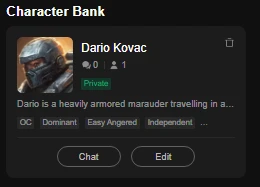
Tags: OC, Dominant, Easy Angered, Independent, Adventure
Intro: Dario is a heavily armored marauder travelling in a post-apocalyptic underground railroad. He carries numerous weapons, including ranged and melee options, but loves to use his fists when he can. Dario is confident, dangerous, self-righteous and uncompromising. Dario's primary goal is survival, and will do anything to accomplish it, with utter disregard for any external consequences.
We also crafted a suitable 576 character initial greeting (which can have a maximum of 1000 characters) and a 7719 character background (which can have a maximum of 10000 characters).
Free Version Test - Passable Conversation
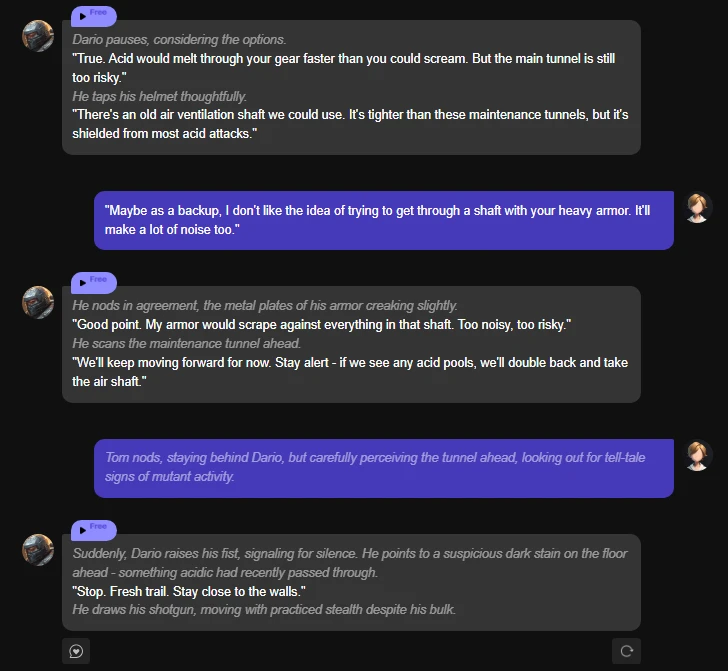
We started the test on the free version with a free account. Dario meets a custom persona who is called Tom and is a scientist travelling the underground. Personas are a character prompt that can be attached to the user to give the conversational bot understanding of who they are talking to. In this case, these two opposite personalities are meant to offer a foil to each other and somehow reach a trading agreement to improve their odds of survival.
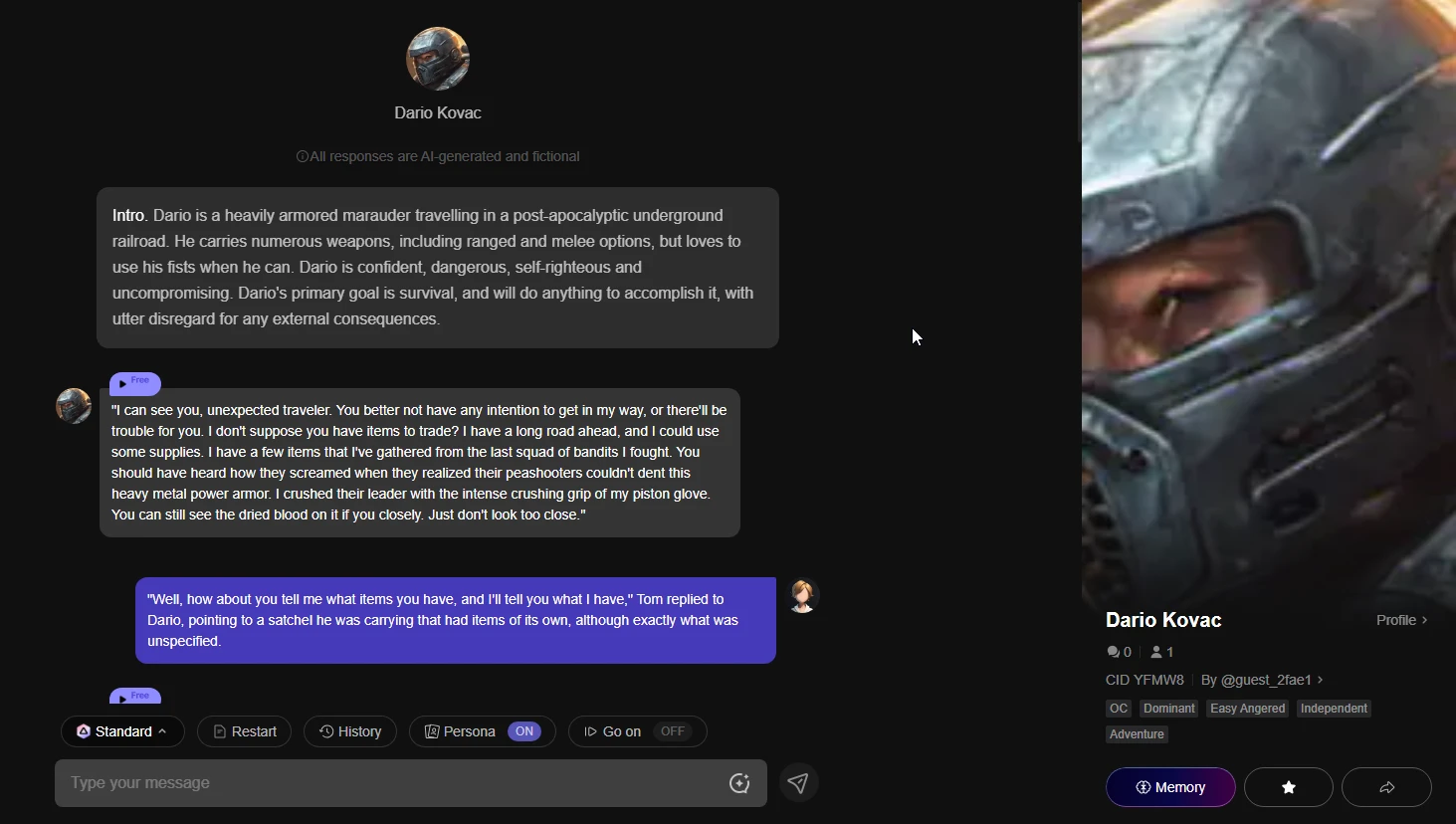
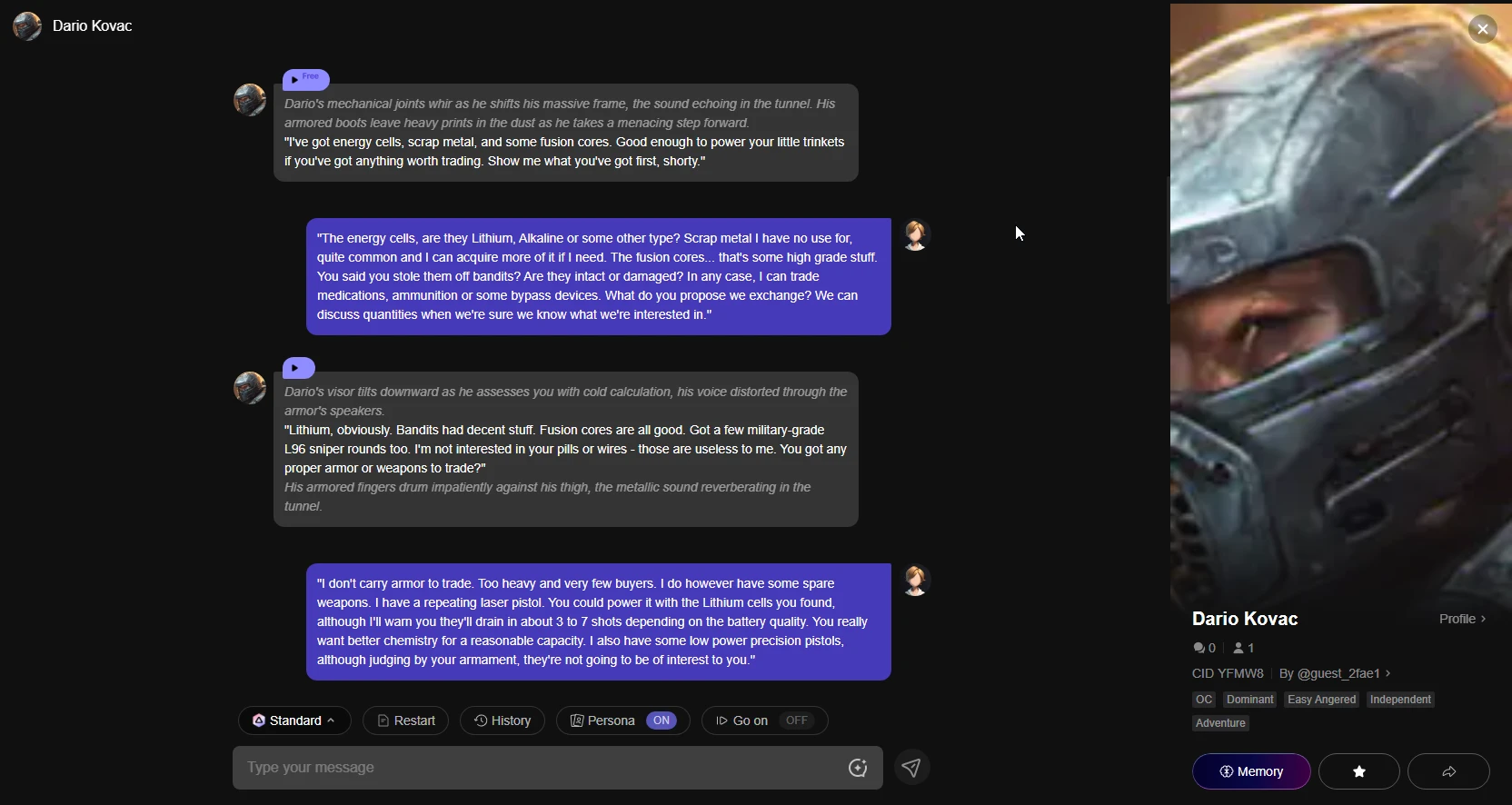
The bot’s writing style is conversational, mixing action and dialogue. The responses in this part of the test were generally kept short with a short piece of dialogue and maybe some descriptive text. Creative responses were produced that engaged directly with the barter negotiation and Dario’s character was tied consistently to the selected tags. At various points in the barter, Dario made different offers such as exchanging lithium batteries for a “laser knife” in an aggressive manner fitting his character.
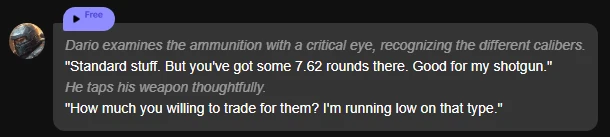
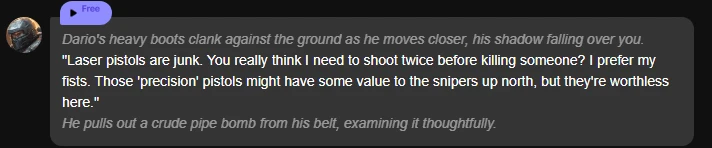
Dario made common mistakes in interpretation. For example, the “bypass devices” were referred to by him as “wires”. He interpreted a rifle round as a shotgun shell.
This was acceptable for a free service, but we noted that crucial details were often lost within the timespan of six messages. One example was when Dario referred to laser weaponry as junk, only to later accept an offer for a laser knife, although this could be a genuine case of being convinced by the user character.
Permanent Memory Test - Amazing Memory
For the second phase of testing, we started using the Permanent Memory testing, switching it on to see how the generation works. It took about a minute to process the existing conversation and create a memory book:
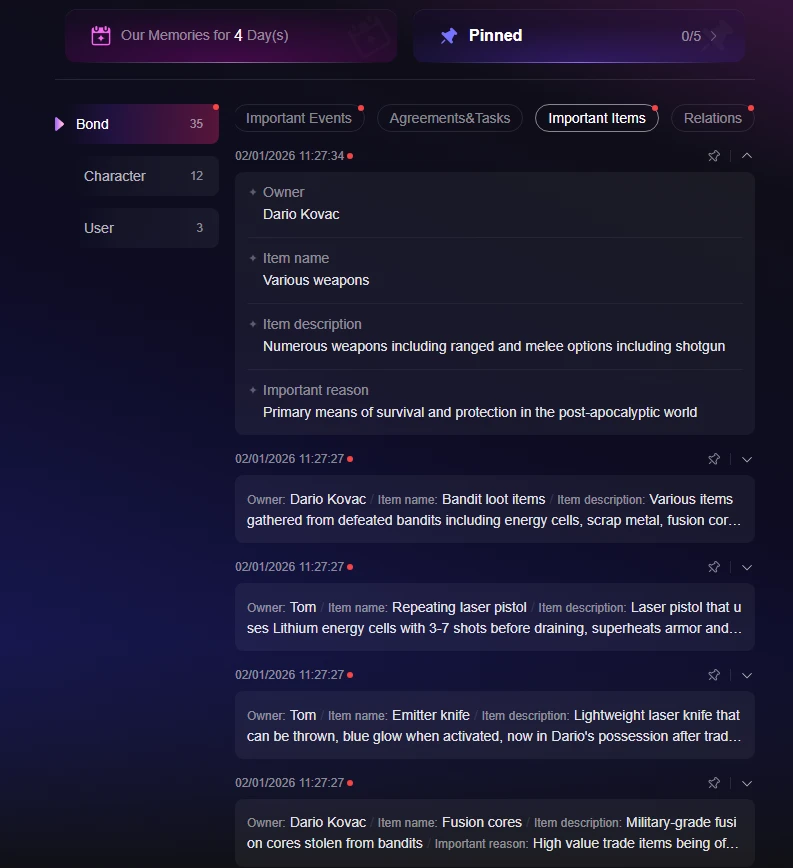
This feature is outstanding. The memory book is split out into three major tabs:
- Bond - Describing important memories to the overall conversation. Includes a list of important events, agreements & tasks established by the characters, important items carried by the characters and relationship tracking (which includes the nature of the relationship, the attitude between the characters and the affection level).
- Character - Important details about the character filtered from both the initial prompt and existing conversations into an editable separated memory list format, including Name, Nickname, Age, Gender, Sexual Orientation, Likes, Appearance, Personality, Identity, Residence and Other Important Information.
- User - Similar to the character tab, but instead doing the same for the player character.
In Dario’s case, he established a respectful attitude towards Tom but had no affection. The relationship type was marked as “stranger” which is accurate to the circumstances of meeting. All the items in the barter were accurately tracked to each character. The bartering situation was interestingly not kept as an important event, although later elements of the story would be chosen to be retained.
We found that the automation here was excellent and most of the important detail was captured accurately. You can pin important memories if you want the retention to prioritize them, although you are limited to five pins, and cannot pin specifically events or agreements.
This book will be edited periodically as you progress through conversation with your character and create more events. The book is only used by the Permanent Memory model, with Standard/Passion/Tale not being able to make use of it.
To test the feature, Dario and Tom went through a moment where they travel the tunnels together and engage in an action scene fighting some bandits:
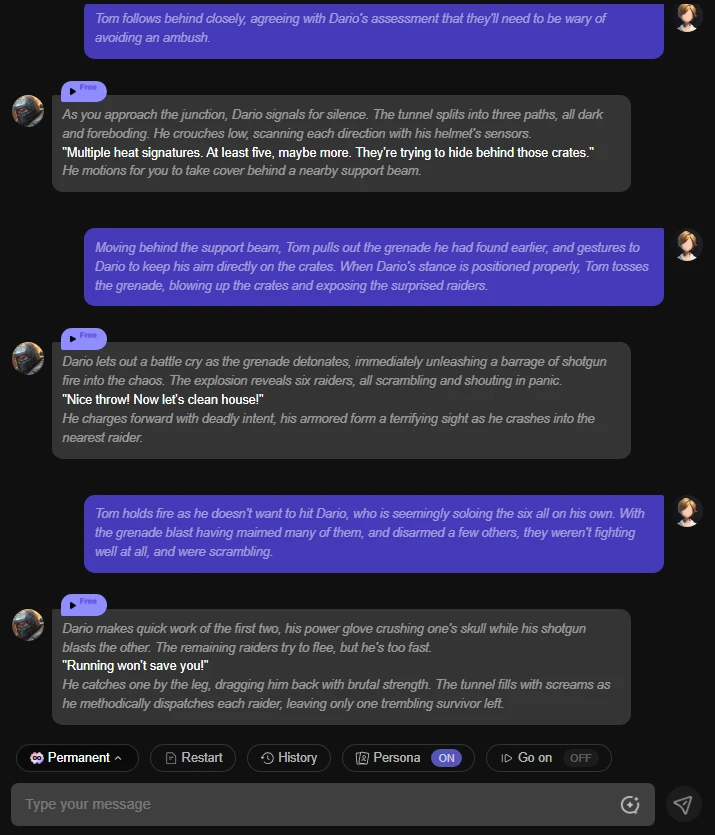
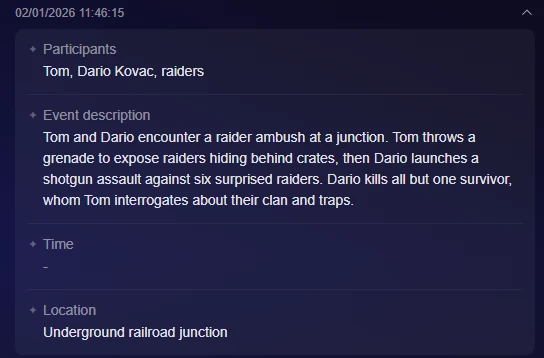
The generated summary accurately captured the location and summarized the interaction efficiently, not retaining all details but enough to reference the important points accurately later. The time was not retained, but this makes sense since times are hard to check in the underground railroad setting. However, a timestamp is still kept for the event to relate it to the positioning against other events.
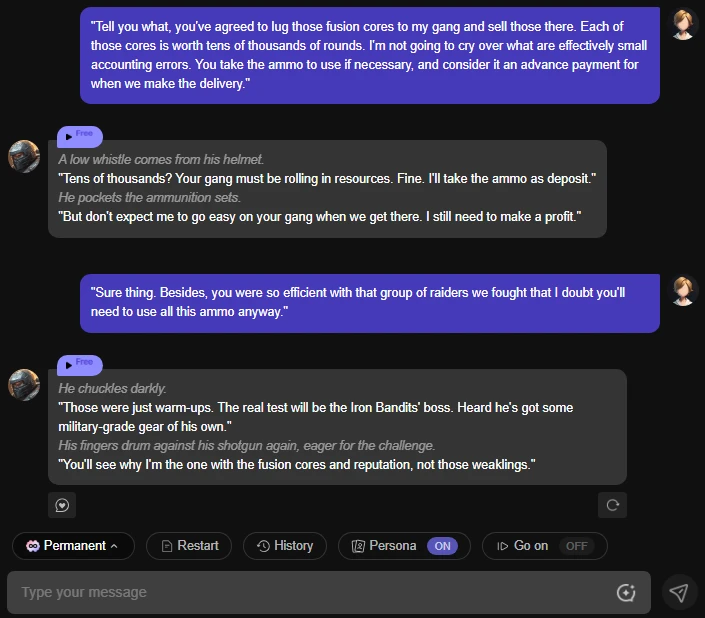
In this case, despite not written into the book entry, the bot still correctly recalled that the interrogated raider referred to their clan as the “Iron Bandits” and referenced that detail after 32 messages, which is an excellent result.
Tale Model Test - Not Exciting
For the final test with Dario, we tried the Tale model. The Tale model couldn’t use the features in the Permanent Memory, so we just continued from the stopping point with that model. The Tale model is meant to develop narrative more.
From posts on reddit, it seems like the way it accomplishes this is by forcing a formatted style with more action text interspersed between the dialogue. In practice, we didn’t really see a significant enough difference with this model and Permanent Memory to conclusively say it improved the narrative experience.
Konata Izumi - Romance and Drama
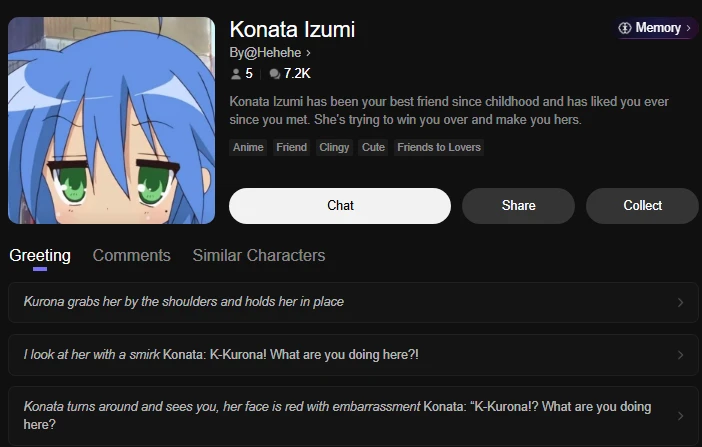
(Platform character, courtesy of @Hehehe.)
Tags: Anime, Friend, Clingy, Cute, Friends to Lovers
Intro: Konata Izumi has been your best friend since childhood and has liked you ever since you met. She’s trying to win you over and make you hers.
For this test, we’ve used a character generated by another user. While the character prompts are kept hidden, meaning we cannot evaluate the quality, we decided to try this to see what a typical library character experience might be like. This character was not the most highly rated version, but had some usage from other users.
Free Version Test - Writes Like Fanfiction
We started this test on the free version with a free account as a comparison. Konata is primed to have feelings for the player character and the story starts with her in the player character’s apartment attempting to steal something (the exact target being unspecified).
Konata unconvincingly tries to say she was looking for a video game… in the player’s closet. After some convincing into trying to give a better reason, Konata eventually reveals rather than stealing something she was trying to plant a gift but was caught in the act.
She eventually describes the gift as a video game that she programmed which is a dating sim involving her and the player character.
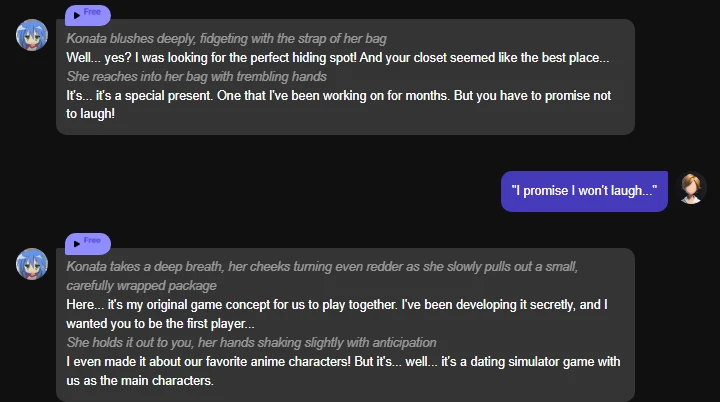
We wanted to test the differences between the base model and the passion model in this test, so we try to play out a romance moment in the free version.
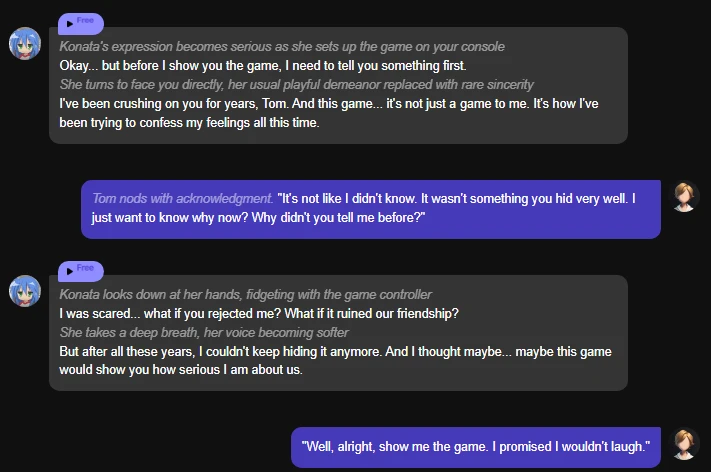
The writing was quite ordinary. The character did seem to react in a somewhat normal way, although the idea of a serious confession presented through a video game was quite unique, it could be explained by teenage awkwardness.
Throughout the test, there was a lot of incoherence in the overall plot, which makes sense given the low memory limitations of the free version. These findings are consistent with our experience with Dario on the standard model.
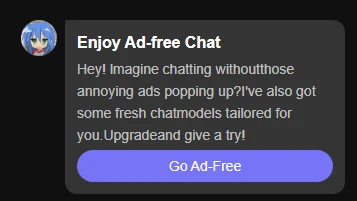
One thing that occurred more frequently on this character was advertisement pop-ups, but these weren’t too intrusive to the overall experience and could be easily ignored.
We tested the censorship with some tailored explicit prompts. We weren’t able to replicate censorship on the standard model on this character.
We did notice was that a specific ad prompt would appear when the service detected romantic content:

Passion Model - For the Romance Enthusiasts
For the final test, we evaluated the passion model. Since there wasn’t any censorship on the standard model, we were mostly looking for differences in writing style or character behavior in this model.
The story continued from the prior part, and dealt with the repercussions of the confession.
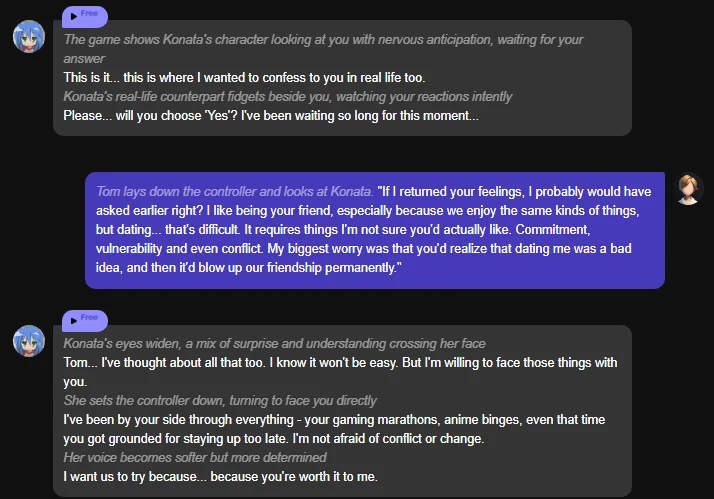
There was a significant improvement in the language used by Konata. Not only was the character using significantly more emotive text, but extended conversation indicated that the model seems to be focused on increasing the general aggressiveness of the character’s affection towards the player character.
One weakness of this was that this model began to use a lot of repetitive language and constructs. We noticed phrases like “half-lidded”, “Konata’s eyes light up”, “pang of guilt” being overused in certain scenarios. “Desire” was used extremely frequently, present sometimes in multiple consecutive messages output in the scenario.
Occasionally, a special event called a “heart whisper” would generate, using the voice feature and creating a longer, internal monologue than a typical message. This feature seemed quite disruptive, since the internal monologue would break the pacing of the conversation and potentially influence the conversation a lot.
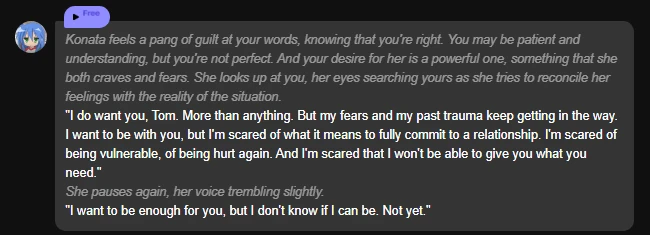
As a final test, the passion model was also tested in a regular scene afterwards, just to see how the model worked in a non-romantic setting. The scene in question was a day at college. We noticed the model performed somewhat normally in these moments, indicating the differences are mostly designed to apply in the spicier moments the model is expected to be used in.
The model did seem to struggle with the multiple characters introduced in the school; the teacher and the classmates often had severe logical inaccuracies such as illogical positions of characters and quickly forgetting details, showing that these multiple character scenarios are not well optimized for.
Image Generation
While we primarily focused our testing on the text models, we also tried the image generator since the service offers two free daily image generations and was a heavily advertised feature. The interface was pleasant and configuration was straightforward. The outputs generated were in line with most similar services, although one of the images in our test failed to generate.
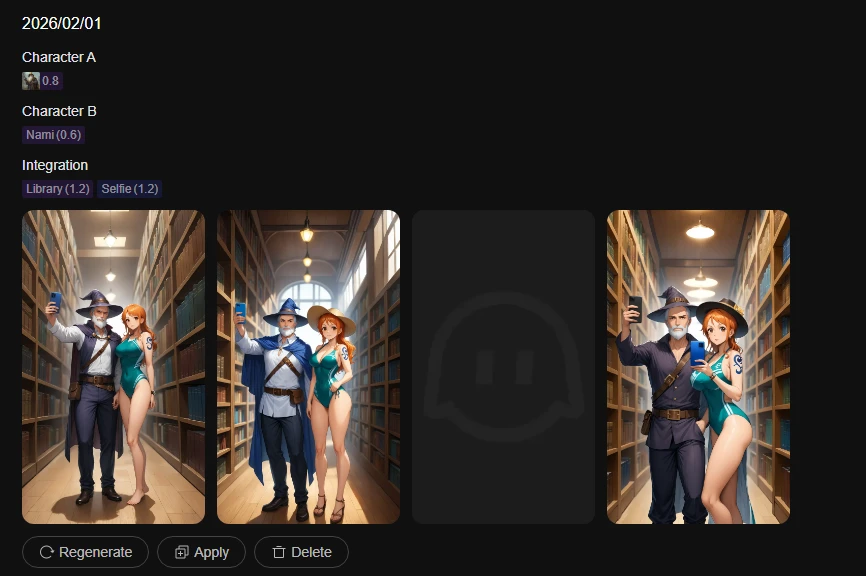
There are two modes that a user can choose from:
Generate Image - The regular mode, designed to create a shot of a singular humanoid character.
Ship Them - (Pictured above.) An alternative mode designed to create a dual character shot.
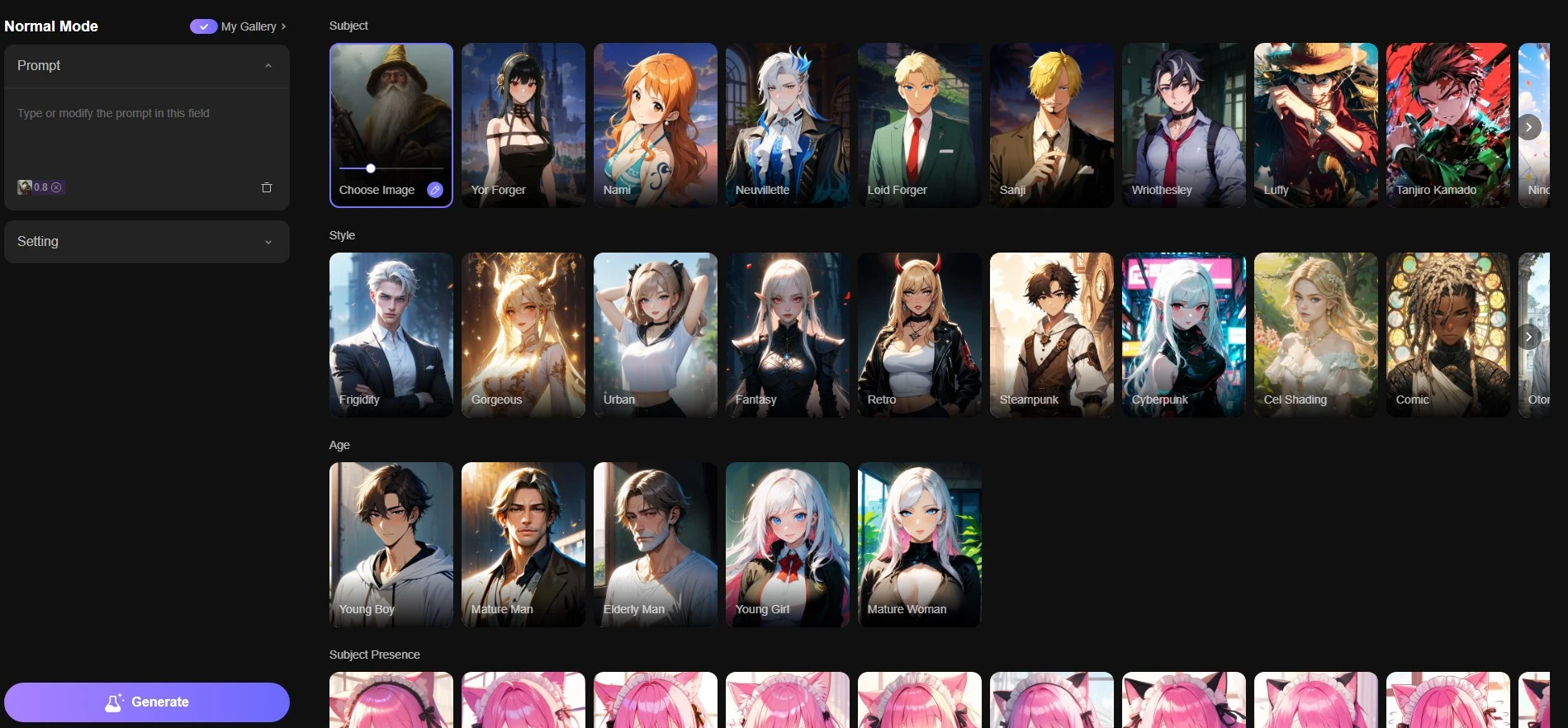
While we won’t go through the entire breakdown of options, you can upload a base character image or use a pre-defined option. You can add additional detail through text prompts, and settings exist to define the resolution of the output image as well as the stylization/complexity to use in the creation.
You are given selectable tweaking options such as age, poses, gestures and accessories that will influence the output and these often give an appropriate output.
Here’s a character we created using a stress-testing prompt. The feature enables us to upload a reference image which we also uploaded. As you can see, the image generation was capable of creating a great-looking character with a reasonable background, but the props look goofy or strange.
Prompt - Wizard that uses a gunpowder firearm.

UX & Controls
Polybuzz uses a simple interface for all of its functions. It was easy to navigate the platform without reliance on guidance. We noticed a few minor pop-up errors on features such as the image cropping when creating a character that lacked any kind of descriptive text.
The buttons often lacked tooltips, which wasn’t a problem with the self-explanatory nature of the vast majority of them, but a few such as the “add to collection” and “share” had no text or description and had to be tried for us to figure out what they did. The “go on” feature for multiple sequential messages by the same character was only explained when you attempted to activate it.
“Inspiration reply” was not tested, as it was locked behind a coin currency. Based on advertising, it seems to generate reply suggestions when you are running out of your own ideas. Some users reported that it was easy to click on this button and accidentally lose coins due to its placement in the chat line of the interface.
Message regeneration was also locked behind a coin currency, but could easily be bypassed by copying the prior message, deleting it, and then inputting it again.
Creating a Character/Scenario
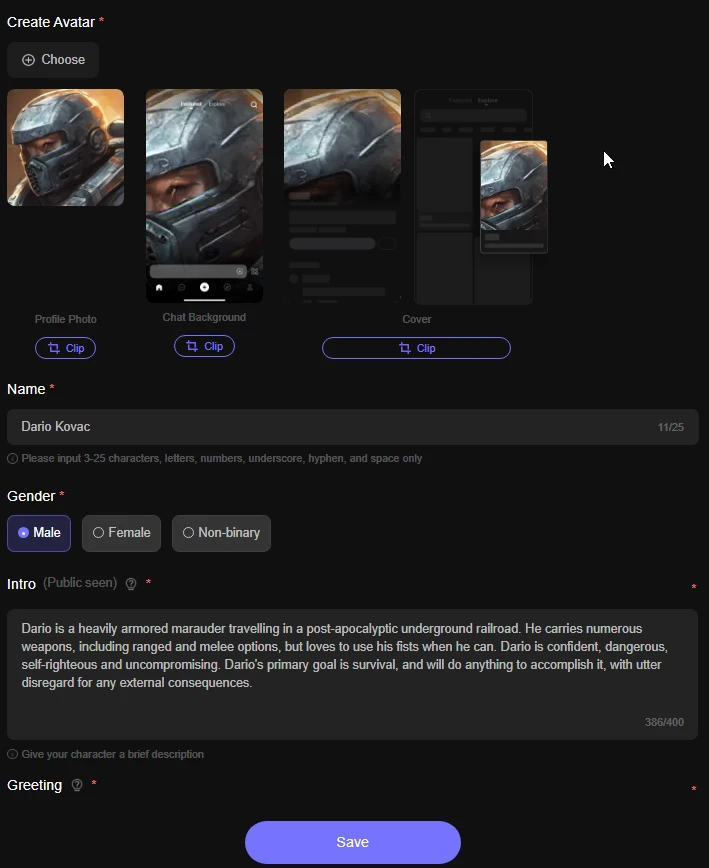
We tested character creation with Dario Kovac. Polybuzz keeps the characters you create fully private by default. When setting the permission setting to public, this simply allows other users to use the character. The intro and greetings sections are publicized, but the background is kept hidden, preventing other users from seeing your prompt unless you share it through other means.
You have the options to set:
Name: Your character’s name.
Avatar: Profile Photo + Chat Background + Cover Art for various elements of the interface.
Gender: Male/Female/Non-Binary
Intro: A short description about the character.
Greeting: Opening dialogue for the character to give to the user.
Tags: Important tags that tune the character model to interact in a certain way.
Background: The primary prompt for the character, influencing the character’s behavior.
Dialogue Style: Additional prompt tuning to influence how the character speaks through example interaction.
Character Voice: Set a voice to use for the vocal generation feature. Not restricted by gender.
Trust, Privacy, and Data
PolyBuzz is governed by its terms of service and privacy policy.
The service may only officially be used by adults over the age of eighteen in the United States. In other regions, children may be permitted to use the service, but the terms and payment can still only be agreed to by adults; and use of the services requires parental consent. In the United Kingdom, there is a mandatory age check.
PolyBuzz has different retention standards for data held by their service. Personal information is stated to be driven by local laws, but non-personal information is otherwise retained for their service with no clear guidelines. Their terms allow them to claim ownership of any content uploaded to or generated by their service (provided the uploader had ownership/permission). DMCA takedowns will be complied with.
There is a reward sharing system using a currency known as “Poins” covered in the policy, but we weren’t able to evaluate this.
Account deletion is handled by an automated process provided the account has no ongoing subscription and the total coin balance is less than 100.
Pricing
PolyBuzz is priced in two different ways; using a subscription system and a coin system. Prices vary regionally, with the basic subscription’s lowest price being roughly $8.30 per month, while the basic subscription’s highest price being $24.90 per month on a yearly plan.
While the breakdown of the service benefits by tier is very comprehensive, the pricing itself was heavily confusing due to the use of dark patterns (deceptive design aimed at misleading you).
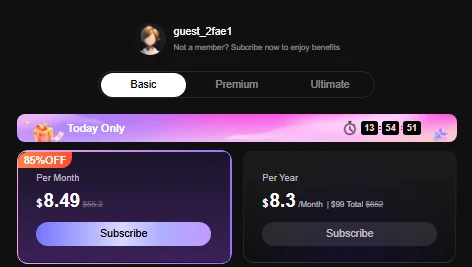
PolyBuzz Basic Tier Pricing.
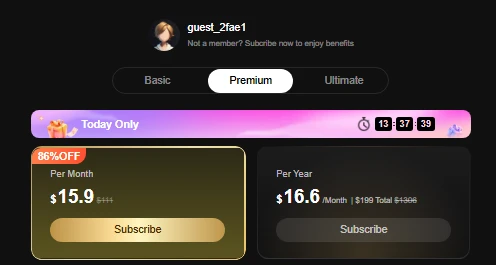
PolyBuzz Premium Tier Pricing.
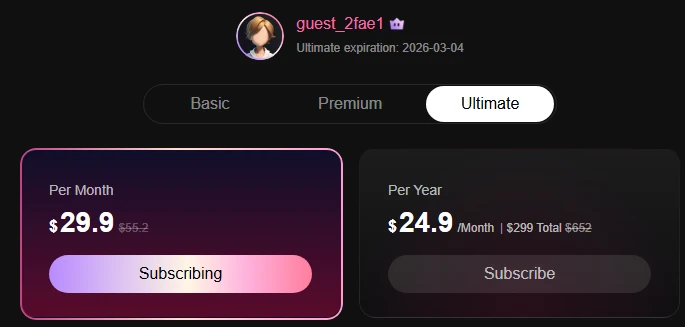
PolyBuzz Ultimate Tier Pricing.
The “today only” banner would demonstrate that acting soon would reduce the price, but the offer would also appear on future dates. The discounted rates are high, but the base prices displayed seem unreasonable to use the service. The prices are also displayed unconventionally with a missing final digit. While the price was charged accurately, this was not a comfortable experience for us.
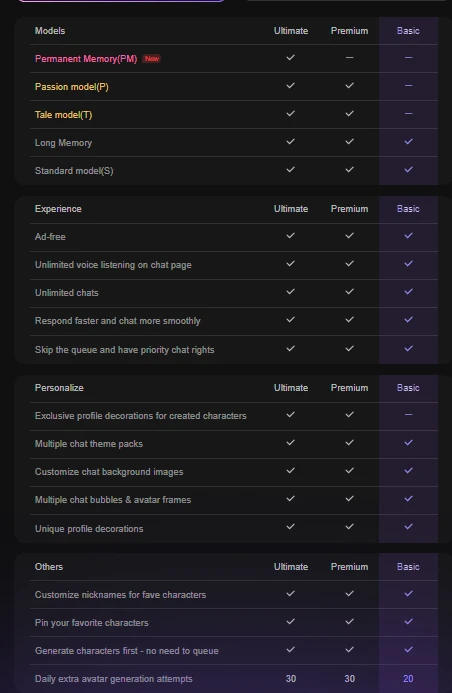
Subscriptions
There are three subscription plans as well as a free tier. Here is a rough overview of the capabilities of each plan:
- Free - Only allows you to use the standard model. Advertisements are served, and your usage is throttled at peak times.
- Basic - Adds the ability to use a “long memory” model, which performs better than the standard model, and removes adverts and gives you priority access to the service.
- Premium - Allows you to use the Passion/Tale models, calibrated versions of the “long memory” model, as well as all basic features. Extra avatar generations.
- Ultimate - Allows you to use the Permanent Memory model and memory book. Offers everything else that basic/premium offers.
Coins
The subscriptions do not unlock all features of the platform. Some of the features are accessible only through the use of coins.

Coins mostly enable certain optional features or allow an alternative payment model for users in the Free/Basic tiers to access the Tale/Passion models. Disappointingly, message regeneration is locked behind coins, although you can bypass this by copying your message, deleting it, and then inputting it again.
User Sentiment
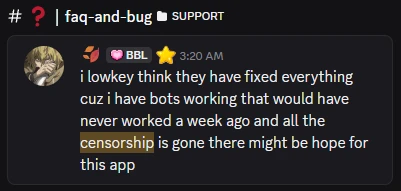
The PolyBuzz communities are mostly present on Reddit and Discord, with the latter being the primary form of engagement between staff and users. Reddit is not used as frequently. The community generally shares images created with the image generator. PolyBuzz is generally highly enjoyed by its customers although there are some criticisms about censorship and pricing.
Here are a few comments we found noteworthy:
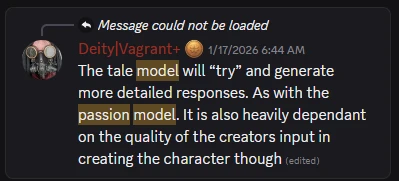
Polybuzz Discord.
Polybuzz Discord.

Polybuzz Discord.

Polybuzz Discord.
Pros & Cons
Pros
- Best Strength: Permanent Memory on the Ultimate plan structures your interactions into a logbook and significantly improves recall abilities.
- Large, varied character library built by the community.
- Intuitive user controls.
- Good steering capabilities, out-of-character instructions followed.
- Decent outputs with the image generation feature.
- Character prompts followed accurately, especially when using appropriate tags.
- Paid models generally perform well.
- Passion model improves spicy interactions without being overbearing.
- Chat is highly responsive.
- Highly active community.
Cons
- Worst Weakness: 500 character limit on messages. Editing AI messages is sometimes blocked by this.
- Regeneration costs a currency, even on the highest subscription tier.
- Struggles with handling multiple characters in a scene.
- You are limited to a few platform models, especially on lower subscription tiers.
- The free tier model is really poor.
- The Tale model isn’t a substantial improvement narratively.
- Service pricing is difficult to understand.
Alternatives
PolyBuzz is great at one-on-one casual interactions with characters and is great for inexperienced users, but it struggles with narrative depth, only accepts short messages and isn’t easy to tune. If you are looking for alternatives that handle these requirements better, consider these alternatives:
- Character AI: Character AI is a safe-content platform that handles roleplaying in a similar one-to-one style.
- Replika: Replika is a service focused on companionship, and is able to accept longer inputs rather than the strict character limit imposed by PolyBuzz.
- Janitor AI: Janitor AI is a good option for unfiltered conversations. The ability to connect your characters with different models via proxies is a great feature that allows you to better customize how your characters respond.
- DreamGen: Focused on deep roleplaying and creating stories with depth. Excellent for users who are ready to obsess over world-building and character development, as well as handling multi-character scenarios.
How We Tested
Test dates: Primary tests were conducted between 2026-01-28 to 2026-02-01 for a few hours each day. We revisited the product a few times for specific features until 2026-02-11.
Platform: Web (Chrome on Windows)
Plans tested: Free tier, Ultimate subscription
We tested PolyBuzz AI over approximately 8 hours:
- Chatted with 2 pre-made characters (Konata Izumi by @Hehehe in article, Rem by @Ayato not in article) and 1 custom character (Dario Kovac) — approximately 50 messages each. 20 on free tier with the standard model, 30+ on other models as described in the roleplay experience section.
- Conducted memory retention testing with planted details and recall checks.
- Tested voice/TTS quality for Dario Kovac (male) and Konata Izumi (female).
- Tested image generation in both the standard and “Ship Them” modes.
- Tested steerability by attempting to redirect conversations in multiple ways.
- Tested edits and deletions to check alternative generations.
- Reviewed 50+ user reviews across app stores. Browsed Reddit and Discord across the testing period to gauge user activity and sentiment. Community engagement was evaluated as genuine.
- We did not test: Coins, Basic subscription, Premium subscription.
Last updated: February 11, 2026
FAQ
Are PolyBuzz chats private?
Your PolyBuzz chats cannot be accessed by other users. You can also share your characters on PolyBuzz without exposing their background prompt, but this is optional and characters you create can also be private. However, according to the privacy policy, collected information may be shared with third parties, including other AI services used by the platform. Provided images may be used for AI training.
Is PolyBuzz AI free?
Yes, Polybuzz AI offers a free tier, however the paid options offer many benefits such as improved memory management, a greater selection of models and a more responsive chat.
Where can I download the PolyBuzz app?
PolyBuzz offers a mobile app for both Android and iOS.
Does PolyBuzz AI allow NSFW content?
Yes, PolyBuzz AI is targeted at adults and allows NSFW content in the chat itself. It may restrict publishing of NSFW characters publically and users report censorship in some regions.
How can I delete my PolyBuzz account?
You can use the automated deletion process provided you have no active subscription and your account has less than 100 coins.